

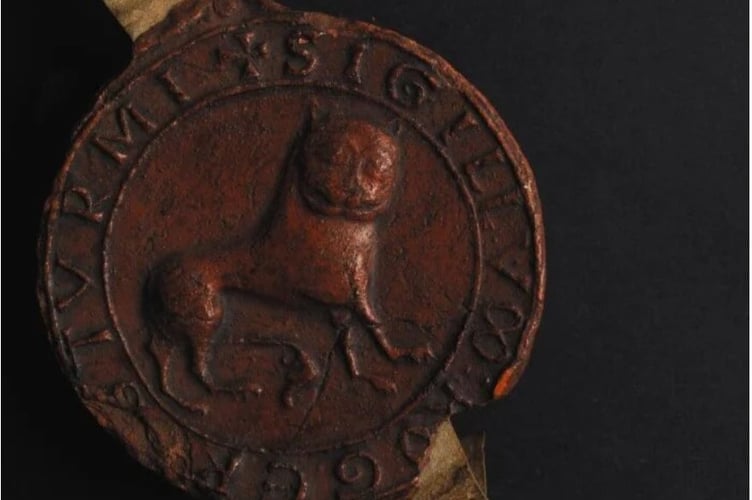
A charter was an administrative document usually (but not always) legally conveying land or rights from one person to another, and could include the transfer of any type of property.
They could also convey a withdrawal or termination of a claim (known as a ‘quitclaim’).
Charters usually included the details of all those involved in the claim or conveyance - the person conveying the property, the recipient, and the witnesses - and also commonly included attached wax seals of participants (usually bearing the sigil of the lord or institution granting the claim) to show that the document had been endorsed or witnessed.
As functional legal documents, charters were very rarely decorated or adorned, and the majority produced between the 12th and 15th centuries in Wales were written in Latin.



Although charters can be rather uninteresting to look at, they are fundamental in helping us to understand what life was like in Wales in the Middle Ages, and can contain important information that we do not find elsewhere.
Fortunately, charters were very commonly produced, which means that a greater proportion of them survived in comparison to other types of documents.
Charters are among the few types of medieval documents that provide the names of lay people and occasionally their occupations.
Like many ecclesiastical records from the Middle Ages, the charters of Strata Marcella abbey have survived as part of an estate library and give us clues as to who some people were in the local population at the time.
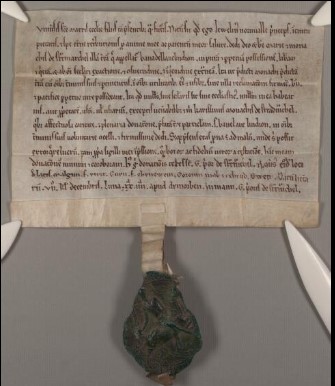
This charter from c.1209 (below) conveys a grant of land to Strata Marcella from the Welsh prince Llywelyn ab Iorwerth (Llywelyn Fawr, c.1173-1240), naming not only the important figure of Llywelyn but also a number of local witnesses such as ‘Malgwn’ (Maelgwn) and ‘Goronui’ (Goronwy).
As many charters were mainly concerned with land, they can also give us an idea of local topography and flora at the time of their writing.
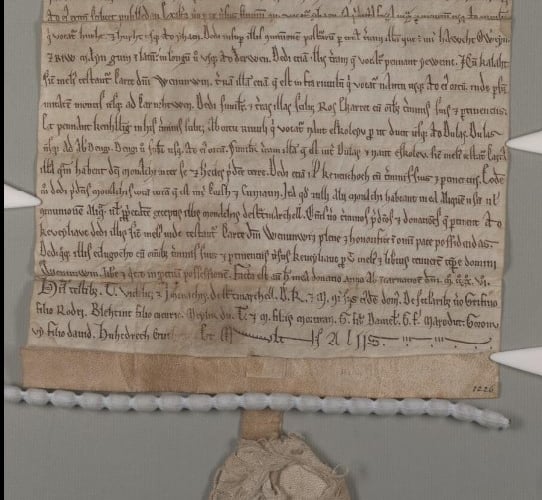
This 1226 charter (below), also from the Strata Marcella collection, describes the hills and rivers of the piece of land being gifted in addition to the location of a well, and tells us that there were willow trees growing there.
Charters can also tell us how land was used, most commonly for farming, fishing, or hunting.
This 13th-century chirograph (below), a copy of a court agreement produced in duplicate, conveys an agreement between Gwenwynwyn of Powys (d.1216) and the monks of Strata Marcella for the use of a fishery at Cyfeiliog.
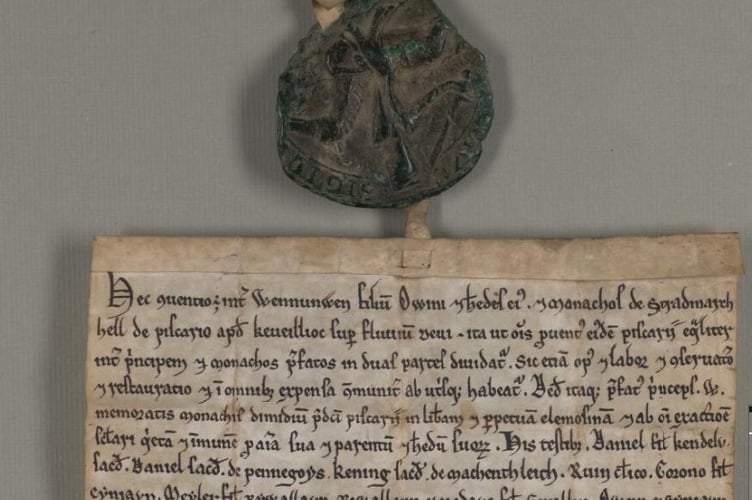
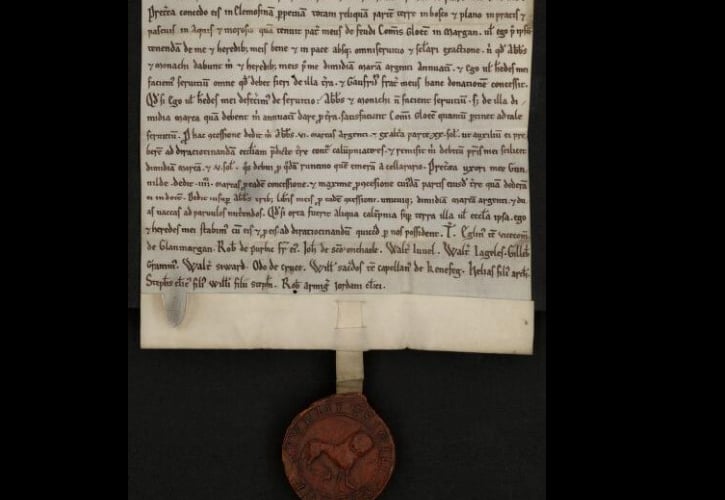
During the Middle Ages, most lay people relied on professional scribes to produce documentation for them. Scribes would normally be connected to either a religious institution such as an abbey or monastery or to the lord or court of the local territorial or administrative unit, and this regular production of documents enables us to chart the development of formal handwriting.
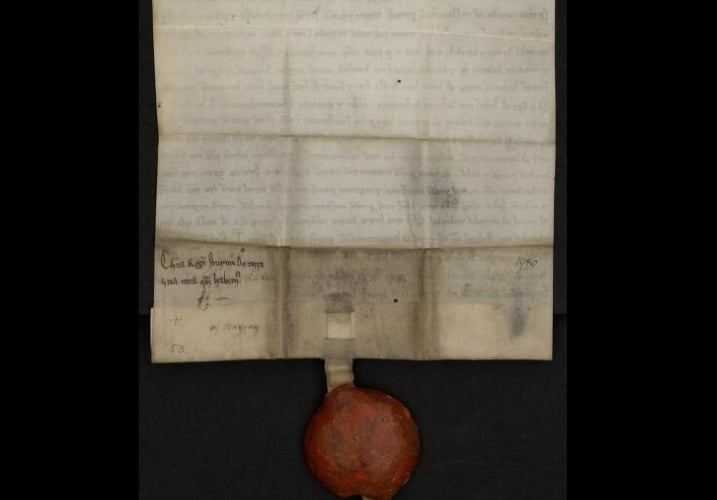
These two charters (below), from the Penrice and Margam Estate Records collection, are dated roughly a century apart and show considerable differences between the lettering and penmanship.
Key events of the time can also be traced inadvertently through charter evidence.
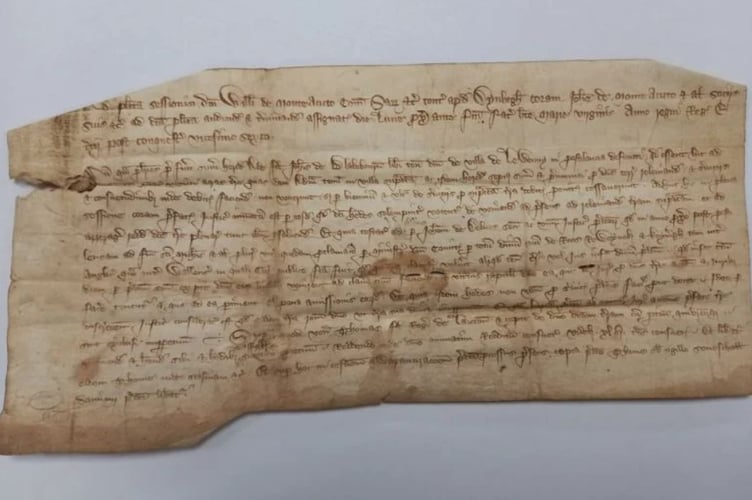
This copy of a court roll (below) dating from 1352 from the court session of William de Montagu, Earl of Salisbury, Denbigh, refers to land being escheated to (forfeited to) the lord as the tenant had died of ‘pestilence’ (likely the Black Death).
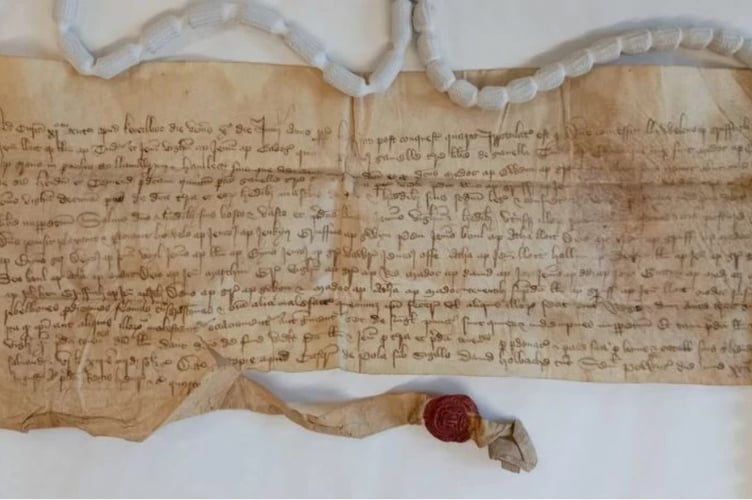
This charter (below) from the Mathafarn Estate is thought to date from around 1403, and contains a pardon for the estate’s tenants who rebelled in Owain Glyndwr’s revolt.
Charter evidence also shows us that medieval Wales was internationally well connected and had links across Europe.
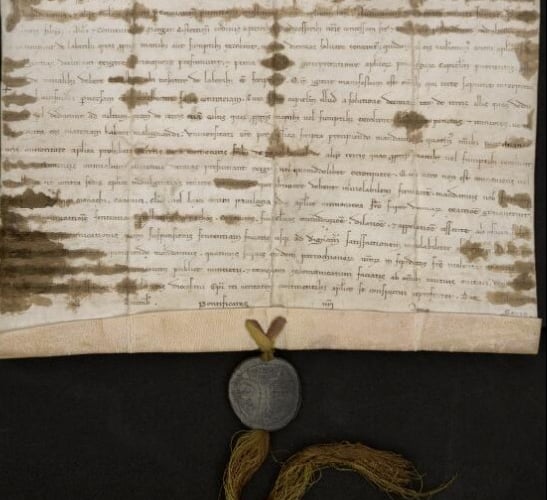
This 1203 charter from the Margam Abbey collection was dated at Anagni, Italy, and is an example of a papal ‘bulla’ – a confirmation by Pope Innocent III of the privileges of the Abbey in respect to exemption from payment of tithes, and forbidding any infringement thereof under penalty of excommunication.
The original papal seal, made of lead rather than wax, survives fully complete including the silk strands used to attach it to the document.
Far from being dull pieces of parchment, charters are an invaluable source for the study and understanding of medieval Wales, telling us about people’s property, rights, names, occupations, illnesses, and beliefs. So why not explore our medieval collections – and see what you can find.
Comments
This article has no comments yet. Be the first to leave a comment.