

A Trust set up to protect wild uplands of Wales from development and industrialisation has warned that “the scale and scope of wind farm proposals” near the Dyfi Biosphere would “involve a huge disruption to the land and the entire natural habitat.”
Dozens of wind farms across mid Wales are currently in the pipeline amid the move towards renewable energy.
Conservationists including the Wild Wales Trust warn that proposals in mid Wales would “degrade and industrialise huge areas of the uplands and valleys” while supporters argue the infrastructure is necessary to ease the reliance on fossil fuels.
The Wild Wales Trust, in a letter to directors of the Dyfi Biosphere, called upon them to “robustly defend the land and its heritage” with five wind farms currently planned in mid Wales that border the Biosphere – the only UNESCO recognised Biosphere Reserve in Wales.



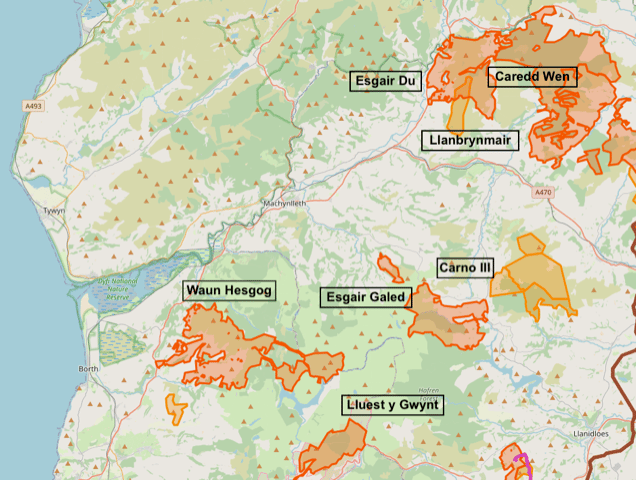
Plans for Waun Hesgog wind farm will see 37 turbines built at 220 metres high above Talybont and Artists’ Valley, while the Esgair Galed plans will see 26 turbines at 220 metres high on the Glaslyn Uplands and Hafren Forest.
Plans for the Esgair Du wind farm will see 13 turbines at 230 metres high above Cwm Llinau on the hills above the Dyfi, with the Carnedd Wen wind farm plan seeing 28 turbines built at 200 metres high northwest of Llanbrynmair.
Another 15 turbines are planned at 230 metres high just south of Carnedd Wen, close to Llanbrynmair.
Another proposed development, Lluest y Gwynt, with 12 turbines at 180 metres high, west of Pumlumon could also have a negative impact on the water sources that flow into the Nant-y-moch and Llyn Llygad Rheidol reservoirs, then towards Aberystwyth, Wild Wales Trust said.
Carno III also has planning approval for 13 turbines 149 metres high, and “water from this upland area drains into the Twymyn along the Pennant Valley towards Llanbrynmair”, the Trust added.
“If these developments went ahead, the land surrounding the Dyfi and its catchment area would be irreversibly degraded,” Wild Wales Trust warned.
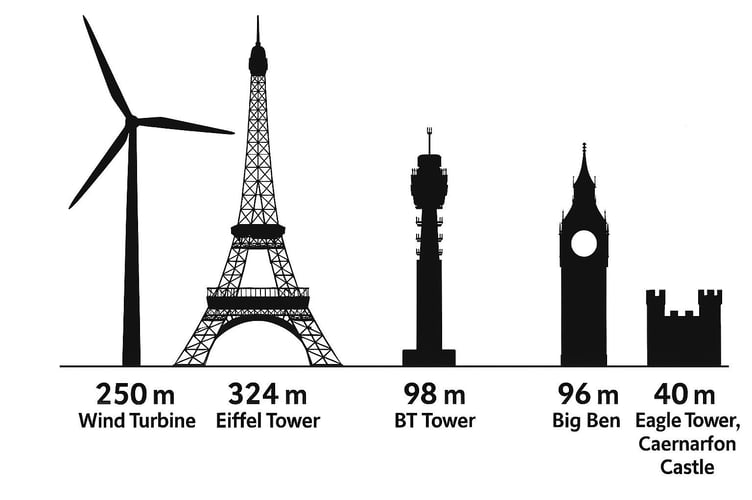
“The uplands would be dominated by 119 turbines at heights of 200 to 230 metres.
“Each of these would be at least double the height of any turbines currently operating in Wales.
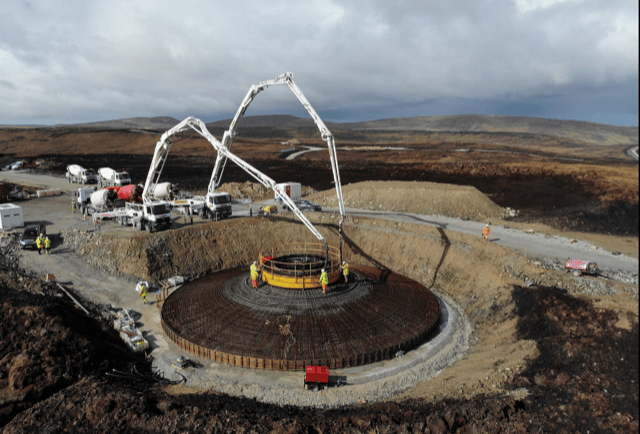
“A 220-metre wind turbine requires between 600 and 800 cubic metres of concrete for its foundation, weighing around 2,000 tonnes.
“The base requires between 100 and 165 tonnes of steel rebar.
“Clearly, developments of this size would have a devastating impact on the peat bogs and fragile hydrology of the uplands.
“Wildlife would be squeezed out of habitats that are already rare.
“Huge components would have to be transported to the sites, including 80 metre turbine blades.
“Rural roads would have to be widened, leading to the destruction of hedgerows and trees.
“New roads and wide tracks would have to be build up hillsides and across the uplands.
“UNESCO Biospheres are described as ‘learning places for sustainable development’ and that their primary function is to conserve and protect wildlife, habitats and the environment.
“The current wind farm proposals in Mid Wales would degrade and industrialise huge areas of the uplands and valleys.”
The Dyfi Biosphere said in a statement to the Cambrian News that “the role of the Biosphere is to be a space in which residents and others with a commitment to the area can create a future where the economy and the natural environment are in a positive relationship with each other.”
“We want to encourage respectful and well-informed discussion on this important topic and will be following the developments closely,” the statement added.
The wind farm plans across mid Wales have seen campaign groups spring up, including Caru Teifi, a Community Action Group based in Cellan and Llanfair Clydogau, formed in March 2024 “to oppose the industrialisation of The Cambrian Mountains by Green Gen’s 52km Towy Teifi Pylon Line proposal and Bute’s Lan Fawr Energy Park along with other associated large-scale wind farms.”
The group said that “whilst we acknowledge the need to address the climate crisis, we believe that the potential damage to the rural areas of mid and west Wales, our environment and our economy is too high a price to pay.”
“We believe these industrial developments are unnecessary and inappropriate for the Cambrian Mountains,” the group said.
“These areas are environmentally sensitive and depend on farming and tourism for economic survival.”
“The Dyfi Biosphere is the only UNESCO Biosphere Reserve in Wales, and one of seven thoughout the UK.
“It recognises the natural and cultural importance of the area. It includes a number of significant wildlife and natural landscape reserves.
The concept of the Biosphere is not incompatible with production of renewable energy, quite the opposite.
“However, it does raise the question of whether the very large and commercially biased proposed developments are appropriate or is the risk of resulting environmental damage unacceptable.”
The Ceredigion Penfro branch of the Green Party said that while “plans to build windfarms and pylons across Carmarthenshire, Ceredigion and Powys are facing opposition from local landowners and residents”, the party “needs to be honest with voters.”
“These windfarms have been planned for in a strategy called ‘Future Wales National Plan 2040’,” the Green Party said.
“Since it was written during the time Plaid Cymru had a co-operation agreement with the Labour Government, it is disingenuous of them to complain now about the planning applications.
“The issue of pylons versus cable trenching is also being exploited by Senedd candidates.
“Promising unrealistic solutions is not being honest with the voters.
“While cheaper than burying cables in trenches, cable ploughing would still be much more expensive to install and maintain than pylons.
“Cable ploughing has also never been used before at the high voltages used for long distance transmission.
“Large pylons are also able to withstand storms.
“We believe that planning decisions ought to be made at the lowest appropriate level – by elected parish, town, district, county or unitary councils. In the case of a strategic plan, the Welsh Government should have the final say, but with plenty of input from local communities.
“The residents in the Cambrian Mountains feel bombarded at the moment.
“When we stop to think about the real reasons why this strategic area exists and explain it to local people, when they get the rewards, their own heat pumps and solar panels, batteries and car charging facilities, when their communities are able to improve by having things such as a local bus service and community halls that are upgraded, whatever needs doing to make their lives better, the conversation shifts.
“And we need to shift this conversation fast.
“The Green Party has been arguing for a sensible, organised transition to renewables for decades.
“It is a shock to read that 72 percent of households in the Ceredigion North Pembrokeshire constituency rely on oil for heating.
“In order to make our homes and households less vulnerable to price shocks, we need to urgently electrify our heating systems.
“That means we need to build renewables, both turbines and solar panels.”
The Green Party added that communities “should be involved properly on major decisions” and warned that “consultations feel meaningless if people can't see that their voices are being heard.”
The Welsh Government has set a target for renewable electricity generation to meet 70 per cent of Wales’ consumption by 2030 and 100 per cent by 2035, whilst also delivering at least 1.5 gigawatts of locally owned renewable energy capacity by 2035.
The Welsh Government also unveiled a Renewable Energy Sector Deal, which it said will be a strategic partnership between Welsh Government and industry, focused on unlocking the full economic potential of Wales’ renewable energy future.
CPRW, The Welsh Countryside Charity, has warned that Wales’ renewable energy transition must better protect rural landscapes and secure the support of local communities.
CPRW said: ““The current approach of the Welsh Government is not working as they have not achieved buy-in from the communities most impacted.
“These communities are not, in general, climate change deniers or anti-renewables activists; they are simply against the way major change is being imposed upon them by a government which “knows best”, to primarily benefit financial investors, often from other countries.”
In March, Bute Energy withdrew its application for up to 13 turbines at Nant Ceiment Energy Park, around three miles south of Lampeter, citing environmental, land and commercial challenges.
Bute Energy said its decision following a detailed review of which considered early survey and assessment data and planning requirements.
An evaluation of this data, it said, found that challenges at the site would have a significant impact on the wind farm’s long-term viability.
Green GEN, partnered with Bute Energy, is hoping to build 200km of pylons across mid and north Wales to connect all the proposed wind farm projects to the National Grid.
Last year, they took 20 landowners to court over obstructing access to land.
In the last few years, there has been a “gold rush” with dozens of planning applications to build wind farms in Wales.
There are approximately 48 proposals for private wind farms across Wales currently seeking planning permission, submitted by large companies like Bute Energy, who are responsible for 14 of them (29.1 per cent).
If all their ‘energy parks’ went ahead, Bute states it would produce 25 per cent of the electricity demand for Wales by 2035 through sites near Llanbrynmair, Aberystwyth, Lampeter, two near Llangurig, two near Tregaron, and more in the east, north and south.
The pylons Green GEN is hoping to install would enable these wind farms to become connected to the Grid.
Plaid Cymru said it would underground pylon cables if the party won the Senedd elections in May.
The party said it would establish a “strong presumption in favour of undergrounding”, and use wooden poles where necessary - banning steel pylons for lines of 132kv or below.
Pylons have been a hot topic in Welsh politics as energy companies close in on the Welsh landscape in an attempt to profit from the country’s many natural resources.
MPs and MSs across political parties have spoken out in opposition to pylons and in favour of underground cabling to protect the Welsh landscape.
The Welsh Labour government’s Planning Policy Wales is in favour of undergrounding cables, but some have criticised the policy for being too easy for companies to get around.
Green GEN Cymru have said that underground cabling would make their wind farm connection project “unviable”.
Earlier this year, Powys County Council granted an extension on permission given for two weather masts to collect data for two potential windfarm sites at Rhiwlas and Banc Du Energy Parks near Llangurig, as the flood of proposals into mid Wales continues.
A residents group, the Saving Banc Du and Rhiwlas Action Group, oppose the extended permission, saying the council was “greasing the wheels” for “colossal” wind turbines to be built, paving the way for private developers to “industrialise” mid-Wales hills.
Last year, the Welsh government turned down an official Powys County Council request to pause wind farm development applications.
The council voted unanimously in October 2025 to call on the government to pause its open invitation for wind farms proposals in Powys over concerns about the significant number of proposals being considered simultaneously and their impact on residents, wildlife and infrastructure.
Llanidloes councillor Glyn Preston branded the government’s response as “turning a blind eye to pylon concerns in Powys”.
Despite campaign groups springing up across rural Wales when wind farm projects are announced, applications continue to flood in, with dozens currently at various stages of planning and more in the pipeline.
In March, Bute Energy wrote to a number of Powys councillors saying they are able to build windfarms anywhere except for national parks and national landscapes, but will the Welsh Government let the “Wild West” of wind farm proposals coming in left and right affecting communities across the region continue or will they listen to residents’ concerns over huge turbines and strings of pylons marring the countryside?
Comments
This article has no comments yet. Be the first to leave a comment.