

There are enough holiday lets and second homes in Wales to rehouse every family housed in temporary accommodation three times over, a report has found, with calls for national action to tackle the crisis.
In its latest report: Holidays or homes? The loss of homes for the people of Wales to holiday accommodation, the Bevan Foundation calls for “national action to minimise the loss of permanent homes to second homes and holiday lets” as figures revealed that families and people in temporary accommodation in Wales remains on the rise.
Figures from last year showed that 137 people in Ceredigion, 40 of which were under the age of 16, were in temporary accommodation, with that number rising as figures increase across Wales.
During the same time frame, there were 429 people in temporary accommodation in Gwynedd, 94 of which being under 16.
Powys recorded 410, with 83 under 16 and Carmarthenshire 334 people in temporary accommodation, including 48 children.
Over the course of the last Senedd the number of households in Temporary Accommodation almost doubled – driven factors including the ongoing cost-of-living crisis and a shortage of affordable homes.
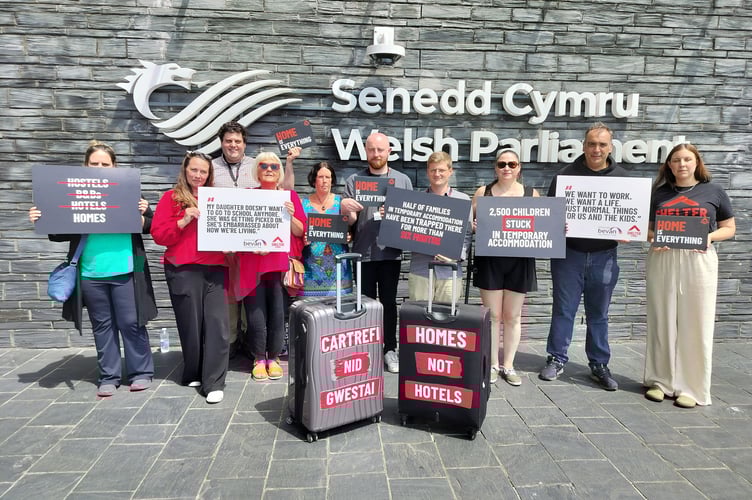
Half of families with children in temporary accommodation have been there for more than six months.
The Bevan Foundation report says: “Many homeless households in Wales are living for long periods of time in bed and breakfast and hotel accommodation meant for holidays, causing harm and trauma particularly for the children and families involved.
“Meanwhile, dwellings intended as permanent homes are being used for holidays, either as commercially run holiday lets, privately used second homes or a combination of both.


.png?width=209&height=140&crop=209:145,smart&quality=75)

“The issue of holiday accommodation in Wales and its impact on communities and the Welsh language has been a longstanding concern, with a sensitive and often painful history for those who have seen its effects in their areas.
“Calls for policy action in this area have remained and have been fuelled by new pressures in recent years.”
Plaid Cymru’s new Government has promised a review and evaluation of the measures that have been put in place.
The Bevan Foundation estimates that there are between 21,300 and 25,300 dwellings which could provide permanent homes in Wales – enough to rehouse every household housed in temporary accommodation three times over.
Between 11,700 and 15,700 are likely to be used as commercial holiday lets and 9,600 as second homes.
“There are clear concentrations of holiday accommodation in certain local authority areas and communities within them which have traditionally been holiday hotspots,” the report adds.
“However, growing numbers can be seen nationally cross Wales, many in less obvious areas, as staycations remain popular and tourists explore new areas.
“Our analysis reveals a 10 per cent increase in holiday lets using permanent homes over the last four years, with an additional 1,345 homes likely to have been lost to households in need of a settled home.”
The Bevan Foundation said it “appreciates the important contribution of tourism to the Welsh economy, and the role of different types of holiday accommodation in providing for visitors.”
“However, we believe that more could be done to minimise the loss of permanent homes for holiday accommodation,” they said.
“Much has been said about the negative community impact of holiday accommodation on housing supply and affordability as well as community viability.
“Campaigners have long called for action to protect the Welsh language.
“However, it remains the case that it is difficult to isolate the impact of holiday accommodation from other pressures such as demographic factors and outward/inward migration.”
The previous Labour Welsh Government introduced some measures to tackle the issues, including using national and local taxation systems to ensure that second homeowners make a fair and effective contribution to the communities in which they buy.
A one per cent increase in the higher rates of Land Transaction Tax (LTT) was introduced across all price bands from December 2024.
Higher rates are paid on most residential property purchases where another property is already owned.
Despite this increase, second home purchasers in Wales still pay some of the lowest rates of tax.
In Scotland, the tax paid on a £300,000 property purchase is £4,000 more than in Wales.
From April 2017, local authorities have been able to charge a premium of up to 100 per cent of the standard rate of Council Tax on empty dwellings and second homes.
This was increased to 300 per cent from April 2023.
The Bevan Foundation said the premium “has the potential to raise significant funding for housing activities to mitigate any impact of holiday accommodation” but guidance says that it should be used for this purpose but places no obligation to do so.
The report said: “The Bevan Foundation believes that there is a clear case to be made for Council Tax premium revenue to be ring-fenced for housing activities within a local authority area.
“We would also like to see a mandatory requirement for local authorities to report on how premium funds are spent and for the Welsh Government to consolidate this local data into a national picture.”
Commercially let holiday accommodation which is let at market rates and actively advertised would generally be classed as non-domestic for local taxation, subject to a threshold on the number of days it is let.
Many are likely to be eligible for small business rates relief, meaning that no tax is payable.
From April 2023, the threshold was increased from 70 days to 182 days.
This was to deal with the perceived ease with which second homeowners were able to move their properties to non-domestic rates and avoid the Council Tax premium payment.
The Bevan Foundation report said it “recognises that taxation action, and the 182 day rule in particular, has had implications for the broad range of accommodation which is used for holidays.”
“We believe that action has not been focused enough on the use and loss of permanent homes,” the report said.
“This is diluting the opportunity to address the availability and affordability of homes for local people, as well as impacting commercial holiday let businesses using types of accommodation which could not provide permanent homes.”
In October 2022 changes were introduced to planning legislation, introducing three new classes for to separate main residences from second homes and holiday lets.
Local planning authorities were given the ability to require planning permission for material changes from one use to another through an Article 4 Direction and can also adopt local policies to place a cap or ceiling on the number of second homes or holiday lets to inform and guide its decision making.
To date, Article 4 Directions related to second homes and holiday lets have only been put in place by Cyngor Gwynedd in September 2024 and Eryri National Parkin June 2025.
Gwynedd’s Article 4 Direction was subsequently quashed following a judicial review.
The Bevan foundation said “given the complexity of implementing planning controls of this nature in relation to holiday accommodation and the growth in this accommodation across many areas of Wales, a more robust and national approach is now needed.”
Towards the end of the last Senedd term, legislation was passed to introduce a registration and licensing scheme for visitor accommodation which will enable regulation of holiday lets.
Visitor accommodation – everything from hotels to camping pitches – has to be registered with the Welsh Revenue Authority from October 2026.
The register will be used to collect a Visitor Levy, where a local authority decides to introduce it.
Regulated visitor accommodation – self contained, self catering – will also need to be licensed.
The Bevan Foundation said it believes that the new Welsh Government should take the opportunity to ensure that arrangements for the licensing of holiday lets take a “strategic approach by improving the quality of individual lets, while also ensuring that the cumulative impact of holiday lets on local communities, and the homes available to them, is actively managed.”
The report says that while “the previous Government should be commended for the scale of action which it undertook across a wide range of policy areas”, it added “that action has not always been clear in its intentions or joined up in its detail.”
The report also found “significant gaps in the evidence on holiday accommodation, its impact on housing supply and the surrounding community.”
The Bevan Foundation held a panel discussion at the National Eisteddfod y Garreg Las in Pembrokeshire in August to mark the launch of the report.
The panel discussion was chaired by the Bevan Foundation’s CEO Steffan Evans, and he was joined by Mabli Jones our Head of Policy (Poverty), Walis George representing Cymdeithas yr Iaith, Cllr Craig ab Iago from Cyngor Gwynedd and Heddyr Gregory, Press Officer at Shelter Cymru.
The report concludes that “given the evidence of the growth of the issue across Wales, second homes and holiday lets are now a national driver of pressure on housing supply, and national action is needed, rather than leaving it to local authorities to tackle the problem.”
The report says that action “should also focus on preventing the loss of permanent homes.”
“We have evidenced that the number of permanent homes being used as holiday accommodation continues to grow across Wales – despite interventions by the Welsh Government in the last Senedd term – and this growth is not confined to the traditional holiday hotspots,” the report said.
“This is now a national driver of pressure on housing supply.
“Historically, it has been framed as an issue which is only faced by Welsh-speaking communities, and has largely been overlooked in terms of its importance other than by language campaigners.
“We now need to challenge this and call for national action.
“Government action in recent years has, for the most part, offered greater powers to local authorities to take action at a local level.
“This allows for local autonomy in decision making and for the level of intervention to reflect local circumstances.
“We have highlighted that there is a danger of this resulting in a knock-on effect with, for example, authorities which take a more lenient approach, but which neighbour those with stronger policies, being the new focus of holiday accommodation activity.
“We would argue that passing responsibility for action to local authorities in this way is not sufficient, that there should be a focus on what could be put in place on a national basis, while still providing a framework for local action.”
The recommendations include a national requirement for planning permission to be required for change of use from a permanent home to holiday accommodation (second home or holiday let) or a change between holiday accommodation types.
Moving away from the current lettings day threshold (the 182 day rule) and instead using the planning status or intended purpose of the accommodation to establish the tax system in which they should sit, is also recommended.
The report calls for ring-fencing the funds raised through Council Tax premiums on holiday accommodation “to be used for mitigation action locally to provide housing services and boost the supply of affordable homes.”
It also calls for incentivising holiday accommodation which does not use potential permanent homes as part of a wider tourism strategy as well as an increase of at least two per cent in the higher rate of Land Transaction Tax on the purchase of homes for holiday accommodation.
The report said that “a robust and effective registration and licensing scheme for holiday lets” is needed “to not only improve the management and condition of properties, but also to minimise any negative impact on the surrounding community.”
The report is part of the Bevan Foundation’s ongoing partnership with Shelter Cymru which aims to highlight the need to boost the supply of affordable and social housing.
“We are aware that the new Welsh government has committed to a review and evaluation of the measures that have been put in place through taxation, planning consent and regulation,” the Bevan Foundation said.
“We hope that this research is timely in providing new evidence and analysis to inform future policy making.”
Comments
We've recently changed our login process. If you have an account for commenting, you will need to re-register on the login window.
This article has no comments yet. Be the first to leave a comment.