
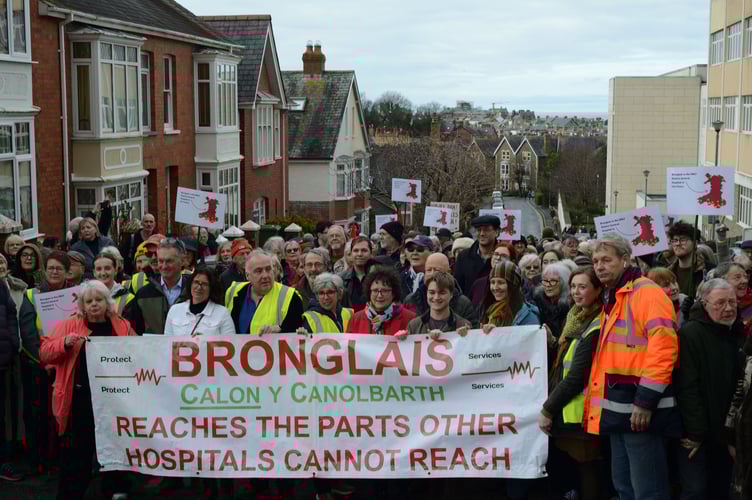
LIKE A dog with a bone, Hywel Dda health board clings with obsessive obstinacy to its contemptible non-plan to dismember Bronglais Hospital’s outstandingly good stroke unit.
This disreputable organisation’s life-threatening ‘treat-and-transfer’ scheme is, literally, a non-starter, the board last week openly admitting it has no strategy to ensure stroke victims would be transferred with the necessary swiftness from Aberystwyth to another hospital somewhere in south Wales.
Yet this is the perilous model it persists in trying to foist on an enraged public which refuses, and will continue to refuse, a third-class service when a first-class one run by skilled and experienced stroke-teams has been in place for years.
The board knows stroke patients suffer serious long-term disabilities because they and health ministers have failed to act effectively over dramatically worsening ambulance response times caused by bed-blocking and overstretched accident-and-emergency units.
And where would highly vulnerable stroke victims forced to endure the board’s mad pseudo-plan - and thus given only initial treatment at Bronglais - end up? Best seek odds at a betting-shop. Would it be Llanelli? Carmarthen perhaps?
Or, with frustrated ambulance crews often left immobilised outside accident-and-emergency units, unable to hand over patients because there are no empty beds, would their destination be an ambulance parking-lot?
On this, too, it was painfully apparent at last week’s crunch two-day board meeting that executives and members were in a state of bewilderment. It could be either or neither, the various charts and papers piled before them seemed to suggest.
This, then, is the floundering reality behind the board’s war of attrition against stroke victims and a public utterly determined they will never be worn down by a perverse grouping of health executives and, mainly, subservient ‘independent’ members.
What emerged last week is that Bronglais is not alone in being faced with the logic of the madhouse. Crazily, the board proposes to cut specialist stroke units in its vast rural catchment from four to one - at Carmarthen. It wants to stop emergency general surgery at Withybush Hospital and, at Llanelli, to change an intensive care unit to an ‘enhanced care unit’, providing a lower level of care. These changed proposals show health officials all over the place. Under a blueprint current until a fortnight ago, services outlined for all four hospitals were entirely different.
Presumably as a sop to Bronglais campaigners, the board now suggests Aberystwyth could potentially get a stroke rehabilitation unit. Does it think protesters will thus be bought off ? Most certainly they won’t be. The one and only satisfactory outcome is retention of full specialist stroke unit status.

-resized.jpeg?width=209&height=140&crop=209:145,smart&quality=75)
The shameful desertion of Eluned Morgan
THE Protect Bronglais group will have given up on any hope of intervention by Eluned Morgan or health secretary Jeremy Miles to safeguard the stroke unit in its present form.
Yet the government’s failure to pull rank on a health board which resolutely ignores massive public opinion constitutes a serious abdication of democratic responsibility.
Morgan and Miles have no right to sit back and give this outfit carte blanche to do what they like, regardless of democratic wish.
Labour’s abdication was displayed most recently at first minister’s questions. She was asked by Preseli Pembrokeshire Tory Paul Davies about the health board’s plans to change clinical services across the region, including stroke-downgrading in Aberystwyth.
Would she do everything she could for patients and oppose changes that forced them to travel further for essential care and essential services? Would she make clear to the board that her government would not support any changes that took services away from the people?
Davies knew he was reading from the Senedd question-and-answer playbook. But he had to try.
And no, of course she hadn’t told the board her government would not support changes that axed services. That would have looked uncomfortably like governing. And the important thing is not to be discomforted.
Everyone knew what she’d say. Which was that she understood how strongly people felt about their local services. She had met the board’s chief exec and chair, and she could assure Paul she was ensuring the views of local communities were taken on board (pun probably not intended), but it would be “for them (the board) to determine.” Further, it was “important that what should be driving this is the best possible clinical outcomes for people.” These last being precisely the board’s own words.
For Labour this May, health will be the biggest vote-winner - or loser. Morgan knows few will be fooled into thinking other than that doing what’s expected and maintaining solidarity with health executives is, for her, what matters.
She knows this could be her downfall. The conclusion? She’s easy with that. In a roundabout way, she made clear she couldn’t give a toss about losing her Senedd seat and sliding back onto the red benches as Baroness Morgan.
The reality of Reform’s economics
ANYONE troubled by the cost of living and thinks a vote for Reform UK could give them a leg up financially should tip an imaginary bucket of cold water over themselves.
My advice follows a vaguely alarming More in Common election poll showing Nigel Farage’s ragbag of assorted odd-bods and Tory turncoats seven points ahead of Plaid Cymru, and another four ahead of Labour. YouGov recently put Plaid 14 points ahead of Reform.
More’s numbers would give Reform 36 seats, Plaid 26, Labour 21, Conservatives 10, Liberal Democrats two, Greens one. Plaid and Labour combined would thus amass two seats short of an outright majority, meaning a rainbow coalition of Plaid, Labour, the Lib Dems and Greens could emerge.
But back to Reform, and Farage’s claim to speak for the working-class. Has anyone got a polygraph - all right, lie-detector, if you must be blunt? His policies would hardly help the working-class at all, while the super-rich would do very nicely.
Reform’s manifesto posted a £60bn income tax cut and a personal allowance increase from £12,750 to £20,000 a year, while lifting the 40 per cent higher-rate threshold from £50,271 to £70,000.
According to the IPPR think-tank, Reform tax cuts are “both substantial and highly regressive, benefiting the wealthiest households the most. Upping personal allowance would cost the exchequer at least £40bn a year, and give the worst-off 20% of households £380 more, on average, in annual household disposable income. The richest fifth would get £2,400 more.
Higher-rate threshold changes would cost about £18bn and benefit the poorest fifth of families by £17. The richest would get £2,700 more. The top 10 per cent of households would get 28p for every £1 of cash lost to the exchequer, the bottom 10% would receive 2p.
Yeah, if you’re on low pay, Nigel’s your man.
Comments
We've recently changed our login process. If you have an account for commenting, you will need to re-register on the login window.
This article has no comments yet. Be the first to leave a comment.