
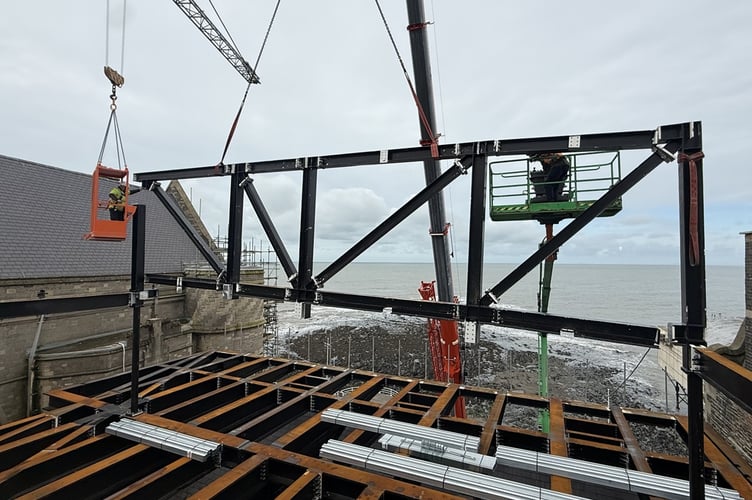
As Aberystwyth University pauses work on the regeneration of the Old College, just how did costs on the prestige project spiral out of control?
In 2017, the university launched an ambitious bid to transform the listed building major new cultural and creative centre and pegged costs at around £20m.
The university said the revamped building would create more than 100 jobs and put the site “on a par” with Caernarfon Castle for tourism.
However, last week Aberystwyth University announced that nine years after the plans were launched, and three years after restoration work began, the work has been paused on site with costs spiralling out of control and likely to reach more than triple the original estimate.
Earlier this year, university accounts showed the cost to redevelop the Old College in Aberystwyth spiralled to £53m – more than double the initial estimate – with no firm completion date for the building set as work on the building continued.
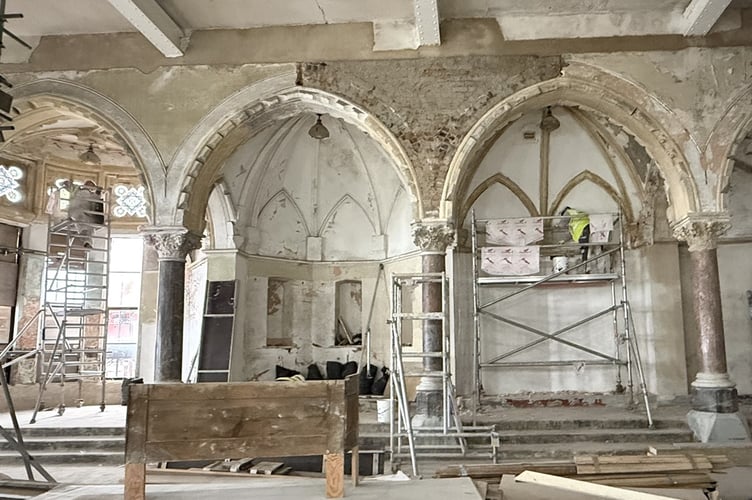
Aberystwyth University originally wanted the revamped building - which is set to include a hotel as well as educational and community spaces - finished in 2022 in time to mark the institution’s 150th anniversary but delays including the Covid-19 pandemic pushed the project timeline back.
The target was then moved to summer 2024, but with extensive work still needed, the university then hoped the project would be completed by the end of 2025 – more than three years after it had originally planned.
That date came and went, with concerns that overspends on the project were holding up completion.
The latest annual report from Aberystwyth University said that “most of the construction work [is] due to be completed by late 2026”, but the university has not put a pause on the remainder of the work as it looks for more funding to complete the project.


In 2017, initial cost estimates for the scheme put the work at £20.6m.
That figure rose by more than £1m before work even started, while the expected cost when planning permission was granted in 2019 was pegged at around £26m.
In 2020 the total cost of the redevelopment was estimated to be around £27m, with the university planning other sources of financing for the project including a second phase of its major fundraising appeal.
The addition of the Grade II Listed Cambria building into the project saw estimates rise to £43m.
The latest estimate earlier this year sat at £53m, but now Aberystwyth University says that costs have spiralled even beyond that figure.
The latest set of accounts from Aberystwyth University, covering the 2024/25 financial year, show that £15.2m was spent on the project during that time period, with a “similar level” expected in 2025/26.

The report said: “The Old College project made up the vast majority of the 2024/25 capital budget with £15.2m spent over the financial year.
“Expenditure at a similar level is expected over 2025/26.
“The total forecast capital costs of the project have increased to £53m and most of the construction work [is] due to be completed by late 2026.
“The project is funded by external grants, fundraising and earmarked university investments and we are grateful that additional funding totalling £3.8m has been pledged from the Welsh Government.”
Tens of millions of pounds of public funding from Welsh Government, National Lottery and other sources have been pumped into the project, along with two rounds of university fund-raising.
The purchase of the Cambria was fully funded by £5.4m from the UK Government through its Levelling Up Fund.
Another £10.8m grant from the UK Government Levelling Up Fund also funded the regeneration project alongside the widening of south promenade in Aberystwyth for an active travel route which took away 50 car parking spaces.
In 2025, more than £2m from the Welsh Government was also handed to the university towards its plans to create a cultural and community zone at the heart of the delayed project.
The Old College scheme was approved by Ceredigion County Council in 2019.
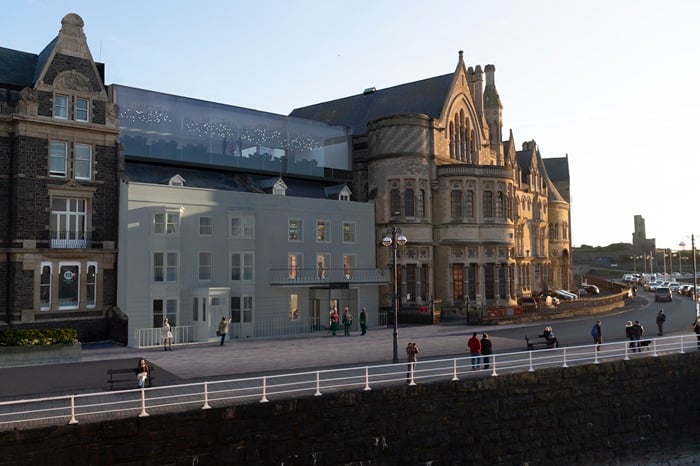
The most controversial aspect of the scheme is a glazed conference space that cantilevers over the Grade II listed Georgian Villas at 1 and 2 New Promenade, which attracted several objections as being “not in keeping” with the building.
Aberystwyth says the project will contribute more than £14m to the local economy when complete.
If the project is completed, it will comprise 143 rooms across seven floors, including 10 rooms with capacity ranging from 60 and up to 200 and 60 hotel bedrooms.
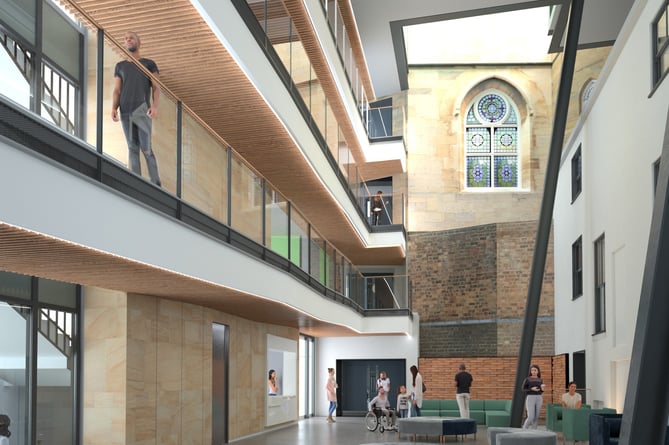
It will also include a Culture and Community zone alongside new facilities for community activities, events and meetings and dedicated spaces for young people and students.
Aberystwyth University said it remains committed to completing the project, despite pausing work whilst it evaluates its funding options.
In a statement, the university said: “Aberystwyth University is considering the next steps for the Old College project, following a significant increase in total project completion costs that have recently been presented to the university.
“After the building has been made safe and weatherproof, construction work will pause to allow the university to undertake a comprehensive review of the project.
“With significant progress already made and considerable investment committed, the temporary pause will provide the opportunity to evaluate the options for the next phase in light of the new increased cost projections.
“The review will consider future costs, funding and the most appropriate timeline for the remaining work.
“We remain firmly committed to the Old College project's long-term outcomes.
“Given the rise in projected costs, it is prudent to take a considered approach to ensure that the Old College project is completed in a way that delivers lasting benefits for our university, town and Wales.
“We would like to thank our staff, funders, partners and stakeholders for their ongoing support, understanding, collaboration and commitment, which have helped drive the significant progress so far.
“We will continue to engage closely with all those involved throughout the review and provide further updates as appropriate.”
Speaking in 2023, the university said once completed, the Old College is “expected to attract 200,000 visitors and contribute up to £14.5m annually to the local economy”.
The university said at the time that those figures would “put it on par with major tourist destinations such as Caernarfon and Conwy castles.”
“Up to 130 jobs will be created directly and indirectly and there will also be more than 400 volunteering opportunities,” the university added.
“There will be 4* hotel accommodation and spaces for activities and events across seven floors and 143 rooms, including 10 rooms with capacity ranging from 60 and up to 200 people.”
The Old College became the university’s first home in 1872 and the redevelopment aims to reimagine the building for the 21st Century, with the university saying: “The Old College will again become a place of cultural and social enrichment, a space for young people to learn and thrive, a venue where communities come together to overcome shared challenges and a catalyst for economic growth.”
The Old College project is supported by The National Lottery Heritage Fund, Welsh Government and the European Regional Development Fund, the Coastal Communities Fund, The National Lottery Community Fund, philanthropic trusts, and individuals.
Comments
We've recently changed our login process. If you have an account for commenting, you will need to re-register on the login window.
This article has no comments yet. Be the first to leave a comment.