
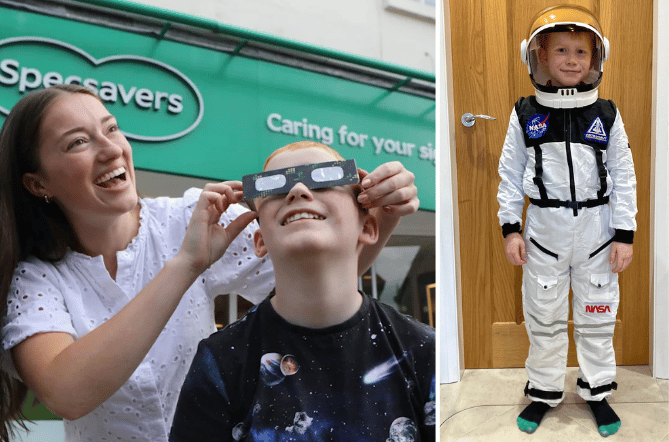
With one-in-seven Welsh residents getting solar eclipse safety wrong, Specsavers has enlisted the help of an 11-year-old astronomy enthusiast from Bala.
Eleven-year-old stargazing superfan Efan Dafydd is passionate about stargazing and has dreamt of being an astronaut since he was a toddler.
He has visited space centres across the UK, wears a space suit at every fancy dress opportunity, has Apollo 11 bedsheets and has even met his space hero, famed British astronaut Tim Peake.
A dedicated member of Vale Stargazing Club, Efan never misses a meeting and will gather on the runway of a gliding club in Denbigh to watch the rare partial solar eclipse.
Ahead of the rare partial solar eclipse, Specsavers research reveals one in seven Welsh people falsely believe that the solar eclipse can be viewed without any protective eyewear.
Specsavers has therefore enlisted the support of Efan to educate the public on the dos and don’ts of eclipse viewing. Efan received expert eye health advice from Specsavers, along with solar eclipse glasses, a telescope and a stargazing experience to help him safely enjoy the celestial event
The partial solar eclipse this evening will be the most impressive solar eclipse visible from the UK in almost 30 years and will coincide with the peak of the Perseid meteor shower later that night.
“It’s a really exciting opportunity to see it,” said Efan.
“The next total eclipse visible from the UK won’t happen until 2090.
“The partial eclipse will begin shortly after 6pm and reach its maximum shortly after 7pm, depending on where you are in the UK.”

-and-Simon-Llewelyn-Roberts.jpeg?width=209&height=140&crop=209:145,smart&quality=75)
Efan's passion for space extends far beyond stargazing. After learning from astronaut Tim Peake that Russian is spoken on the International Space Station, he started learning the language himself and has maintained a Duolingo streak of more than 280 days.
Efan dreams of one day travelling to Kennedy Space Centre in Florida, and his favourite planet is Neptune because of its Great Dark Spot, a vast storm system roughly the size of Earth.
To help prepare Efan for his first solar eclipse sighting, Specsavers gifted him the ultimate astronomy prize package including solar eclipse safety glasses, a telescope and a stargazing experience in Wales.
As part of the prize, Efan visited Specsavers Mold to have his eyes tested and receive expert advice on how to view the eclipse safely.
After attending the appointment, Efan said: “I've been looking forward to seeing a solar eclipse for a long time, so it was great to hear advice from the Specsavers optometrist. My message to others watching the eclipse is to make sure you never look directly at the sun without solar eclipse glasses or solar filters as it can be very damaging.”
The need for increased awareness of solar eclipse safety is clear, with further research findings revealing nearly one in 13 (8 per cent) Welsh people have looked at a solar eclipse without eye protection before, 20 per cent thought it was safe to view the eclipse through a camera or smartphone screen, while 11 per cent believed polarised sunglasses were a safe alternative.
Amelia Topping, the Specsavers optometrist who carried out Efan’s eye test, adds: “The new research shows that many people are unaware of the risks of looking at a solar eclipse without proper eye protection, but this can damage the retina and, in some cases, lead to permanent vision loss.
“It was great to speak to Efan and hear all about his passion for astronomy. He is incredibly knowledgeable and understands the need for these safety precautions. We’ve made sure his glasses prescription is up to date and talked him through the importance of using certified solar eclipse glasses when viewing the eclipse.”
Specsavers’ top tips for safe eclipse viewing:
• Never look directly at the sun without certified solar eclipse glasses or an approved solar filter/viewer, always ensure they are not scratched or damaged first
• Ordinary sunglasses, no matter how dark, do not provide adequate protection
• Do not look at the sun through binoculars, telescopes or cameras unless they are fitted with the correct solar filter
• If you don't have certified eclipse glasses, you can watch safely using simple projection methods, such as a pinhole projector made from paper, a colander, or even the gaps between tree leaves, which project an image of the eclipse onto another surface without needing to look directly at the sun.
• Parents should ensure children are properly supervised while viewing the eclipse
• If you experience blurred vision or distortion after viewing the eclipse, seek advice from an optometrist
Comments
This article has no comments yet. Be the first to leave a comment.