

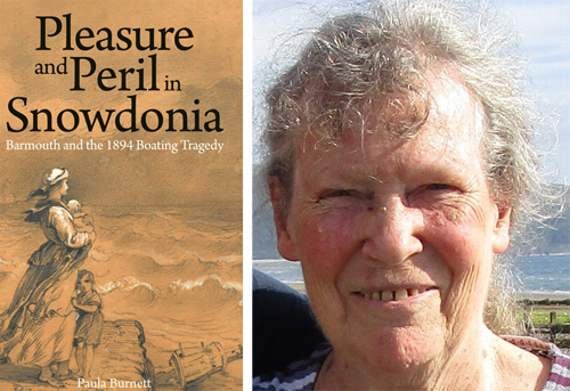
A book based on a “largely forgotten disaster” in Meirionnydd has been released.
Paula Burnett’s book looks at the victims, the National Home Reading Union which organised their reading holiday in Barmouth, and examines how and why the tragedy unfolded in 1894.
The story is set against topical issues today, like health and safety and the relish for excitement and risk.
Paula, from Trawsfynydd, said the tragedy “involves 10 young serious-minded visitors from all parts of England who drowned over a century ago in tragic circumstances on the river at Barmouth, a place where many people from all parts of the country have long liked to take their holidays”.

Paula said: “The news hit the headlines all over the nation. The inquest which opened immediately was reported in great detail. Issues were raised to do with the regulation of boating and how three rowing boats full of young people, two in the charge of local boatmen, could have met disaster independently on an evening excursion upriver when a summer breeze turned into a gale.”
Recalling where she first learned of the tragedy, Paula said: “The memorial plaque in Llanaber church is what first drew my eye many years ago.
“It seemed such a sad accident – and I had never heard of it although I had been quite busy researching Barmouth’s history.
“The first two names in particular stood out to me, both with the surname Golightly. A rare surname, it is my husband’s original name, associated with County Durham where he was born.
“His father having died in an accident, eventually his mother remarried so as a lad he took on his stepfather’s name, Burnett. I had always known if things had been different, Golightly might have become my name too.
“Since I had been researching family history for some time once I retired, I looked up the Golightly women who had died on 1 August 1894, and found they were indeed from Durham, sisters who had travelled by train to Barmouth for what would have been a special opportunity in their lives, a holiday in a beautiful place with likeminded people who enjoyed books and discussion.
“Intrigued, I explored why they were in Barmouth and how that fateful evening unfolded.
“As I unravelled its complexities, and the way that the errors of judgment that emerged interacted with chance to produce disaster, I felt the story deserved to be retold, and those 10 victims deserved to be remembered, not just as names on a memorial plaque, but as individuals, with their own families and histories.”
She added: “As the holiday season gets under way and countless people look for fun and excitement on the water, the thought-provoking narrative delivers a dramatic and readable account of historical events while engaging with some urgently contemporary issues. Recent news has sadly been full of reports from across the country of new tragic loss of life in open water – and warnings about the dangers.
“But as the Cambrian News said in a special editorial supplement published a few days after the tragedy, ‘Life, perhaps, would not be worth living if we were not more or less reckless with it’.”
Paula believes some readers may be descendants of the local people involved, and have their own handed-down stories to add.
Pleasure and Peril in Snowdonia: Barmouth and the 1894 Boating Tragedy (Llanrwst: Gwasg Carreg Gwalch, 111pp, colour-illustrated throughout, £6.50).
Comments
This article has no comments yet. Be the first to leave a comment.