
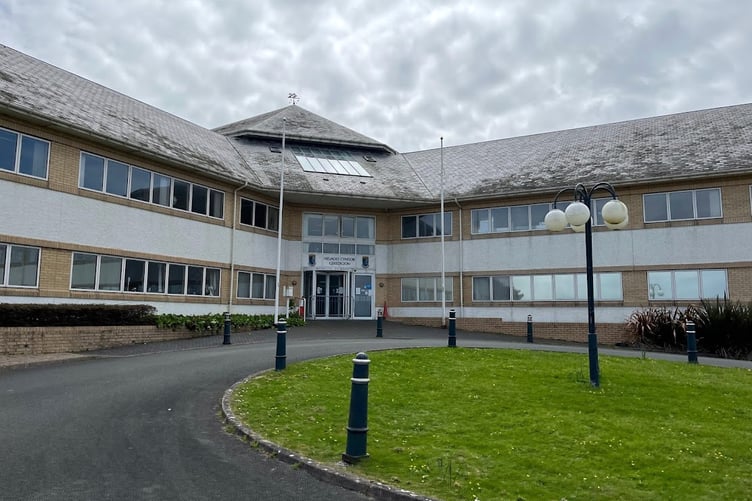
Ceredigion could face a bill of at least £49 million to make its council buildings more environmentally friendly, according to figures highlighted in a damning new Audit Wales report.
The assessment comes as auditors warn that Wales is now highly unlikely to achieve its ambition of creating a net-zero public sector by 2030.
The report, ‘Zeroing in? Follow-up on public sector decarbonisation’, published on 3 November, examines progress since Audit Wales raised concerns about the pace of decarbonisation in 2022.
It cites research commissioned by the Welsh Government and Welsh Local Government Association in 2025, which estimated that decarbonising council buildings across Wales would require capital investment of at least £2.3 billion.
The estimated cost for Ceredigion was at least £49 million, compared with £218 million for Cardiff.
The calculations cover the period between 2024 and 2030 and include improvements such as heat pumps, double glazing, renewable energy installations and other measures designed to reduce buildings' carbon emissions.
However, the figures represent estimated investment requirements rather than confirmed spending commitments or additional budget deficits.
Audit Wales found that decarbonisation had become a lower priority for public bodies, with financial pressures increasingly taking precedence over environmental objectives.
The watchdog criticised the Welsh Government's approach, finding that its collective net-zero ambition was poorly defined and that insufficient progress had been made towards establishing meaningful accountability.
Although public bodies have introduced environmental initiatives, auditors concluded that improvements had not accelerated sufficiently since their previous investigation.



The report also identified weaknesses in financial planning, with many organisations lacking a comprehensive understanding of the investment needed to decarbonise their operations.
Across Wales, reported public sector emissions increased by approximately 20 percent between 2021-22 and 2024-25, although Audit Wales cautioned that improved reporting and additional organisations submitting data contributed to the increase.
During the same period, the number of public bodies reporting their emissions rose from 69 to 82.
Auditors also found that emissions associated with supply chains accounted for 84 percent of the public sector's reported carbon footprint, presenting further challenges for organisations seeking reductions.
The Welsh Government has provided approximately £144 million in loans and £84 million in grants to support public sector decarbonisation between 2022-23 and 2025-26.
Audit Wales warned that delaying improvements could ultimately create additional financial pressures as public bodies face the consequences of climate change.
Ann-Marie Harkin, Executive Director for Audit Delivery at Audit Wales, said insufficient progress had been made overall and called for greater action.
Responding to the findings, the Welsh Government acknowledged that further work was necessary and said it would outline its future priorities for public sector climate action.
The Welsh Local Government Association recognised the financial difficulties facing councils but highlighted potential benefits from decarbonisation, including reduced pollution, employment opportunities and support for local businesses.
Audit Wales has recommended clearer expectations, improved emissions reporting and stronger financial planning to help public bodies reduce their environmental impact.
Its findings raise questions about how authorities such as Ceredigion can reconcile ambitious environmental commitments with growing financial pressures and competing demands on public spending.
Comments
We've recently changed our login process. If you have an account for commenting, you will need to re-register on the login window.
This article has no comments yet. Be the first to leave a comment.