
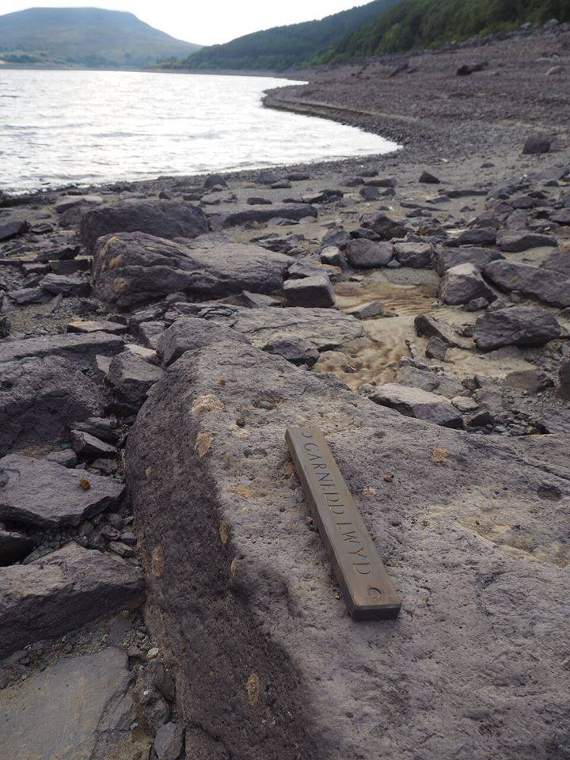
THE hot weather has uncovered relics of one of Wales’ greatest national tragedies.
Cllr Mabon ap Gwynfor has paid a poignant visit to Tryweryn, the site of a drowned Welsh village on the outskirts of Bala.
2015 marked five decades since the Welsh village of Capel Celyn was flooded to create a reservoir to provide a water supply to Liverpool.
70 residents of Capel Celyn had to leave their homes to make way for the controversial scheme which fuelled Welsh nationalist feeling and calls for devolution.



In 1963, two men were jailed for bomb attacks on power installations in protest at construction of the reservoir.
Today, you can still see vestiges of the lost community.
“There’s still some water left in the reservoir, so you can’t see the old bridge or the old cemetery yet, for instance, although if this weather continues we might well be able to see more ruins before long,” explained Cllr Ap Gwynfor, grandson of Plaid Cymru’s first MP, Gwynfor Evans.
“But the water level is low, and consequently Capel Celyn and some of the farms are starting to resurface.
“Hedgerow stumps are visible and the old tarmacked road on the northern side of the valley is walkable in parts.
“But the most poignant ruin was that of Garnedd Lwyd, a farmhouse on the north eastern side of the valley. The house name is still screwed tightly on to a large stone, and just beneath it lies huge slate slabs, which must have been the floor of the farm or outbuildings. It looks eerily like a grave, which seemed suitable in the circumstances.
“The story of Garnedd Lwyd is particularly sad, as the old couple who lived there, John William Evans and Mabel Evans, were killed in a car crash near Cerrigydrudion shortly after being forced out of their home.”
The former Aberystwyth town councillor, who lives in Corwen, just a few miles from the site, believes that the Capel Celyn tragedy still has an important part to play in Welsh calls for independence.
“[The flooding] serves to remind us of our recent past and how Wales’ voice has and continues to be ignored by the Imperial Government in London,” he continued.
“It also brings into sharp focus the politics of water, and how little control we have in Wales over our own natural resources. Our communities have always been expendable in the name of progress.
“I’m not sure if we’ve actually learnt anything as a nation from Tryweryn, because the voice of Wales continues to be ignored when it comes to decisions in Westminster.
“We keep voting for politicians and political parties that are content to let Wales remain the poorest country in northern Europe and let London make decisions on our behalf, which are clearly not in our interest.
“Maybe the resurfacing of the ruins of Capel Celyn will make some people realise the unequal nature of the United Kingdom, and that unless we take control of our own destiny then things will continue much the same.”
Comments
This article has no comments yet. Be the first to leave a comment.