
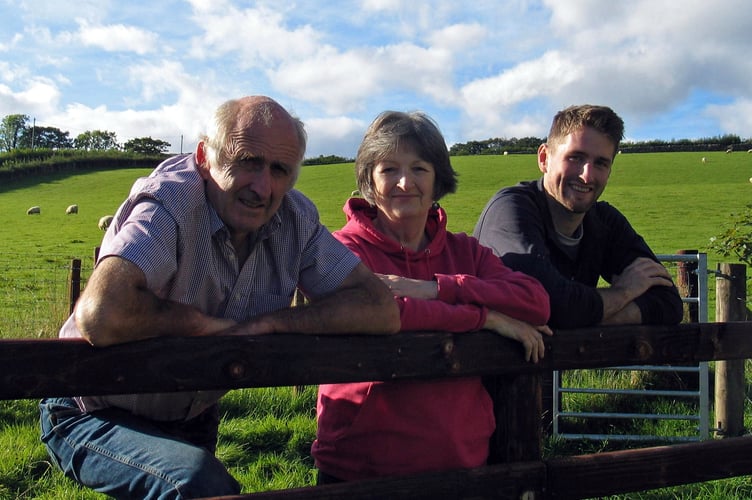
A Dolgellau farmer is one of over 20 Welsh hill sheep breeders taking part in a pioneering environmental project to see how his stock works with biodiversity.
The environmental auditing programme launched during the summer will evaluate where Welsh upland farming stands in terms of its environmental credentials, and what scope there is for further improvement.
Huw Alun Evans and son Rhys are part of Hybu Cig Cymru – Meat Promotion Wales’ Hill Ram Scheme and the family jumped at the chance to participate in the biodiversity audit because “you can’t manage what you don’t measure” is Rhys’ mantra.
Huw, with wife Rhianwen and two of their three sons Huw Ynyr and Rhys, farms 300 acres at Hengwrt in Rhydymain near Dolgellau.




The farm extends from 400 to 2400 feet to the summit of Rhobell Fawr mountain on the western end of the Arenig range.
Lambing their flock of Welsh mountain Meirionnydd type ewes outdoors on the inbye, they are moved uphill to the mountain after lambing. Winter grazing is sought for 100 replacement ewe lambs on the Welsh-English lowland borders, and lambing begins at Hengwrt in April.
Rhys said: “If you have a thriving biodiversity and environment then the condition of your natural resources is strong and that is what gives you the bedrock to then produce food.
“We’re fairly confident that our biodiversity is good at Hengwrt, but we need it measured so we can sustain it, and hopefully further improve it.
“We try to farm within the natural abilities of the land as much as possible, using native stock, not overstocking because it’s important to work within the natural production capacity of the farm, without compensating the environment.
“We do buy in a little feed and fertiliser, but we’ll be looking at ways to reduce our reliance on these, particularly given the huge rise in input costs,” explains Rhys.
Since 2018, Hill Ram Scheme farmers have been using DNA-based technologies to record the performance of hill flocks, enabling farmers to use genetic data to breed selectively to improve farms’ commercial performance and environmental sustainability.
Huw Alun explains: “The scheme has given us the tools and expertise to use the data we collect to identify the poorer performing ewes so we improve the flock performance in general. Our pedigree herd of Welsh Black cattle are descendants of my grandfather’s stock, bought when he purchased Hengwrt in 1927. We are very proud of the cattle’s family bloodline.”
Comments
This article has no comments yet. Be the first to leave a comment.