
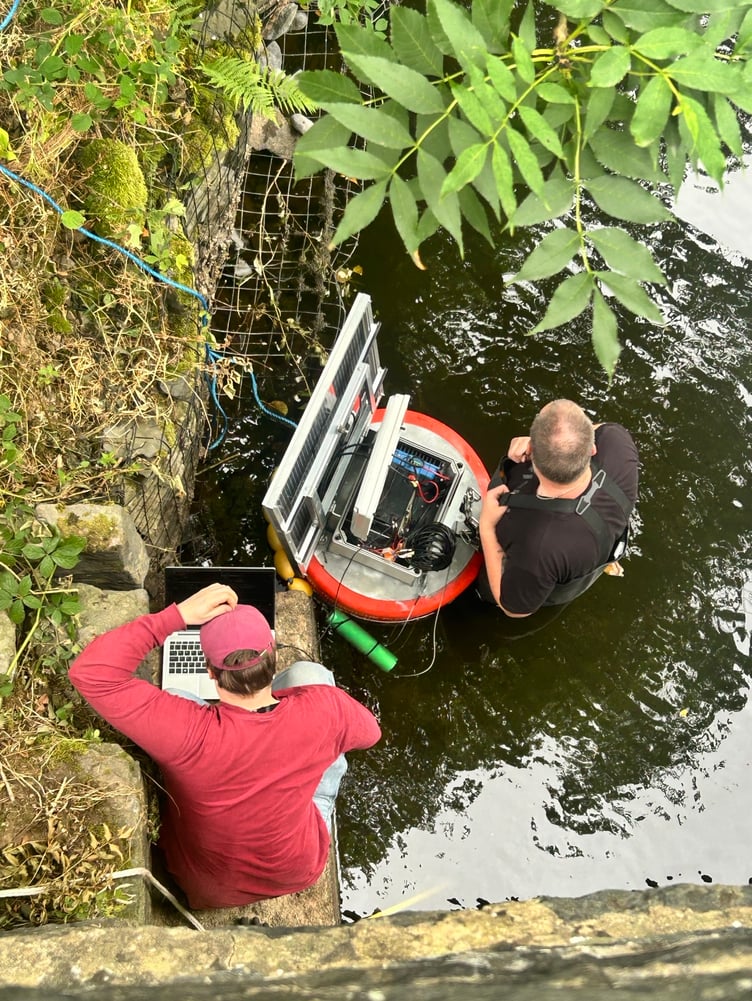
Some of Wales’ most remote rivers are being monitored in near real-time using satellite-linked sensors, in an innovative project that is providing valuable insights into water quality.
Monitoring rural Welsh river catchments relies on periodic site visits, leaving significant gaps in scientists' understanding of rapidly changing river conditions and pollution events.
A new project involving researchers from Aberystwyth University is helping to overcome that challenge by delivering continuous water quality monitoring in near real-time in locations where conventional approaches are difficult or impractical.
Through STREAMS (Space Tech for River Environments & Agricultural Monitoring Sensors), an Innovate UK-funded collaboration between Aberystwyth University, Lacuna Space and the UK Agri-Tech Centre, researchers are developing advanced multi-parameter sensors that continuously measure key indicators of river health, including dissolved oxygen, turbidity, temperature, electrical conductivity, nitrate levels, ammonium and pH.
The sensors communicate via a low-power satellite network developed by Lacuna Space, designed to retrieve essential information from battery-powered sensors located anywhere on Earth.
This technology enables measurements to be transmitted from remote river catchments without relying on mobile phone coverage.
The result is a continuous stream of information on river conditions, giving researchers and environmental managers new opportunities to identify pollution incidents, track environmental change and better understand long-term water quality trends.
Dr Elizabeth Hart, from the Department of Life Sciences at Aberystwyth University, said: “For many rivers in Wales, opportunities to collect continuous monitoring data have traditionally been limited.
“STREAMS is helping to address this by providing reliable, long-term monitoring that improves our understanding of how water quality changes throughout the year, during rainfall events and in response to activities across the catchment.



“By improving understanding of how rivers respond to natural processes and land management practices, the project aims to support farmers, land managers and environmental organisations in delivering positive outcomes for both productive farmland and sustainable river ecosystems.”
Comments
We've recently changed our login process. If you have an account for commenting, you will need to re-register on the login window.
This article has no comments yet. Be the first to leave a comment.