

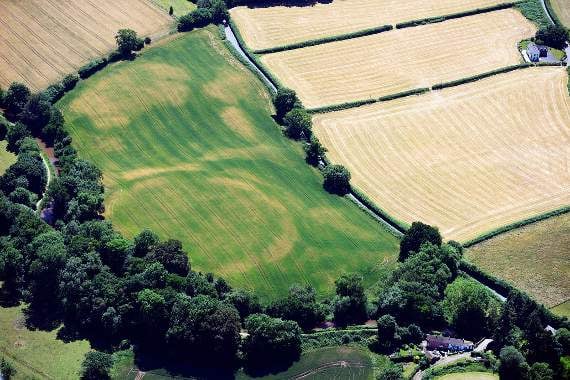
THE historical secrets of Ceredigion have been exposed by scorching temperatures - as the outlines of lost wonders have emerged in fields and hillsides.
The outlines of a first century town, a ‘ghost garden’ from the 1850s and a Second World War airfield have all appeared as the normally luscious green landscape turns brown.
The parched land is due to Britain’s longest heatwave since 1976 and the hottest June on record.
Dr Toby Driver, archaeologist and senior investigator at the Royal Commission on the Ancient and Historical Monuments of Wales, said aerial footage they took of the excoriated Welsh countryside on Friday, 6 July, even unearthed some previously unknown sites.
.png?width=209&height=140&crop=209:145,smart&quality=75)

Dr Driver said: “There has been such an extreme drought we’ve got sites of national significance emerging.”
The crop marks photographed at Langstone are one of the commission’s new discoveries, which have been found in the same area as an already-discovered Roman fortification.
Dr Driver said: “It’s a race against time now to find out the significance of this new discovery. Those marks will probably only be there for another two-and-a-half weeks or so.”
Other shots taken from the Cessna Aircraft include the nearly dried-up Nant-y-Moch reservoir and the Gaer Fawr hillfort, both in Ceredigion.
The hillfort, according to Dr Driver, has not been seen for 30 years.
Comments
This article has no comments yet. Be the first to leave a comment.