

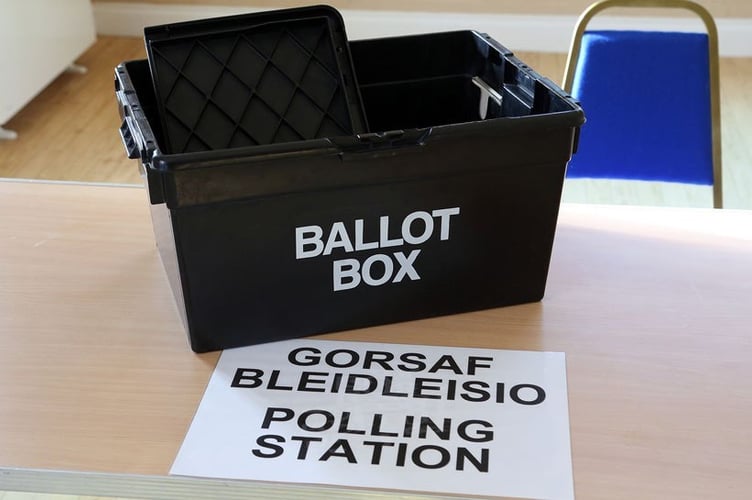
Residents will head to the polls this week to vote in an election that is likely to represent the biggest change in the political landscape of Wales since devolution.
A bigger Senedd with more members, a proportional voting system, and polling suggesting that Labour’s iron grip on leadership in Wales has loosened, will mean the election on Thursday, 7 May could have a seismic impact on the country’s politics.
Polling suggests that Labour will lose power in Wales for the first time since the-then Welsh Assembly was established in 1999.
Polls suggest that a two horse race is developing between Plaid Cymru and Reform UK to be the largest party – but the expansion of the Senedd and the proportional representation model used to select candidates mean a majority government in May is extremely unlikely on current polling numbers with parties having to agree to work together for a majority, or one party going it alone as a minority government – something Labour did towards the end of the current Senedd term.

While the party in charge is likely to change following May’s elections, the way residents vote will certainly change, with a new system designed to reflect every vote to fill the newly expanded 96 seat Senedd.
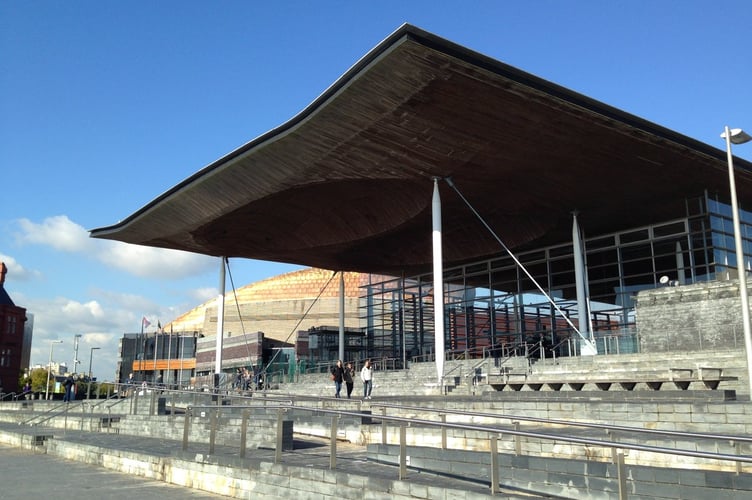
When you head into the polling station on 7 May, the ballot papers will be different – not just the names of people standing for election – but the manner in which you exercise your voting preference will be different too.
In previous Senedd elections, a voting system called the ‘Additional Member System’ was used.
This system combined two types of voting.
First, people voted for a candidate to represent their constituency using the First Past the Post method.
Then there was a second vote, using proportional voting to choose candidates to represent regions of Wales.
The combination of these two votes elected all 60 Members of the Senedd.
This time around, a new system will be used — a ‘closed proportional list system.’
This means the number of seats a party or independent candidate wins will more closely reflect the percentage of votes they get.
The new ‘closed proportional list’ system uses a formula called ‘the D’Hondt method’ to make sure seats are allocated to closely reflect their share of the vote.
So, if Party A gets 50 per cent of the votes in a constituency, they will likely get three of the six seats. If Party B gets 30 per cent, they will likely get two of the six seats. If an independent candidate has enough votes, they will also win a seat.
The D’Hondt formula divides each party's votes by the number of seats they have already won, plus one.
After winning a seat, a party’s votes are then divided by two; after winning two seats, their votes are divided by three, and so on.
Vote counts takes place in rounds, with the party with the highest total in each round winning the seat.
The new method means that you will only cast one vote for a political party and its attached list of candidates.
You could also vote for an independent candidate standing in the election.
The new system makes sure the number of seats each party or independent candidate wins is closer to the percentage of votes they receive.
New Members of the Senedd will be elected, in order, from party lists.
Independent candidates will be elected where they win enough votes.
With around half of Labour’s 29 Senedd Members announcing they will not stand in May, coupled with a declining Labour support in polls and the rise in support for Reform UK, Plaid Cymru, and the Green Party, more than half of the 96 members of the new Senedd this year are likely to be new to the roles.
For the 7 May elections, Wales will have 16 constituencies instead of the current 40.
Democracy and Boundary Commission Cymru created the new constituencies for Wales and the Senedd will have 96 members instead of 60, each constituency electing six members.
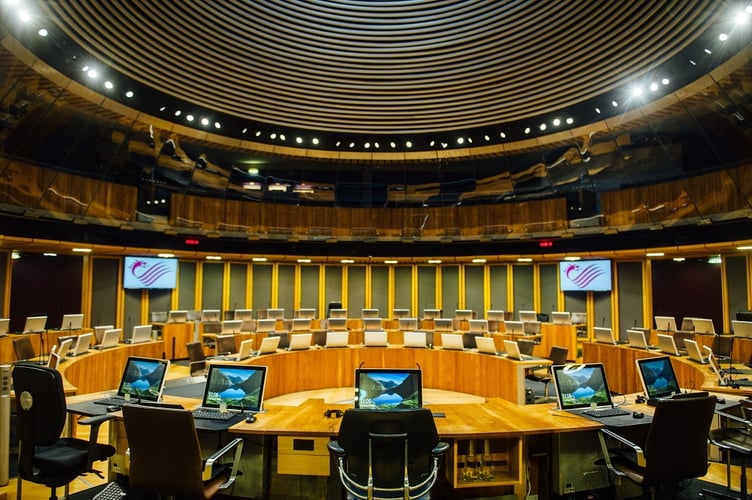
Due to time constraints ahead of May’s election, the commission was tasked with pairing neighbouring UK parliamentary seats to create 16 for the Senedd.
But a full boundary review – the first in 18 years, with the last held before the 2007 poll – will take place post-election, with the political map of Wales set to be redrawn by 2030.
Each of the new constituencies will have about 140,000 voters but Bangor Conwy Môn will have around 20,000 fewer because Ynys Môn has historically been a protected seat.
For Pembrokeshire and Ceredigion, the new Ceredigion Penfro constituency is made up of the Ceredigion Preseli UK Parliamentary constituency and the Mid and South Pembrokeshire UK Parliamentary constituency, stretching from north of Aberystwyth to Angle in the southwest and Llanteg in the southeast.
The six Welsh Conservatives candidates are: Paul Windsor Davies, Samuel Deri Kurtz, Claire Victoria George, Brian Andrew Murphy, Gill Evans, and Claire Malaina Jones.
Plaid Cymru has eight candidates: Elin Jones, Kerry Ferguson, Anna Nicholl, Cris Tomos, Colin Nosworthy, Clive Davies, Owain Jones, and Matt Adams.
Wales Green Party has six candidates: Amy Nicholass, Tomass Jereminovics, James Henry Purchase, Morgan Hope Phillips, Rosie O’Toole, and Kezia Autumn Hine.
Reform UK also has six candidates: Susan Claire Archibald, Paul Marr, Michael Timothy Allen, Elisa Bessie Gonzalez Randall, Peter Martin John, and Bernard Holton.
Welsh Labour is fielding seven candidates: Eluned Morgan, Marc Tierney, Joshua Phillips, Margaret Greenaway, Tansaim Hussain-Gul, Luke Davies-Jones, and Peter Huw Jenkins.
Welsh Liberal Democrats have six candidates: Sandra Louise Jervis, Alistair Ronald Cameron, Tom Hughes, Lee Dennis Thomas John Herring, Andrew Christopher Lye, and Maggie Robinson.
Gwyn Wigley Evans is standing for Gwlad, and Elizabeth Davies for Heritage Party.
Also standing as Independents are: Aaron Carey, George Alexander Chadzy, and Paul Haywood Dowson.
Gwynedd Maldwyn was created by merging the Dwyfor Meirionnydd UK Parliamentary constituency and the Montgomeryshire and Glyndŵr UK Parliamentary constituency.
Machynlleth now sits within Gwynedd Maldwyn - which spans parts of Denbighshire, Wrexham County, Powys and Gwynedd, taking in places like Newtown, Porthmadog and Ruabon.
The Welsh Conservatives candidates are Aled Wyn Davies, Henrietta Elizabeth Hensher, Peter Lewington, Hedd Vaughan Thomas, Daniel Lewis Spilsbury, and Roger Francis Cracknell.
Standing for the Green Party are Nathan Jarvis, Nicole Wait, Sue MacFarlane, Sian Thomas, Curtis Wilford, Ed Mason.
The Welsh Labour candidates are: Ian Pryce Parry, Dawn McGuinness, Steffan William Chambers, Dana Davies, Mathew James Norman, and Morgan Peters
The Welsh Liberal Democrats are fielding six candidates: Glyn Preston, Stephen Churchman, Richard Wilfrid Church, Pete Roberts, Carol Elaine Robinson and Manny Akpoteni.
The Plaid Cymru candidates are Siân Gwenllian, Mabon ap Gwynfor, Beca Brown, Elwyn Vaughan, Elin Hywel, Donna O'Brien, Victoria Evans, and Elfed Wyn ap Elwyn.
Standing for Reform UK are: Andrew Charles Grifffin, Claire Victoria Johnson-Wood, Robert Karl Lewis, Peter Phillip Robinson, Mark Phillip Blake, and Richard Charles Pendry.
Gwlad will be represented by Jeremy Davies while Mattie Ginsberg will stand for the Heritage Party.
Former Conservative Montgomeryshire MS Russell George will stand as an independent candidate.
Monty Kennard will also stand as independent.
The expansion of the Senedd to 96 members across the 16 larger constituencies in Wales will “give the Senedd greater ability to look at and challenge the Welsh Government’s plans and spending on important topics that may affect you like hospitals, education, and transport,” a report for the Welsh Parliament said.
“Having 96 Members will also bring the Senedd in line with other countries of a similar size to Wales, like Scotland which has 129 Members and Northern Ireland which has 90.”
The Senedd commission outlined a 21 per cent budget increase for the Senedd to support the expansion to 96 members, including £12.7m for the costs of 36 extra Senedd members.
£4.2m is the estimated cost of expanding the Senedd chamber itself to hold the new members elected in May.
Those costs also included a promotional campaign to encourage more people to vote, with turnout at Senedd polls having been lower than 50 per cent in every election over the past 25 years – much lower than UK Government elections.
It is hoped turnout for this first of its kind election in Wales will be higher.
£4.5m has been set aside for one-off election-related costs for the Senedd, primarily for resettlement grants for politicians who do not return and redundancy payments for staff.
Elections for the Senedd will now also be held every four years under new legislation, instead of the previous five.
New rules for May’s election include anyone standing for office having to live in Wales.
The Welsh Government manages a budget of roughly £26 billion, and is in control of some specific taxes like Land Transaction Tax.
The Welsh Government also has some control over income tax and landfill tax.
Several of the parties are campaigning on bringing more tax-raising power to Wales and devolving further powers to Wales including policing and control of the Crown Estate.
Devolved issues controlled by the Welsh Government rather than the UK Government include health and social care, education, environment and agriculture, transport, planning, economy, and local government.
The Welsh Government is also on charge of Welsh language development, with a current target set of a million Welsh speakers by 2050.
When initially created, the Senedd was able only to pass secondary legislation in devolved areas.
The Government of Wales Act 2006 gave the Senedd limited powers to pass primary legislation.
Following a referendum in 2011, the Welsh electorate voted in favour of extending primary law-making powers to all areas where the Senedd has responsibility.
Labour has won every devolved election and led the Welsh Government since 1999 as well as topping the poll in Wales at every Westminster election since 1922.
If latest polling holds true, the new-look Senedd is likely to be led by a different party for the first time, with a coalition of parties a possibility.
Talks will begin in earnest between parties in the days following the election counts in a bid to form a Government.
Under the new system, every vote will count more than ever, as parties battle it out for the six seats in each constituency.
Every resident in Wales will have six Senedd members representing them, albeit within constituencies that can cover huge geographical areas.
While the system will give residents a choice of which MS to contact with an issue, concerns have been raised that losing truly local Senedd Members will make hyper local issues more difficult to raise and deal with.
Senedd Cymru said: “When you vote, you’re helping to choose the people who will represent your community in the Senedd, and shape the kind of country you want to live in.
“Your vote can shape your future – make your mark on 7 May.”
Polling day on 7 May will run from 7am to 10pm.
In a break from tradition, votes will be counted beginning on the morning of 8 May and not overnight.
Full details of polling stations, how to vote, and full information on the candidates in the Ceredigion Penfro is available on the Ceredigion County Council website at www.ceredigion.gov.uk/your-council/voting-elections/senedd-elections.
Details and information for the Gwynedd Maldwyn constituency can be found on the Cyngor Gwynedd website at www.gwynedd.llyw.cymru/en/Council/Voting-and-elections/Senedd-Elections.
A dedicated website for the election across Wales, with information on all constituencies can be found at www.vote.wales as well as all information on the Senedd website at senedd.wales/senedd-election-2026.
Your polling card will give you details of where your polling station is.
You do not need to take your polling card when you vote.
You also do not need to bring ID to vote in a Senedd election.
Throughout polling day, the vote counts and the following days as a Government is formed, the Cambrian News will keep you up to date online and in print with election news as members are elected and the new-look Senedd takes shape.
Comments
This article has no comments yet. Be the first to leave a comment.