

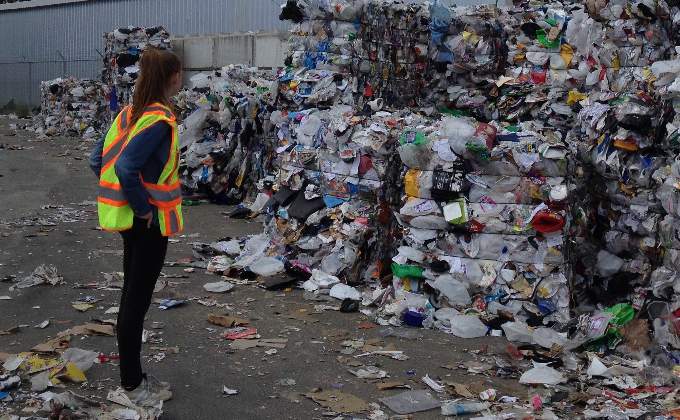
Few of us give a second thought as to what happens to our recycled waste after we’ve dropped it off or the council has picked it up.
But some of it ends up in far-flung places, as CHRIS BETTELEY follows the recycling trail.
THOUSANDS of tonnes of Ceredigion’s recycling waste – from paper and plastic to broken electrical appliances – are being shipped overseas to places as far flung as Uganda, India and Malaysia.
Data on how the county’s recycling is dealt with is kept by the Welsh Government, which sets statutory targets on what percentage of total waste should be recycled.



The target – for each authority to recycle 70 per cent of waste by 2025 – has already been hit the past two years in Ceredigion, with 2020/21 data showing exactly 70 per cent of the county waste being recycled instead of going to landfill.
While changes to the frequency of black bin collections and more recycling options has led to an uptick in the rate, the latest data shows that the recycling residents present on the street on bin day – or take to one of four waste collection services in Ceredigion – can end up all around the world.
While the vast majority of recycling waste was sent within the United Kingdom, either to England or Wales, Turkey (934 tonnes), India (813t), Germany (458t), The Netherlands (386t), France (263t), Thailand (258t), Malaysia (130t), and Belgium (125t) all feature in the top 10 destinations for recycling waste from the county.
Most of the county’s waste electrical and electronic equipment ended up in Turkey, with 135 tonnes of things like old kettles, broken microwaves and mobile phones, heading to the country in 2020/21.
The wine and beer bottles and jam jars residents leave out for the three-weekly roadside glass collection will likely end up as fibre-glass insulation, data showed, as Knauf Insulation Ltd of Cwmbran took 2,173 tonnes of glass from Ceredigion – more than 96 per cent of all glass collected throughout the year.
None of the 77 tonnes of carpet recycled in Ceredigion was sent abroad, while 3,352 tonnes (63 per cent of the total) of organic waste collected from food bins across the county went to Severn Trent Green Power.
The food waste there is treated, and the end products are a bio gas which generates electricity, and a slurry type fertiliser.
In a year enough electricity is produced from Ceredigion’s food waste to power about 300 homes, with the fertiliser distributed onto agricultural land.
All waste rubble and aggregate remained in Wales, as did all recycled textiles and clothing apart from 13.48t which made its way to Uganda.
Uganda also took in 7.01 tonnes of paper from Ceredigion, with Turkey, France, Germany, India, and Thailand also taking hundreds of tonnes each of paper and cardboard from the county.
In all 74 per cent of all paper and cardboard collected by Ceredigion bin men ended up abroad, along with 18 per cent of all plastics.
All 304 tonnes of recycled wood remained in the UK.
Ceredigion Council told the Cambrian News it “looks to secure the most efficient solutions possible for the treatment of its waste”, and while the waste treatment industry is “global”, “innovative and new solutions are emerging which mean there may well be opportunities to treat waste more locally in the future.”
Figures show that in total, 21,000 tonnes of waste from Ceredigion were recycled, with an estimated cash saving against disposal for the year of around £2m.
With 2020/21 taking in the first wave of the pandemic, the data reveals that lockdowns and coronavirus restrictions brought the total waste per person in Ceredigion down to 402kg compared to 458kg the previous year, with total residual waste per person also falling from 130kg to 120kg.
As the council, along with other bodies in the county, declare a climate emergency and move towards a carbon-free future, the data also indicates that 9,000 tonnes of CO2 emissions were avoided through the high recycling rate in the county.
The latest figures show that just 1,416 tonnes of waste were sent to landfill in Ceredigion in 2020/21, a huge drop from the almost 10,000 tonnes in 2018, with most unrecyclable household waste now going to an energy from waste facility to be treated.
A council spokesperson said: “The council looks to secure the most efficient solutions possible for the treatment of its waste.”
Comments
This article has no comments yet. Be the first to leave a comment.