

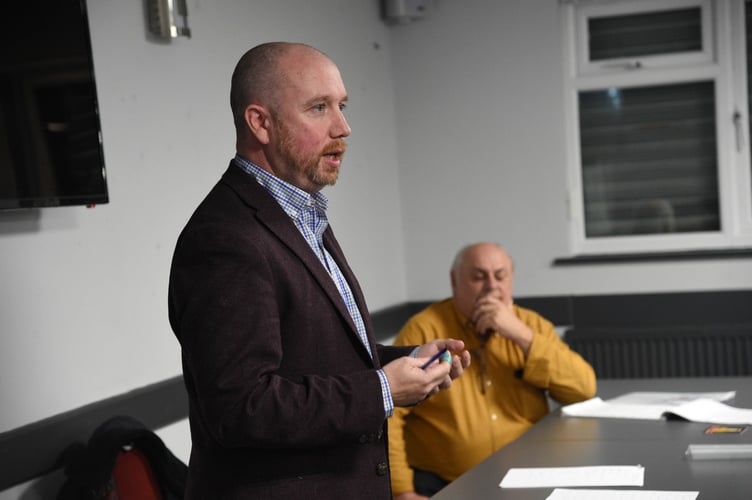
Dwyfor Meirionnydd MS, Mabon ap Gwynfor has been looking back to the origin of the Air Ambulance in north Wales.
Speaking in the Senedd, he explained how the service came to the area following a campaign by Nia Evans from Dolgellau following a road accident that she and her then fiancé, Kieron Wilkes, suffered near Harlech in 2002.
“The sadness is Mr Wilkes lost his life in the accident, but Nia was saved after the police air ambulance took her to Ysbyty Gwynedd,” Mabon explained.
“She successfully petitioned to have an air ambulance centre in north Wales.
.jpeg?width=209&height=140&crop=209:145,smart&quality=75)

“I had the privilege of going to Dinas Dinlle to speak to the workforce last year. The glory of the Dinas Dinlle site is that it’s just a stone’s throw from Ysbyty Gwynedd, which means the workforce can improve their medical skills, which of course enhances the experience of all.”
“But there’s more to the air ambulance than a helicopter. The most important element, of course, are the medics who are part of the team, but the rapid response vehicles, the RRVs, are also a core element.
“Dwyfor Meirionnydd, despite the incredible beauty of the constituency, the sea, the lakes and the rivers, often leave us in a blanket of fog and mist, and when this happens, the helicopters can’t land, and we are reliant on the rapid response vehicles that are part of the charity’s service. If the service was centred in Rhuddlan, how quickly do you think a rapid response vehicle could reach from there to somewhere such as Anelog at the far end of the Llŷn Peninsula, or Llanymawddwy? It would take hours. It would be impossible for them to get to any of these places in time. So, despite the fact that computer modelling suggests more lives could be saved, the truth is that our coastal and rural communities will suffer.
“I want the government to give us an assurance they have full confidence in the Optima modelling programme that’s been used to justify these recommendations. These are the Welsh Government’s health figures that are being inputted, and EMRTS is making the assessment, so the government can’t wash its hands of this.
“As I understand, the figures focus on the number of incidents that can be reached but without taking account of whether these are the most serious incidents, because Optima is drawn up for ambulances in more general contexts, not for the needs of an air ambulance covering large rural area.
“The Wales Air Ambulance service has proven itself to be crucial, and the recommendations made suggest that our rural communities will lose out. The people I represent, and I, are seeking assurances we won’t lose any level of service here, and this isn’t an exercise in reaching targets at the expense of the health and wellbeing of the people in my constituency.”
Comments
This article has no comments yet. Be the first to leave a comment.