
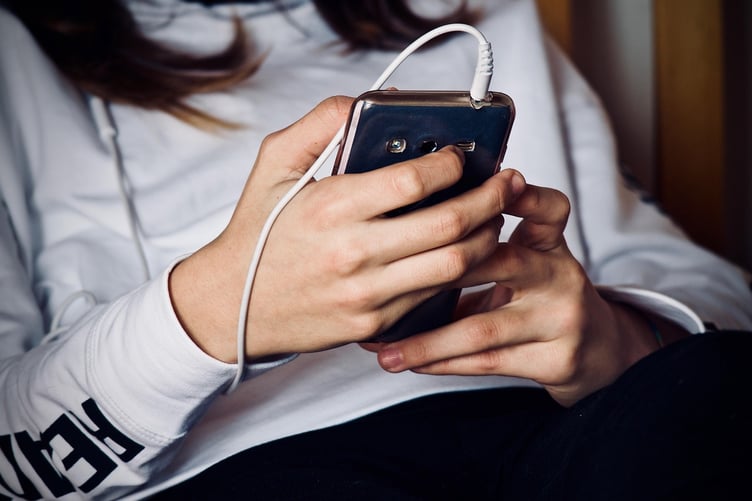
In the pockets of 97 per cent of secondary school children in Wales is a buzzing, shining portal to information and to each other.
Twenty years ago, smartphones didn’t exist to distract millennial youth (or their parents), but now teachers and police are pointing to smartphones and access to social media as the reason behind a 40 per cent increase in assault and rape across England and Wales, in which both the victim and perpetrator are under 18.
This ‘toxic’ online culture that encourages the watching of violent pornography and misogynistic content accessed via smartphones is what National Police Chiefs’ Council lead for child protection, Ian Critchley, blames for an 81 per cent rise in these incidents taking place on school property, according to an Observer investigation.
Anna [pseudonym] from Pembrokeshire was just 15 when she became a victim of physical and sexual abuse from a fellow pupil.




She said she didn’t know the words for what she was experiencing: “It escalated really badly to the point where [the abuse] was unbelievable. I didn’t know what it was. I was ashamed.”
Anna finally spoke out when the boy started carrying weapons, and her dad called the police– only then was she told that what she had experienced was not normal.
But when speaking to the Cambrian News, she didn’t use the word “terrifying” until she described the bullying she received after pupils found out what was happening, most of which was done online.
The bullying got so bad that she decided against pressing charges against the boy: “I was really terrified that if I did move forward with it, it would cause even more issues.”
She lost out on school time, and she said she felt effectively excluded from the school due to a lack of support from staff.
The question of what to do about this issue, which has been largely unaddressed by the Welsh government, is looming over parents and teachers in Wales.
It comes as a movement is sweeping across the UK to get young people off phones and social media.
Parents in mid-Wales are becoming a salient voice in this campaign; some spoke to the Cambrian News of having to pull their children out of school for months on end after nude images of their children were shared around the school via phones.
A child at one school said that nude photos of underage students are shared on phones “all the time”.
Though some parents don’t see it as a huge concern, the impact on the child at the centre can be huge, leading to self-harm, suicidal thoughts, depression and anxiety.
The impact on the other children is also not to be dismissed, contributing to an online culture in which it’s ok to objectify and belittle people.
It remains a criminal offence to make or share indecent images of underage people, even with their consent.
One child support worker in Ceredigion said referrals for “misogynistic behaviour” have become a bigger part of her role than even a year ago.
Jessica Terry-Hamer, Children and Young Person Support Worker for West Wales Domestic Abuse Service, said teens will often talk to her about the misogynist influencer Andrew Tate and porn star Bonnie Blue: “I hear a lot about [Bonnie], it’s a very common topic.
“I do think a lot comes from [social media] influencers.
“Social media isn’t the only problem but it has a part to play in normalising unhealthy behaviours.”

Jessica is part of a programme that works with young people throughout west Wales on healthy relationships.
It seems that mobile phones have become this generation's tool for bullying - children's most embarrassing moments are now recorded and repeated with one touch.
Phones are poked under toilet doors, leaving children scared to use the toilet at school, whilst others film pupils eating, leading some children to avoid eating in public.
Parents who spoke to the Cambrian News said that schools and the police did not know how to deal with this issue.
Recent research published this month found that policing smartphones was a “huge drain” on already strained school resources.
Birmingham University found that 102 staff hours a week were spent enforcing restrictive phone policies, going up to 108 hours a week for more lenient policies – the equivalent of 3.3 full-time staff.
Many secondary schools have rules around phones being out of sight, but teachers admit that in practice this rarely works and phones are in hands when they turn their backs.
With the average teen receiving 237 notifications a day, it makes sense that paying attention at school is a struggle.
It’s not just secondary schools that are affected - primary schools are also having to deal with the consequences of phone use, even when they’re not brought onto site.
The Children’s Commissioner for Wales found that 62 per cent of primary school children owned a smartphone according to a snapshot survey from October 2024, with 77 per cent bringing them in.
Heini Thomas, headteacher at Ysgol y Dderi Primary School in Llangybi, said she has seen firsthand the impact of smartphone use in children aged 11 or under: “At first it didn’t seem sensible to me to have this conversation with children so young.
“But I’ve had to deal with online bullying happening with my pupils on smartphones overnight – it's creeping into school life.
“Children who are on screens for a long time are tired, agitated, and exposed to things perhaps they shouldn’t have.
“It has a huge impact at home, and it comes into school.”
In lieu of intervention from the Welsh government, local authorities and schools are taking matters into their own hands with an issue that one teacher describes as the ‘single biggest cause of problems and tensions’ in schools.
Many parents at Ysgol y Dderi have signed up to the Smartphone Free Childhood (SFC) campaign, a growing movement that started as a WhatsApp group of concerned parents, and has since garnered the support of high-profile parents including Kate Winslet and Benedict Cumberbatch.
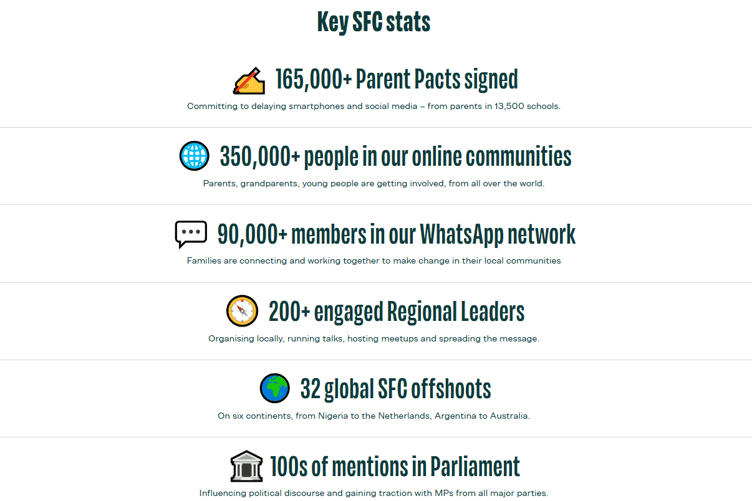
179,364 parents have now signed up to their ‘pact’ to delay giving their children access to smartphones and social media.
Whilst a lot of topics come to Ms Thomas through parents, she felt this was one she could fully support: “All our teachers signed up straight away.”
Tessa Lyle, who has two children aged 6 and 8 at the school, said the conversation needed to start in primary school “before it's too late”: “There’s no denying how hard it is to take away something once a young person has it.
“It’s when everyone has one that it becomes so difficult.
“That’s why it's important to get this movement started in primary schools.
“My children talk about smartphones already, seeing other kids with them.”
Parents report peer pressure as a major factor in their buying their children smartphones early – the concept behind the SFC campaign is that, with the ‘pact’, enough parents will 'delay together' to interrupt this trend.
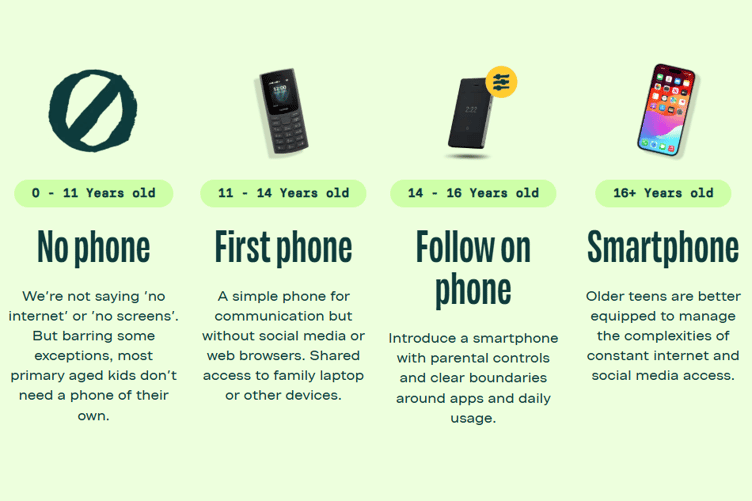
SFC calls for parents to take a phased approach to introducing smartphones and social media to their children, suggesting they wait until 14 for a smartphone and until 16 for social media access.
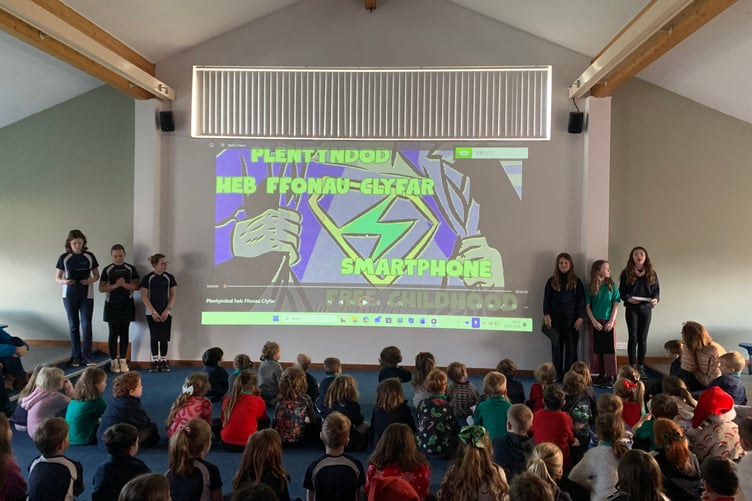
Ysgol y Dderi has begun instilling the values behind the campaign into school activities; Year 5 and 6 pupils conducted research into smartphone habits, held an awareness day, and created a short video for parents.
The Lampeter primary school isn’t the only one to join the campaign - only last month, Ceredigion County Council became the second local authority in Wales to support smartphone-free childhoods after Monmouthshire, believed to be the first council in the UK.
Unlike England, which issued guidance encouraging phone-free schools, the Welsh government has consistently resisted calls to issue guidance or legislation on the subject.
But the UK is actually behind on this subject – one in seven countries now ban phones in schools by law.
But only last March, a Senedd inquiry concluded that smartphones shouldn’t be banned outright from Welsh schools, and though the government conceded that more guidance was needed, they also argued that phones can also play a role in young people’s safety and welfare.
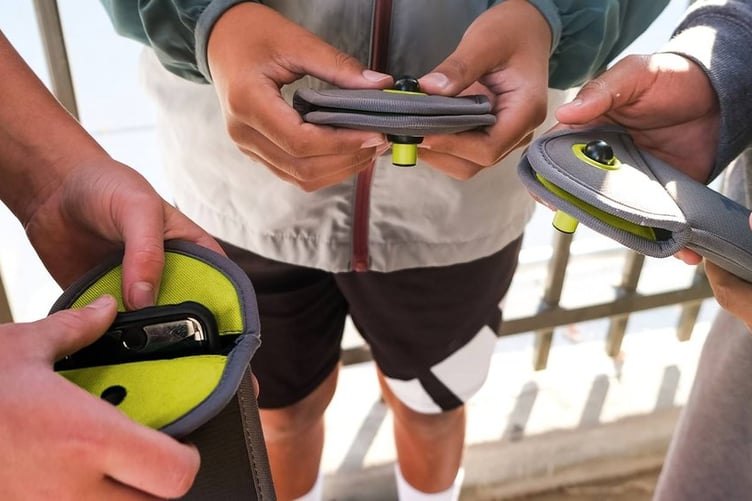
The use of phone pouches to stop children from accessing phones at schools is also growing across the UK – 18 per cent of schools surveyed in 2025 now use pouches, according to a Teacher Tapp poll.
Lampeter’s Bro Pedr Secondary School may be the first school in Ceredigion to use the pouches, announcing the decision in November after the school found that 85 per cent of parents and guardians were “firmly in favour".
The headteacher of Yr Ysgol Gymraeg Secondary School in Aberystwyth, Gareth James, sent a letter to parents in December highlighting the SFC campaign and the Parent Pact, explaining: “As a school community, we’re lending our support to this movement – not because we believe there’s one right way to do things, but because we think this is an important conversation for all of us.
“We know that every family’s situation is different, and many of you may already have devices in your household – for your child or their siblings.
“It’s never too late to reset boundaries, build healthier screen habits, or take small steps toward a more balanced digital life.”
Last month the Education Secretary Lynne Neagle responded to a letter from a concerned parent in Borth, stating that though the issue of social media platforms and age restrictions is not devolved, a Mobile Phone Use in Schools Forum has been created to develop national guidance and practical support: “This Forum brings together education professionals, researchers, wellbeing specialists and stakeholders, including academics from the University of Birmingham involved in the national SMART Schools study.
“This research highlights that school-level action alone cannot fully mitigate the risks associated with smartphones and online access, and that close alignment between home and school is essential. “
New national guidance is due to be shared this February.
However Sarah Wilson, co-founder of Ieuenctid Machynlleth Youth Club, said the onus shouldn’t be on families: “Having worked with disaffected young people across many sectors for over 25 years, I've seen firsthand the damage that access to unfiltered information is doing to our young people, to the relationships they build, their sexual health, self-esteem and mental health.
“I do not believe policing the young people themselves is the way to go.”
She said it should be up to the smartphone makers, web browsers and social media platforms instead: “They all have it within their power to protect young people, and they don’t do it because it profits them to have young people addicted.
“The reason they’re not forced to by governments is for political gain.
“It’s more than disappointing that our children’s safety is being governed by people who care more about power and money.”
This was recently done by the Australian government in a world-first, banning under-16s from social media platforms, and fining the companies up to £25m for serious or repeated breaches.
But opponents to these tactics accuse governments of Nanny state-ism, becoming the chinook to helicopter parenting, arguing that learning how to navigate the online world early can be a good thing, and giving young people who feel isolated due to geography, identity, or neurodivergence access to a longed-for community.
One Aberystwyth parent said that governments should “mind their own business”, suggesting it's the “parents' business and nobody else's”, whilst another argued sending their children to school with phones was a safety reassurance to them.
Many criticised Ceredigion’s guidance to limit smartphone use, considering students are required to access their school timetables online and are assigned homework via apps.
SFC’s rebuttal is that it’s not “anti-tech”: “Tech isn’t the enemy – it’s how we use it that matters.
“We want kids to grow up confident using technology, not dependent on it. That’s why we believe in building digital skills gradually and intentionally, and giving kids more time to be kids before they’re always connected. SFC is about balance, not banning.
“Every family’s path will be different. But here’s one that’s working for many.”
Comments
We've recently changed our login process. If you have an account for commenting, you will need to re-register on the login window.
This article has no comments yet. Be the first to leave a comment.