

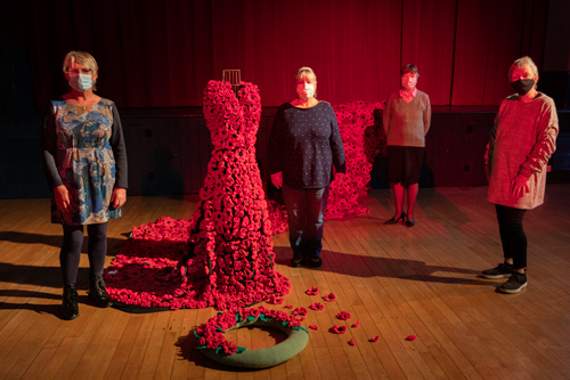
But the town will still mark the occasion in a number of ways, including the unveiling of a spectacular gown of poppies.
The gown forms part of an exhibition in shops on the High Street.
The town council issued an appeal to the community in January, asking for volunteers to paint the town red by knitting and crocheting poppies to commemorate 75 years since VE Day.


The support was overwhelming.
Plans for poppies to form a ‘Curtain of Hope’ to be displayed at the Memorial Hall for VE Day were scuppered due to lockdown, but the work has not been wasted.
Comprising 5,000 poppies thanks to contributions by over 150 individuals, this has been set out on re-cycled fishing nets by Pam Mayo, and turned into a train for the gown of poppies, created by Susan Humphries.
Susan said: “The creation of the poppy dress, inspired by the community project, kept me going through most of lockdown, and the number of poppies on the body of the dress is a closely guarded secret.
“I thought it may take two to three hundred but as the idea grew and the dress started to come together, it became considerably more than that!
“I am hoping one day we can hold a competition to guess how many poppies it took, with the money raised going to Help for Heroes and the British Legion. The train of poppies really is something special to set off the dress.”
The gown symbolises loss, especially to a generation of women who lost husbands, sons, fathers, brothers, grandsons whose names are remembered in the Memorial Hall.
MP Liz Saville Roberts said: “The woman is a symbol of the loss suffered by the entire community. Dressed in the gown of poppies, she is wrapped in the grief that so many women had to endure.”
The Memorial Hall, built after the Great War and opened by war time Prime Minister David Lloyd George, has the names of the men lost in hat conflict on two large oak panels in the lobby.
“After the Second World War an additional panel was added with the names of 22 men from the town killed in action.
These names have been researched using the Commonwealth War Graves Commission database and other sources.
During that research, five other names have come to light.
These four men and one woman, who had connections with the community, are not recorded on the panel but will be included in a future database and printed folder available to the public.
On the notice board outside the hall is a small plaque with a QR scanning code which takes you to a History Point website which gives a list and summary of the men lost from the world wars.
The exhibition in shops on the High Street includes work from community projects and the local school and college to commemorate Criccieth’s contribution to the world wars.
It will run until Christmas.
Cllr Robert Cadwalader, chair of Criccieth Town Council said: “During both world wars communities throughout the country pulled together including, of course, our own.
“We are again in difficult times and it is heartening to see the same. When this is all over and we return to normal life we must strive to maintain this spirit.”
Elsewhere this weekend, Dolgellau Town Council told the Cambrian News that Remembrance Sunday will be marked, but numbers will be limited.
Those taking part have been invited, and there will be a maximum of 30 people allowed at the war memorial, in accordance with Welsh Government rules and police advice.
There will be no religious service and no music. A few words will be spoken and wreaths laid.
The council said members of the community can lay wreaths afterwards.
St John the Evangelist Church, Barmouth, said its annual Remembrance Service “is not taking place due to the Covid restrictions”.
Comments
This article has no comments yet. Be the first to leave a comment.