
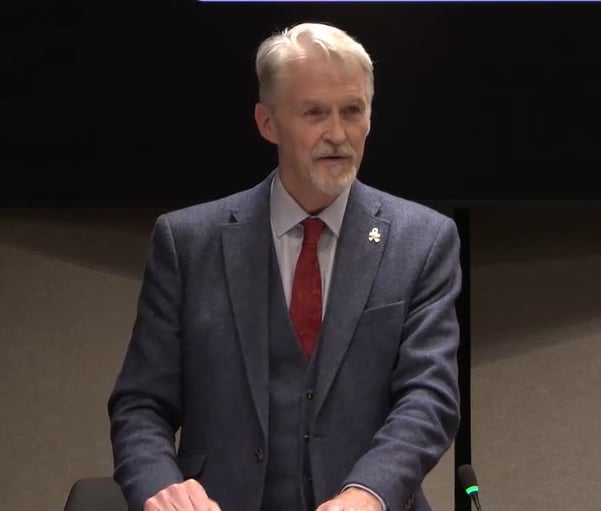
Huw Irranca-Davies will remain in his role as the Senedd's Senedd's Llywydd, after MSs rejected a Reform UK motion to remove him following a bitter row over free speech and conduct in the Siambr.
Reform MSs returned to full Senedd proceedings on 24 November after a two-week boycott in protest after Mr Irranca-Davies had ruled that Caerdydd Penarth MS Joe Martin had breached the parliament's standing orders.
On 10 November, Mr Martin had claimed that white British people were being replaced in parts of the UK.
His comments had appeared to echo 'The Great Replacement Theory' - a debunked far-right conspiracy that Western populations are being displaced by non-white immigration.
In a video interview released online, Mr Martin said he was unaware of the theory when he spoke.
Mr Irranca-Davies said the remarks were “unnecessarily provocative and deliberately offensive” and declared in a later ruling that Mr Martin would not be called to speak in the Siambr until he made a formal apology.
In a statement issued ahead of the vote, Reform's leader in Wales Helen Jenner said her party “never wanted to have to boycott Senedd proceedings” and had no choice other than to table a vote of no confidence in the Llywydd.
Speaking in the Siambr, Ms Jenner defended the language used by Mr Martin, claiming that similar language has been used in the houses of Commons and Lords without sanction.
She said: “They clearly value the rights of members to speak freely in those chambers. I'm saddened to say that this Llywydd does not, and for that reason we have lost confidence in him.”
“Free speech isn’t a free pass for hate speech”, Plaid Cymru MS, Carrie Harper, told the Siambr.




Rejecting claims freedom of speech was under threat, Ms Harper said the language used by Mr Martin was deemed “discriminatory” which is why he was asked to apologise.
She added: “That isn’t censorship, that is parliamentary accountability.”
The Fflint Wrecsam MS told members ‘The Great Replacement Theory’ “portrays demographic change as the deliberate displacement of white populations”.
She said: “These ideas have deeply troubling history, and language that echoes that deserves to be challenged, because history also tells us where this leads.”
The Llywydd told members the alternative to parliamentary rules is not more freedom but less, suggesting that without rules “only the loudest voices are heard” and parliamentary privilege “begins to lose legitimacy”.
He said: “The Standing Orders of this institution are therefore not constraints upon free speech. They are among the protections that make our free speech possible.”
Closing his statement, Mr Irranca-Davies said: “Long after every one of us has left this chamber, this Senedd must endure. Long after today's controversy is forgotten its authority must endure.
“Long after any individual dispute has faded long from memory, the principles upon which parliamentary democracy rests must endure.
“Those principles are not complicated. Free speech matters, dissent matters, scrutiny matters, challenge matters, but also that rules matter, standards matter, conduct matters, standing orders matter.”
The Senedd rejected the motion with 55 votes against and 29 votes in favour.
Comments
We've recently changed our login process. If you have an account for commenting, you will need to re-register on the login window.
This article has no comments yet. Be the first to leave a comment.