

Rail investigators have released a list of recommendations following a fatal collision between two trains on the Cambrian line in 2024.
The collision between two trains in Talerddig resulted in the death of 66-year-old Tudor Evans from Capel Dewi, Aberystwyth and left four other people seriously injured, with 11 others requiring hospital treatment.
On Thursday, 18 June, The Rail Accident Investigation Branch (RAIB) released its final report into what went wrong and has made nine recommendations.
At around 7.26pm on Monday 21 October 2024, train reporting number 1J25, the 18:31 service from Shrewsbury to Aberystwyth, collided with train 1S71, the 19:09 Machynlleth to Shrewsbury service.

The collision took place near Talerddig, Powys. Both train services were operated by Transport for Wales Rail Limited (TfWRL).
The Cambrian line is predominantly single track, with passing loops provided at intervals to allow trains travelling in opposite directions to pass each other.
Train 1J25 had been approaching the loop at Talerddig, with an intended stopping position within the loop, so that train 1S71 could pass it.
However, train 1J25 did not stop as intended, continuing through the passing loop and into the single line section on which train 1S71 was approaching.
The head-on collision occurred while train 1J25 was travelling at approximately 39 km/h (24 mph) and train 1S71 was travelling at approximately 11 km/h (6 mph) in the opposite direction. At the point where the collision occurred, train 1J25 had travelled around 1,080 metres beyond its intended stopping position.
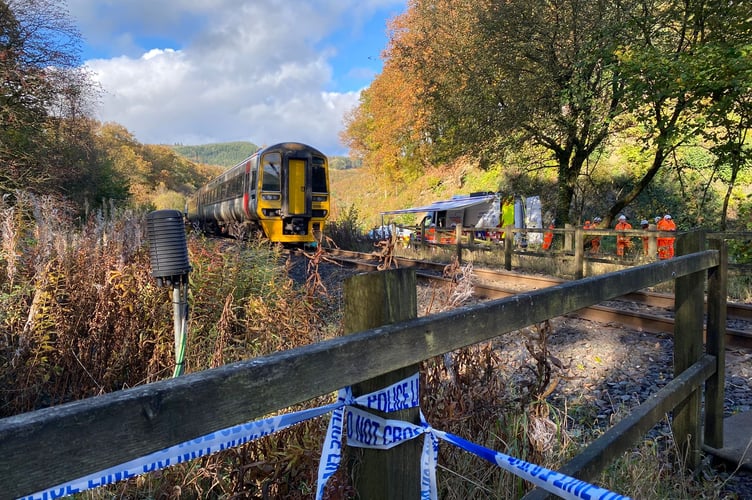
A passenger travelling on train 1J25 suffered fatal injuries as a consequence of the collision. Three people on this train were also seriously injured, including the train’s guard, and 18 other people received minor injuries. The driver of train 1S71 suffered serious injuries, and the remaining five people on this train all suffered minor injuries.
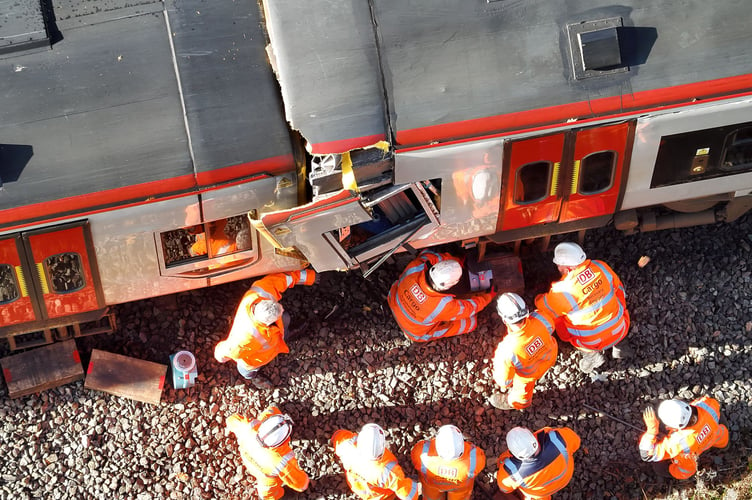
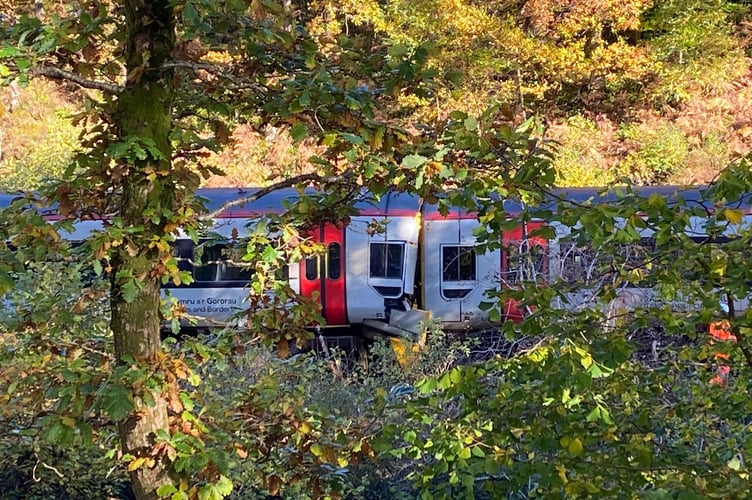
Neither train derailed, but extensive damage was caused to both trains. Damage was also caused to railway infrastructure in Talerddig loop. The railway remained closed until 28 October 2024.
RAIB’s investigation found that the accident was caused by train 1J25 passing its authorised stopping position and entering the single line beyond, which was occupied by the approaching train 1S71.
Train 1J25 passed its authorised stopping position due to a combination of three factors. These were that the wheel-rail adhesion in the area approaching the Talerddig loop was low, although not exceptionally so for this area during October. In addition, the two sanding systems fitted to train 1J25 which could have mitigated the prevailing low adhesion conditions, and avoided the accident, did not dispense sand. The automatic sander did not function, probably due to the presence of electrical faults in its control circuit, while the manually operated emergency sander was not activated by the driver. The third factor was that the approach speed of train 1J25 towards the eastern entry to Talerddig loop was such that the deceleration required to slow the train for the loop could not be sustained with the available wheel-rail adhesion.
Having passed its intended stopping position within Talerddig loop, train 1J25 entered the single line beyond. This area had exceptionally low wheel-rail adhesion and was on a steep downhill gradient. This meant that, even though the brakes on train 1J25 remained applied, the train did not decelerate as it approached train 1S71. There were no engineered mitigations to prevent train 1J25 entering the occupied single line in the event of an overrun.
Behind this lay a number of underlying factors and factors affecting the consequences of the accident. These involve a range of issues and organisations.
As a result of the investigation, RAIB has made nine recommendations:
- Two recommendations are made to the Rail Safety and Standards Board and Angel Trains to improve the design, maintenance and testing of trainborne sanding equipment.
- A recommendation is made to Network Rail to review the assumptions made to justify the use of simple assessments of overrun risk on the Cambrian lines, considering the circumstances of this accident, and updated industry standards.
- A recommendation is made to Network Rail to improve overrun protection in future versions of software-based train control systems and for it to review how overrun risks are assessed, considering the circumstances of this accident.
- A further recommendation is made to Network Rail to improve wheel-rail adhesion conditions through the application of an improved understanding of the effectiveness of railhead treatment regimes. This builds on a previous RAIB recommendation following the 2021 accident at Salisbury.
- Two recommendations are made to TfWRL to ask it to review how drivers are trained, based on issues identified in this investigation.
- A recommendation is made to the Rail Safety and Standards Board to review standards and rules governing the design of passenger train interior fittings to reduce the risk to passengers in the event of an accident.
- A recommendation made to TfWRL intends that all on-train staff, irrespective of role have the skills and knowledge required to assist in the event of an emergency.
RAIB also identified a learning point relating to reaching a clear understanding when safety‑critical communications take place between signallers and train drivers.
Andrew Hall, Chief Inspector of Rail Accidents, RAIB said: “The accident at Talerddig was a tragedy. One person lost their life and others were seriously injured in the first fatal train-to-train collision in more than 25 years.
“Widely varying levels of grip between steel wheels and steel rails is an inherent issue for railways and a lot of effort goes into managing this and its possible consequences. That can involve the way track and the surrounding area is maintained, the way trains and signalling systems are designed, and the way trains are operated and maintained. The Talerddig investigation found factors associated with several of these areas, and related to the way different parts of the overall railway system interacted.
“RAIB has made nine recommendations to reduce both the likelihood and mitigate the consequences of a similar event. I sincerely hope the lessons of this accident deliver lasting safety improvements on the Cambrian line, across the ongoing rollout of ERTMS, and on the wider railway network."
In a joint statement, Transport for Wales & Network Rail said: “Safety remains our highest priority for both our customers and colleagues.
“Our thoughts continue to be with the family and loved ones of David Tudor Evans and those passengers injured in the incident, and we continue to support our colleagues who were injured or affected.
“Network Rail and Transport for Wales welcome the publication of the Rail Accident Investigation Branch’s final report into this incident and have cooperated fully with the investigation throughout.
“While incidents of this nature are extremely rare on our rail network, we remain committed to working together as an industry to carefully consider the report’s recommendations to help prevent a similar incident in the future.”
Comments
This article has no comments yet. Be the first to leave a comment.