

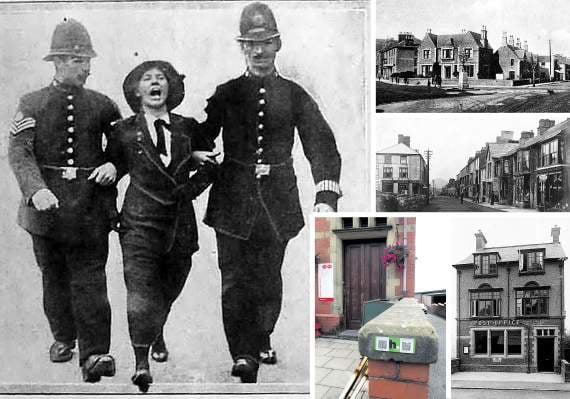
AN incident at Llanystumdwy, near Criccieth, at the opening of the Village Institute in September 1912, is well known.
During a speech by Chancellor of the Exchequer David Lloyd Gorge, suffragettes constantly interrupted and heckled him. The crowd reacted violently and the women’s clothes and hair were torn. It was also reported that one of the campaigners was nearly thrown into the River Dwyfor!
Not so well remembered is a subsequent incident almost two years later when the women returned, perhaps to exact revenge. The event now features in an electronic heritage trail around the community.
The post office on the south side of the High Street in Criccieth was built to replace the first post office, which operated from a shop called Victoria House (15 High Street) for nearly 50 years.


In 1910 it was decided that a purpose built building was needed and the present Post Office was built on a site across the road by John Roberts, a contractor from Pwllheli.
Four years after opening, the new post office made headline news all around the nation.
On 2 June, 1914 a major convention of Liberals from Bristol was held at Criccieth. A stage was erected by the town hall at the foot of the castle and the main speaker was the Chancellor of the Exchequer, David Lloyd George, who was also the local MP.
Trainloads of people arrived and it was estimated that a crowd of 2-3,000 had gathered.
According to the Cambrian News, as soon as Lloyd George rose to make his speech the heckling started. Two suffragettes were quickly manhandled away by the police and these two and another who had been shouting and handing out leaflets on the path from the castle to the station, were bundled on to the train to Barmouth.
This was a distraction however. While the police were occupied, two more ladies had been laying low waiting for the uproar to start at the Old Town. Armed with a hammer and a large “bed key” they attacked the post office, smashing all three windows. They quickly moved across the road and broke the window of West End Stores then ran quickly down the High Street giving the same treatment to Sheffield House, Stanley Stores (now Igam-Ogam hairdressers), Beehive (now Cafe 46), Llys Caradog and New Shop. So sudden and unexpected was the attack that residents and shopkeepers were completely taken by surprise and it took a while for anyone to react. Shopkeepers and passersby restrained the women and took them struggling and shouting to the police station where the constable’s wife, Mrs Thomas, was allegedly assaulted.
PC Thomas arrived and charged them with breaking the windows and the two suffragettes were taken to Porthmadog police cells to await a special magistrate’s court the next day.
The court was in the same building as the police station and next morning total chaos ensued with both defendants struggling, screaming and shouting at everyone and refusing to recognise the court.
While one was before the bench, the other, using her bed and mattress, barricaded herself in the cell.
A carpenter was sent for who had to saw a hole in the door. Police constables had to climb through the hole in to the cell and force the “shrieking” suffragette out.
Finally, after much disturbance and uproar, the two accused were committed to trial at the Quarter Sessions at Caernarfon.
During the whole time both had been giving false names and addresses but at the trial at the assizes a month later they were arraigned as Olive Wherry and Georgina Lloyd. Both refused to plead but were found guilty and given three months’ imprisonment.
A small plaque has been affixed to the post office which has a QR code which, when scanned with a smart phone, (the QR code app has to be downloaded) takes the operator to a website where the story can be found.
The project is run by HistoryPoints.org which delivers Welsh history to your mobile, on the spot.
QR codes can be found on windows, fences, doors, walls, gateposts and notice boards at more than 1,000 places across Wales.
Local amateur historian Robert Dafydd Cadwalader has been providing information and material for the project and, so far, has placed nine of the plaques at prominent positions around the town.
“There has been a community in this corner of the bay for a thousand years and we have a long interesting history,” he said.
“There are many stories, some remembered some forgotten. I hope that residents and visitors will look out for these plaques and stickers.”
The information can also be viewed by visiting the website at http://historypoints.org and entering Criccieth in the search field.
It is hoped to expand this electronic trail and to combine it with the well established heritage trail which can be found in a booklet published by the Eifionydd Historical Society. There is a map in this publication which identifies many historical places around the town.
The plaques or stickers posted so far are at Memorial Hall – names and details of the men and women lost during both wars, commemorated on the boards in the lobby; Stone of Strength – history of the stone in the grounds of the Hall; Prince of Wales and Union Row – History of the Pub and street; shipwreck Owen Morris at Black Rock (plaque is at gateway to Coastal Path, end of promenade); shipwreck Spanker 1885 (plaque is at Harlech. Criccieth lifeboat rescued crew); Caffi Morannedd Cafe – Grade II listed building by Clough Williams-Ellis; lifeboat station – history since 1853 (plaque is in shop window); plaque for drowned boys – in front of Marine Crescent; route of the Old Post Road – plaque is at gateway to the Dryll path.
Comments
This article has no comments yet. Be the first to leave a comment.