
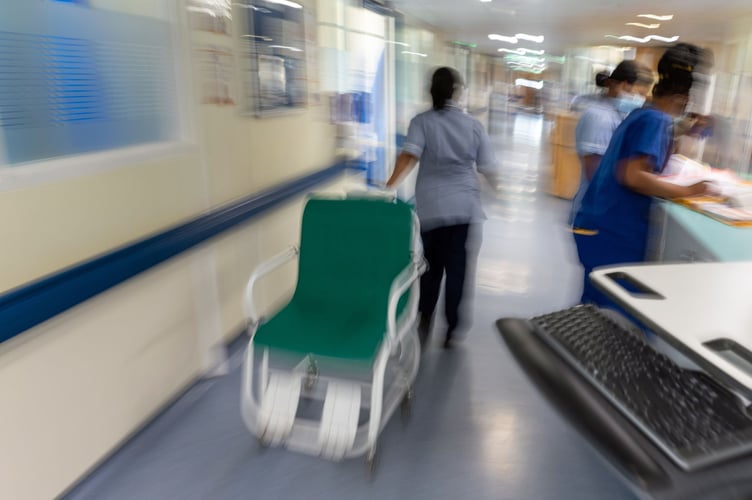
Health and education services across Wales are underperforming and worse than those across the border, a damning report from the influential Institute for Fiscal Studies has warned.
Five years on from the height of the COVID-19 pandemic, waiting lists for pre-planned NHS treatment are finally falling in Wales.
But they remain far higher than pre-pandemic, and have taken longer to start falling than in England. Meanwhile, A&E waiting times are, if anything, still rising.
School absences remain 50 per cent higher than in 2019, Welsh school pupils have seen their performance fall in internationally comparable tests, and the share of young people staying in education post-16 is lower now than 10 years ago.
Overall, performance in both the health and education systems is substantially poorer than before the COVID-19 pandemic – and poorer than in England.
This poor performance is despite significant increases in spending: health spending has increased by 17 per cent per person in real terms since 2019–20, while spending per school pupil has increased by 14 per cent.

These increases are similar to or higher than those seen in England over the same period.
And combined spending per person on health and schools, together, is higher than all English regions bar Greater London.
The report says: “A lack of funding therefore does not appear to be the key driver of current under-performance relative to England.



.jpeg?width=209&height=140&crop=209:145,smart&quality=75)
“Looking ahead, the next Welsh Government will struggle to maintain, let alone improve, services due to a slowdown in funding growth and the impact of recent budgeting decisions – including unrealistic health spending plans for 2026–27.
“Indeed, if it were not for top-ups to funding from the UK government in the 2026 Spring Statement, the next Welsh Government would highly likely have had to make in-year cuts to some services in an emergency post-election budget, in order to boost health and social care spending.”
These are among the key findings of the second Welsh election briefing from the Institute for Fiscal Studies, funded by the Nuffield Foundation.
The briefing note looks at how spending on public services in Wales has evolved over time and compares with England. It looks at key performance metrics for health and education and at the outlook for public service spending – which will affect public service performance in the years to come.
Max Warner, a senior research economist at the IFS and a co-author of the report said: “The last year has seen some welcome improvement in waiting times for planned hospital treatments, with the median waiting time falling from 23.5 weeks at the start of 2025 to 19 weeks by December. But this is still almost twice as long as pre-pandemic and 40% longer than comparable waiting times in England.
“A big surge in outpatients appointments – up 25% since 2019 – doesn’t seem to have delivered the improvements in waiting times one would hope. Working out why, and more generally boosting hospital productivity, will be key to delivering a more significant recovery in NHS performance.”
Darcey Snape, a research economist at the IFS and another co-author of the report said: “On a range of metrics – school absence, results in international PISA tests and post-16 participation rates – the Welsh education system is under-performing.
“The fall in the share of young Welsh people remaining in full-time education post-16 is stark. If this reflects young people moving into training and employment with high long-term returns, this trend may not necessarily be a bad thing. However, at face value this trend is a cause for concern and needs to be better understood.”
David Phillips, head of devolved and local government finance at the IFS and another co-author of the report said: “The causes of the poor performance of Welsh public services are not fully clear. Funding levels seem unlikely to be a major factor given spending in Wales is higher than comparable areas of England and has, if anything, grown slightly faster since before the pandemic. High levels of deprivation can likely only explain part of it too – educational performance, for instance, is lower across the income distribution.
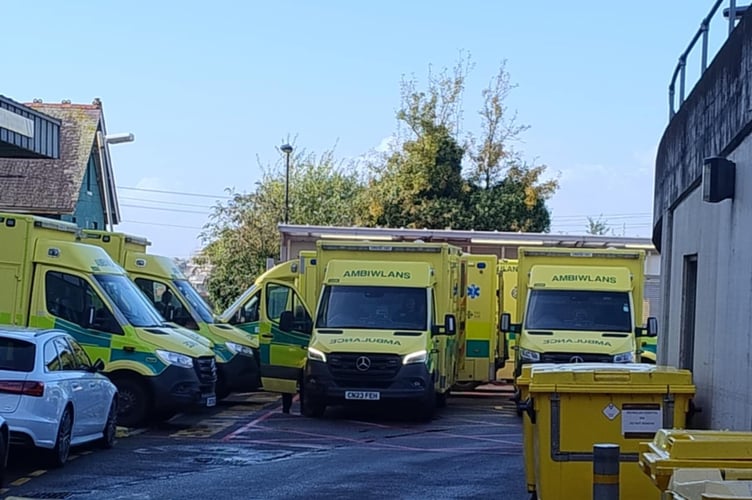
“Instead, policies and the way services are delivered are likely to play a role. Average hospital stays are 40% longer in Wales than England, reducing the number of patients that can be admitted and treated. For schools, accountability for poor performance may be weaker – with less data available to both teachers and parents.
“But more work is needed diagnose the various reasons for and potential solutions to Wales’s poor public service performance. Doing this could be one of the defining successes – or failures – of the next Welsh Government.”
Health and NHS performance
- The median waiting time for elective treatment in Wales was 19.0 weeks in December 2025, almost double its pre-pandemic level of 10.7 weeks. This is also much higher than the current level in England, of 13.4 weeks in December 2025. Waiting times in major A&E departments have long been worse in Wales than in England or Scotland. And A&E waiting times in Wales have, if anything, worsened over the last two years, with only 53% of patients waiting less than four hours in December 2025 (compared to a target of 95%).
- The Welsh NHS had 24% more full-time equivalent staff in April to September 2025 compared with the same period in 2019. It delivered 24% more outpatient appointments over the same period, but these are not obviously improving elective waiting times relative to England and Scotland. The Welsh NHS has only just returned inpatient admissions to pre-pandemic levels, which given large staffing increases suggests there has been a fall in hospital labour productivity since the start of the pandemic, similar to that observed in England and Scotland.
- Life expectancy in Wales has long been higher than in Scotland but lower than in England. Differences in life expectancy between Wales and England are largely explained by differences in average incomes – in areas with similar average incomes, life expectancies are similar in Wales and England. As in the rest of Great Britain, increases in life expectancy have stalled since 2010, and healthy life expectancy has slightly fallen.
Education performance
- Overall and persistent absences from school remain far higher than pre-pandemic. In the 2024–25 academic year, around 9% of pupils in Wales were absent on any given day, up from less than 6% in 2019 – a larger rise than in England. The share of pupils persistently absent (that is, absent more than 10% of the time) more than doubled from 15% of pupils to 34% between 2019 and 2025.
- Performance in the internationally comparable PISA tests for 15 year olds fell by more in Wales than England post-pandemic, further widening performance gaps. On average, pupils in the middle of the income distribution in Wales do no better than the poorest fifth of pupils in England.
- The share of Welsh school pupils staying on post-16 and progressing to higher education has fallen. The share of 16- and 17-year-olds in full-time education in Wales has fallen from 78% in 2014 to 64% in 2024. And the share of 18-year-olds progressing to higher education fell to 29% in 2025, compared to 37% in England.
Further detail on public service spending
- Health spending per person was 9% higher and education spending 7% higher per person in Wales than England in 2024–25. Overall spending was 15% higher, with the biggest differences being for smaller service areas such as recreation, culture and leisure (+67%), housing and community amenities (+63%) and adult social care services (+36%).
- Looking ahead, the Welsh Government has only set spending plans for the coming year, 2026–27, rather than three years as in England and Scotland. After big in-year top ups in the current financial year, health and social care resource spending is set to fall by over 2% in real terms in 2026–27. The next Welsh Government will almost certainly feel the need to top up the health and social care budget. Following an increase to its overall funding by the UK government in the 2026 Spring Statement, it may be able to do this without making in-year cuts to other services in 2026–27. Without this increase, it would highly likely have had to do so.
- If the next Welsh Government wanted to match increases in planned health spending in England in the following two years (2027–28 and 2028–29) and protect funding for councils in real terms, other services would face cuts averaging 5% a year given current funding forecasts.
- Changes in UK government funding or devolved tax rates could materially affect the funding outlook. An additional £500 million increase in funding in 2028–29 – equivalent to 1.25 percentage points on all rates of devolved income tax – would instead enable increases in funding for councils and other services of 1% a year on average. In contrast, a £500 million reduction in funding – equivalent to 1.25 percentage points off all rates of devolved income tax – would see 11% a year cuts to other services, if funding for health were increased and council funding protected.
Reacting to the report, Plaid Cymru MS Mabon ap Gwynfor, said: “This report confirms what people across Wales already know – the state of our NHS and our schools is simply not good enough. After 27 years in power, this decline is the direct result of Labour’s mismanagement, and people have every right to be angry about it.
"Long waits in A&E, patients treated in corridors, cancer patients not receiving treatment on time and waiting lists that remain stubbornly high – these failing standards have been allowed to become normal on Labour’s watch.
"In our schools, Labour has failed to get the basics right. Literacy and numeracy standards have fallen, and too many young people are being let down and denied the opportunities they deserve.”
Conservative MS Samuel Kurtz said: “This independent report lays bare the staggering decline we are seeing in Welsh public services after more than a quarter of a century of Labour running Wales, propped up by Plaid Cymru.
“Families already know things are getting worse, despite the hard work of NHS staff and teachers. Whether it’s struggling to get timely hospital treatment or seeing the impact of falling school standards, this report confirms those concerns in black and white.
“It is particularly alarming to see school absences still dramatically higher than before the pandemic and the number of young people in full-time education falling so sharply. That should concern anyone who cares about Wales’ future.”
A Welsh Liberal Democrat spokesperson said: “Too often, Wales has a political culture that is far too cosy, with senior people moving between political parties, public affairs and public services without enough challenge or accountability.
“Wales doesn’t just need a change of colours in Cardiff Bay, we need a real change in the way our country is governed, with a government focused on delivery, accountability and better outcomes for patients and pupils.”
Laura Doel, national secretary for teaching union NAHT Cymru, said: “School leaders in Wales are working hard to deliver for their pupils amid all manner of challenges – from funding shortfalls and supporting children with additional learning needs (ALN), to issues outside school which can affect attendance and attainment.
“While the PISA analysis can be useful, we should not over-interpret these results and rely on simplistic comparisons which may not capture the richness of children’s learning or the different stages of education policy development in different countries.
“School leaders will be particularly interested to understand where the increased spending on education identified by the IFS has gone – because it has not reached the frontline.”
A spokesperson for the Welsh government said: "We continue to work closely with health boards and local authorities to improve frontline public services at a time when costs are rising.
"The NHS waiting list has fallen and the longest waits are coming down. We have set clear expectations for all health boards to reduce emergency department long stays and complete ambulance handovers within 45 minutes.
"Our education system is moving in the right direction thanks to the additional support we are providing to schools and the hard work of school staff.
"Our latest GCSE and A-level results show improvements in attainment since 2024. For younger learners we are seeing progress within reading and numeracy in personalised assessments."
Comments
We've recently changed our login process. If you have an account for commenting, you will need to re-register on the login window.
This article has no comments yet. Be the first to leave a comment.