
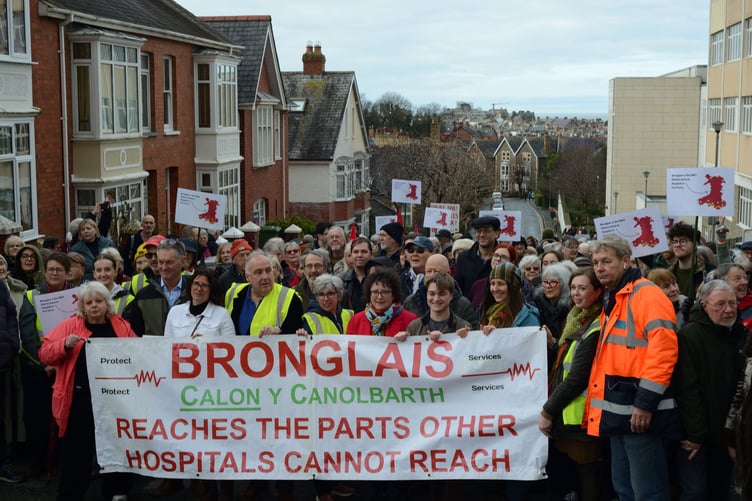
Health chiefs have approved a move to push ahead with plans to centralise stroke services in Carmarthen despite overwhelming opposition from Ceredigion, Pembrokeshire, Powys and Gwynedd.
Hywel Dda University Health board approved a plan at its meeting on 26 November to kick off detailed planning for a scheme that will see Glangwili Hospital in Carmarthen become the centre for round-the-clock specialist acute stroke care, with services in Bronglais Hospital in Aberystwyth and Withybush Hospital in Haverfordwest downgraded.
When the plan is implemented, Bronglais, Withybush and Prince Philip hospital in Llanelli would become ‘treat and transfer’ units.
Bronglais will retain a stroke rehabilitation unit under the plan.
The plan will cost millions of pounds in capital and extra staffing costs at a time that the health board are staring down a huge deficit, but the meeting heard that the plan would “provide the highest level of care for stroke services in Hywel Dda.”
The health board approved plans to launch a second phase of public consultation on the future of stroke services at Bronglais Hospital at its meeting on 28 May.
It formed part of the wider Clinical Services Plan that the Health Board engaged upon in summer 2025.
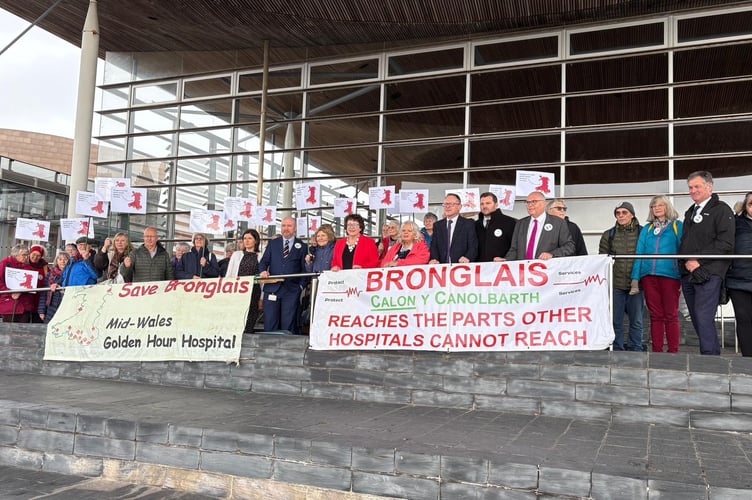
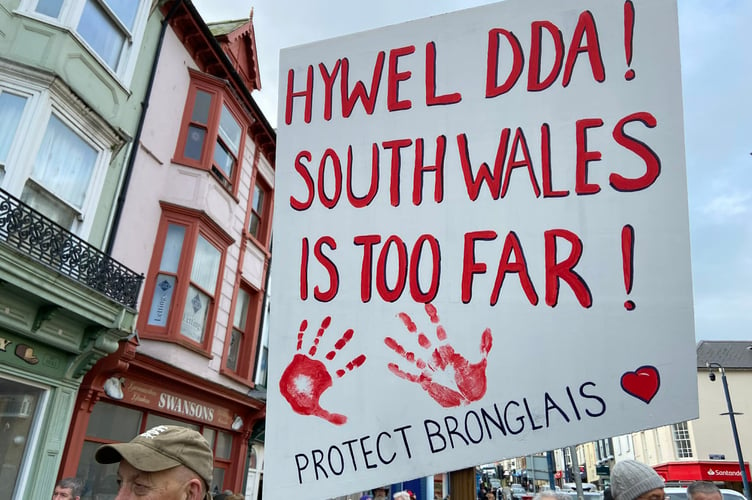
A public consultation on the Clinical Services Plan last year drew more than 4,000 responses and led to a large protest meeting in Aberystwyth’s Great Hall, and more than 17,000 signing one of the biggest petitions in the Senedd’s 26-year history.
Health board members in February were told the current service being offered was not achieving the standards required, but the board was told the service is safe currently.


No definite decision was made at that meeting on the future of stroke services, but a new plan then emerged.
The original plan was to centralise services in Llanelli.
The new plan - an amalgamation of new options presented to the health board in February – then went out to a second consultation as a preferred option.
Protect Bronglais Services – a group set up in the wake of threats to take away services from the Aberystwyth hospital - said the plan which came out of the initial meeting “still results in the long distance ‘treat and transfer’ of stroke patients and there is still no sign of any detail around the ‘transfer’ element of the plan.”
“In effect, this is really no different to what was being proposed before except that Glangwili is some 16 miles nearer to Bronglais than Llanelli,” the group said.
Hywel Dda Executive Medical Director Mark Henwood told the November meeting that “stroke services are fragile and currently do not meet clinical standards.”
“The service is currently spread across four hospital sites, and the Health Board does not have specialist cover seven days a week,” Mr Henwood said.
“This can lead to patient outcomes that are not as good as they could be.
“Change is needed to ensure services are safe, sustainable, accessible and kind for patients and staff.”
The consultation ran for eight weeks from 28 May until 26 July.
It included public drop-in events, online public events, targeted group sessions, and community outreach.
The second consultation cost £71,809 to undertake, documents showed.
The meeting heard that there was “broad support” for a change to stroke services in general, but that people “differed on what that may look like”.
A report for members found that nearly eight in ten Ceredigion respondents to the consultation on the future of stroke services opposed Hywel Dda University Health Board’s preferred proposals.
Of 242 respondents identified as being from Ceredigion, 192, or 79 percent, disagreed that the preferred option would improve clinical standards, patient safety and staff shortages.
Of those, 168 strongly disagreed.
A similar picture was seen in Pembrokeshire where 159 people disagreed with the preferred option, with 136 of those strongly disagreeing.
Across the health board area and beyond, 517 of the 745 people who answered the question disagreed, representing 69 percent, while 176, or 24 percent, agreed.
Among Ceredigion respondents who considered previously proposed alternatives, 167 chose “none of these”, while 46 preferred Option 210, which envisaged 12-hour specialist cover at Bronglais for ongoing inpatient care.
The report records repeated concerns from rural communities about long journeys, poor or unreliable public transport and the availability of ambulances for hospital transfers.
At public events in Aberystwyth and Lampeter, participants also raised the impact on relatives visiting patients in Carmarthen, particularly during winter and for families without cars.
One participant at the Aberystwyth event said: “You cannot consider an option without looking at transport.”
The report also documents concern over whether Glangwili could accommodate additional patients, and whether adequate staffing and beds would be available.
In written representations, Ceredigion Disability Forum argued that the preferred approach would disproportionately disadvantage older and disabled residents and people living in rural communities.
Protect Bronglais Services called instead for a rural stroke model centred on the Aberystwyth hospital.
Aberystwyth Town Council told the health board it “remains unable to support any proposal which results in a reduction or downgrading of services at Bronglais General Hospital.”
The Community Rehabilitation Occupational Therapy team in Ceredigion told the health board that “given the rurality of the region and the known limitations in transport infrastructure, centralising services at Glangwili General Hospital raises significant concerns.”
“Increased travel distances and journey times may heighten the risk of patients missing critical time windows for urgent imaging (such as CT scanning) and interventions such as thrombolysis, which are highly time-dependent,” they said.
Pembrokeshire’s Hospital Social Care Team told the health board that “all hospitals need a specialist stroke unit.”
The meeting heard that travelling for healthcare is “now the norm” and that specialist stroke care cannot be provided across all four sites.
Health board papers said that “a significant group of respondents argued for retaining or strengthening stroke services at Withybush Hospital.”
“Respondents cited Pembrokeshire’s geography, older population, travel distances and previous positive experiences of care,” a report said.
“Many respondents called for local stroke services to be retained, particularly at Bronglais and Withybush hospitals.
“Some describe Bronglais Hospital as strategically important for mid Wales and suggest it should be developed as a rural stroke hub, supported by telemedicine and specialist networks, rather than downgraded.”
A health board report said that the consultation “showed many people recognised the need to improve specialist stroke care.”
“This was alongside consistent concern about how a more centralised model would work in practice, especially when considering Hywel Dda’s geography,” the report said.
“There was also a clear geographical pattern in the feedback.
“Respondents and participants closer to Glangwili Hospital, particularly in parts of Carmarthenshire, were more likely to support or accept the preferred option.
“Concerns were stronger in Ceredigion, Pembrokeshire, Powys and Gwynedd, where people were more likely to focus on the loss or reduction of local acute stroke provision, longer journeys, rural access, the role of Bronglais and Withybush hospitals, and the practical impact on families and carers.”
Feedback from Ceredigion, Pembrokeshire, Powys and south Gwynedd “repeatedly asked for clarity on what would remain at Bronglais, Withybush and Prince Philip hospitals,” the report said.
“Respondents wanted clear public information on local assessment, stabilisation, thrombolysis, transfer, rehabilitation, outpatient follow-up, Transient Ischemic Attack (TIA) pathways, end-of-life care and links with community services.”
Papers for the meeting said: “In March 2023, the Board of Hywel Dda University Health Board approved a programme approach to develop a clinical services plan in response to service fragilities.
“This was based on the principles of care that is safe, sustainable, accessible and kind.
“Stroke was one of the nine clinical services considered through the first phase of consultation.
“Following that consultation, the Board considered the consultation report alongside a range of other information.
“This included workforce and service resilience, quality and performance metrics, estate condition, operational pressures, regional working, new national clinical standards and how services link to each other.
“At its extraordinary meeting, held over two days in February 2026, the Board reached final decisions for the other eight services included in the Clinical Services Plan.
“For stroke, the Board selected an alternative idea, to combine alternative options 106 and 210, that came from communities, as a model to be taken forward for further consideration.
“This was a new idea that was not included in the original consultation process.
“The Board agreed that further assessment and engagement was required before a final decision could be made.
“This was due to the scale of the proposed change and the need to better understand the possible impact on patients, families, staff, communities and stakeholders.”
The papers said that “currently, stroke services across the Health Board do not meet clinical standards, and we do not have seven-day specialist cover.”
“This can lead to patient outcomes that are not as good as they could be,” health board papers said.
“Although staff work incredibly hard to provide the best care they can, changing the way stroke services are delivered gives us an opportunity to strengthen specialist care, improve outcomes and provide more consistent support for patients, families and staff.
“Learning from around the world and the United Kingdom has shown that centralisation to a specialist stroke service delivers improved outcomes.”
Health board papers show the plan to reorganise stroke services could require the equivalent of more than 100 extra full-time posts and add £6.4m a year to staffing costs.
Most of the extra staffing costs would go towards community services and specialist rehabilitation.
A submission from Ceredigion Penfro MSs and MP Ben Lake to the consultation suggested that the cost of a new stroke unit at Glangwili would be around £20m, but health board papers do not set out the capital costs of the move at a time when the health board is facing huge financial deficits amid rising cost pressures and under-performance.
For Bronglais to become a Rural Stroke Rehabilitation Unit that would also require “significant investment”, their submission said.
“Capital and estates requirements remain a challenge in bringing the service together,” the health board report said.
“The implementation plan will need to protect quality of care and avoid adding to wider system pressures, while enabling change to begin in a phased way.”
Dr Neil Wooding, Hywel Dda University Health Board chair, told the meeting that the decision was on the future of stroke services was being made ‘in principle’ ahead of assurances that issues raised including transport, accessibility, staffing and costs can be worked around.
He told members that the plan cannot be ultimately signed off without those assurances.
“Many of the communities are anxious, concerned and cynical about our ability to deliver these changes,” Dr Wooding told the meeting.
“Does that negate the broad principle we are trying to achieve her though, which is that we need to provide the highest quality stroke care services we can.”
He told members that the health board should be less concerned about whether “Mrs Jones can visit Mr Jones in hospital” but rather that “Mr Jones comes home from hospital and receives the best care possible.”
“We need to work with communities to show we can deliver this change,” he said.
“We have to strive towards delivering the highest level of healthcare in regards to stroke services.
“We could talk ourselves out of this as the challenges are so great.
“But we have a responsibility to move forward and strive for the best outcome.
“We cannot wilfully agree to anything that is less than the best standards for our patients.”
The meeting heard that the move will “not happen in the short term” with “challenges to overcome” before the change can be implemented.
The meeting heard that a detailed implementation plan will be brought back before the health board next year.
Comments
We've recently changed our login process. If you have an account for commenting, you will need to re-register on the login window.
This article has no comments yet. Be the first to leave a comment.