
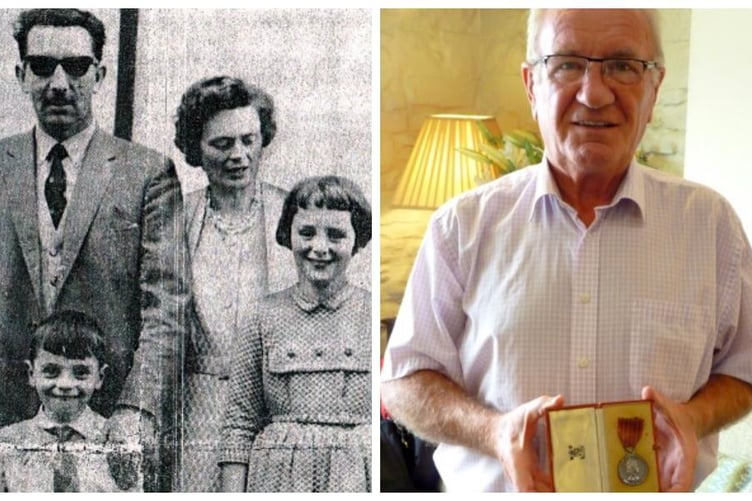
During the early hours of Wednesday 2nd August 1961, Constable Arthur Rowlands of the Gwynedd Constabulary was patrolling Dyfi Bridge, near Machynlleth which formed the boundary with the Mid Wales Constabulary.
There had been several burglaries in the area and Arthur together with PC Dai Williams of the Mid-Wales Constabulary were tasked with checking persons and vehicles with a view to catching the person responsible.
At the end of his shift, Dai had started the short journey to Machynlleth - the town was quiet, in the distance Arthur saw the outline of a man.
He was wheeling a bicycle walking across the front a row of white walled cottages.
A few moments later, Arthur was taken completely by surprise when a man suddenly stepped out of the shadows. He shone his torch at the man and the two stood looking at each and the officer asked his name.
The man replied ‘I’m Robert Boynton. I’m going to kill you’. Boynton then fired the gun into the officer’s face at point-blank range blinding him in both eyes and causing horrific injuries to his face, neck and mouth.
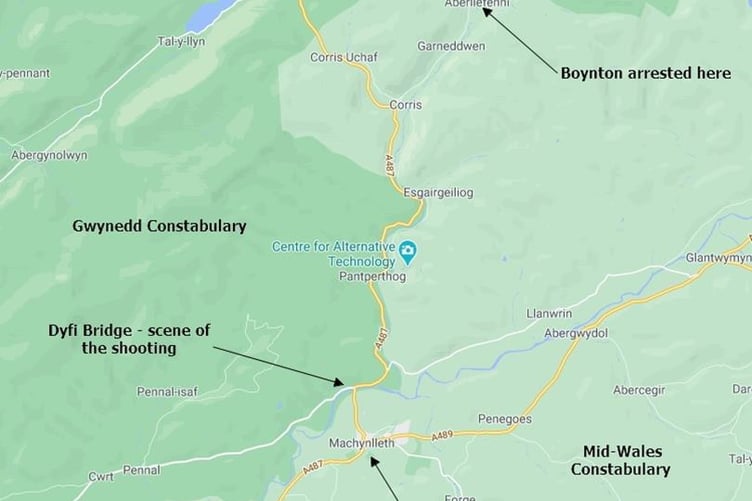
On hearing a shotgun being discharged, Dai returned to Dyfi Bridge and together with the occupier of one of the cottages, administered first aid to his critically injured colleague, this prompt action probably saved Arthur’s life.
Over the past 60 years, numerous articles have been written about the shooting that shocked the nation.
In August 1961, NARPO member, Mr Tom (TO) Davies had just started out on his Police career and volunteered to assist in the largest manhunt mounted in Wales.
.png?width=209&height=140&crop=209:145,smart&quality=75)
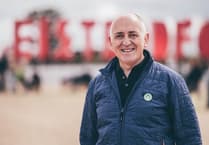
Hugh Colley met Tom (pre-Covid) to obtain a first-hand account about the manhunt for Boynton and his arrest and compiled the following:
Sunday, 6 August 1961
August Bank Holiday weekend - the manhunt for Robert Boynton continued with all 12 Welsh and neighbouring forces including Liverpool City and Shropshire supplying men and dogs to join the search.
On the Sunday morning Tom (TO) Davies was on beat duty 80 miles away at Brynmawr working a 6:00am – 2:00pm shift when he was told that volunteers were required to man roadblocks around Machynlleth that same night.
Tom said: “As a 22-year-old probationer (PC 69), with just six months in the job, I was keen to get involved in the search and willingly volunteered my services. It was known that Boynton had a real hatred of uniforms and I was told to change into old clothes and report to Machynlleth Police Station by 7:00pm. I drove the station car picking up PC’s Henry Jones at Gilwern and then drove to Brecon to pick up John Davies and Arthur Perkins.
“When I got to Brecon Police Station, I was met by Superintendent Mervyn Morgan whose first words to me were ‘Bloody hell Tom, I know I said wear old clothes, but you look a right scruff’! Henry was stood next to me looking immaculate wearing a suit and carrying a briefcase.
“As we travelled north, the four of us talked about the horrific shooting and what the night held in store. On arrival at Machynlleth Police Station, which was being used as an Incident Room, we were briefed by Superintendent John Du Rose of the Metropolitan Police who was leading the search for Boynton. In those days, all major criminal investigations were headed by a senior officer from Scotland Yard - his Bagman (assistant) was Sgt Hancock.
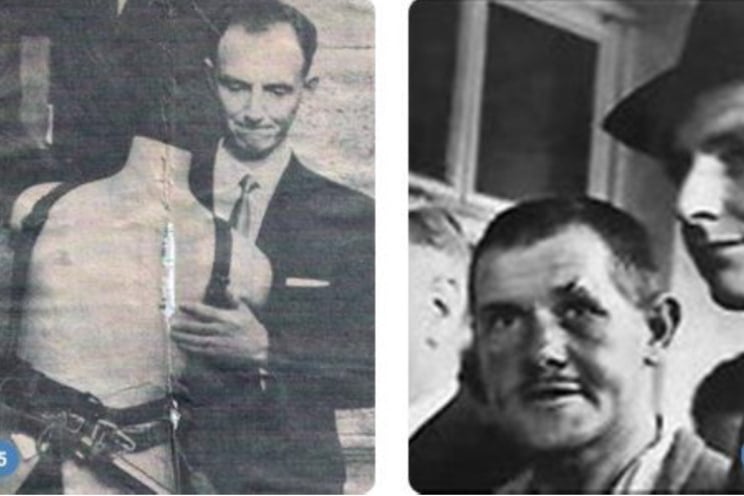
“We were told that Robert Boynton had been identified through fingerprints found at the scene of the shooting and he was probably ‘lying low’ in the densely wooded area around Machynlleth.
“After a cup of coffee, we were given a pack of sandwiches and split up into pairs – I was teamed up with John Davies. John and I were then dropped off at our allocated roadblock about a mile from Aberllefenni, a remote village midway between Machynlleth and Dolgellau where we were told to remain until the next morning.
“In those days there was no such thing as personal radios, Tasers, mobile phones etc.- so there we were stood in the middle of nowhere, unarmed, wearing plain clothes, hunting a highly dangerous, armed criminal with no means of communication.
“However, every half hour or so a Police car would drop by with a Sergeant checking to make sure we were okay! With no means of calling for assistance, God only knows the outcome had Boynton decided to put in an appearance.”
Monday, 7 August 1961 – Boynton breaks cover
Tom says: “It was a long, cold night and by the early hours we were both looking forward to being stood down and returning home. However, all this changed at around 6:00am when a young lady phoned in, stating she could see a male person fitting the appearance of Boynton acting suspiciously near the cottage in Aberllefenni where she lived with her parents.
“We were picked up and driven at speed to the cottage where the man had been sighted and as there was heavy dew, we could clearly see fresh footprints in the grass. By now, about ten of us were assembled at the cottage and we were split into groups to follow the trail of footprints – I decided to team up with PC Robert Roberts of Shropshire Constabulary (Dog handler) and his dog.”
Boynton arrested
“After following the trail for about a mile, we could see a man crouched in bushes by a stream and we all made our way towards him. On seeing us, the man (Boynton) dashed forward and fired a sawn off .410 shotgun at PC Roberts who was about five yards away.
“Boynton stepped out of the bushes into the clearing and rested the gun on his left forearm and pointed it at us in turn. He stayed like that for a minute then turned around and ran downstream. I followed him with PC Ivor Bennett along the path and saw PC Carswell (Liverpool City Police) with his dog (Derry) - I could also see Boynton riding a bike ahead of us.
“On seeing us in pursuit, he dismounted the bike and PC Carswell released Police dog ‘Derry’ which bounded towards Boynton. When the dog was a few yards away he shot it in the head from about three yards. He then pointed the gun at PC Carswell and discharged the second barrel narrowly missing him. (Derry recovered from his injuries and continued in service with Liverpool City Police until his retirement).
“After the shots had been fired, Boynton re-mounted the bike and rode off towards the village. I ran back to where the police car was parked and drove after the bicycle which I could see some distance ahead.
“After a short time, I reached a stone river bridge at the same time as Boynton and realised that this was my best chance of stopping him getting away. I struck the rear wheel of his bike with the front nearside of the car causing him to fall off. I got out of the car and ran around the back where I saw Boynton wedged between the car and the bridge.
“He was frantically trying to free himself and at the same time going for his gun.
“I threw myself at him and caught hold of him by the legs and struggled with him for some time before assistance arrived. Having until recently worked underground at the colliery and played rugby for Swansea / Breconshire, I was a fit 22 year old!
“A few minutes later I was joined by Sergeant Geoff (Duff) Edwards and Seigfried Stieler, a German forestry worker, and after a violent struggle we managed to restrain Boynton who repeatedly shouted ‘I will kill all you bastards.
“He tried to get at the gun which was strapped in a harness attached to a leather belt which allowed him to reload and shoot while on the run. (One of the barrels was found to be cocked and the other chamber was loaded with a live cartridge).
“After the three of us had subdued Boynton and taken the gun from him he was put in the Police car still struggling and repeatedly trying to kick the window out.
“Ivor Bennett and Mr. Stieler sat either side of him and I drove to Machynlleth Police Station. On the way I told him we were Police officers and that he was wanted for the shooting of PC Rowlands, I asked him why he shot the officer. He replied that he did not intend to hurt him and kept muttering about Jews and Gestapo – a lot of which I couldn’t understand’.
Stood down and back to Brynmawr
“At about 9:00am we arrived at Machynlleth Police Station where we were met by Superintendent Du Rose and Boynton was handed over. We were congratulated on the arrest and after a short time, stood down and told to make our way back to our stations.
“There was no such thing in those days as a debrief and although we were exhausted, we were still on a high as we made our way back down south.
“On the way, we stopped off at a pub in Rhayader for a couple of pints to unwind and as it was a Bank Holiday the pub was busy.
“By now, news of the arrest had hit the radio news bulletins and it was strange standing in the pub listening to customers discussing the case, not aware of who we were and our involvement.
“When I got to Brecon, I was again met by Superintendent Morgan who congratulated me on the arrest and instructed me to take Tuesday off but to make sure I was back on duty on Wednesday. After a good sleep, I spent the day off visiting my mother at Abercrave and as instructed, reported back for duty on Wednesday morning.
“Things gradually returned to normal and bearing in mind that I had only been in the job for a few months, I still felt I was a collier wearing a Police uniform.”
March 1962 – A visit to Buckingham Palace
“I got on with learning about my new career and thought little more about the arrest until I received a letter in February 1962 from Buckingham Palace informing me that I was to be awarded the George Medal for my part in the arrest.
“On Tuesday 6th March 1962, I attended an investiture ceremony at Buckingham Palace accompanied by my late mother and my sister Gillian. I was extremely honoured and proud to escort Arthur, who was also awarded the George Medal, to the front of the huge ballroom where we received our medals from HM The Queen.”
Following arrest
Boynton appeared before Caernarfon Assizes in October 1961 (just two months after his arrest) where he was found guilty of three charges of attempted murder and three charges of housebreaking (burglary) and larceny (theft).
Following a summing up by the trial judge, the jury retired, and after just 35 minutes deliberation, returned a guilty verdict on all six charges.
Over 130 offences of housebreaking and larceny remained on file. Boynton was found to be criminally insane and ordered to be detained at Broadmoor Hospital for 30 years where he died in 1994.
After passing sentence, the judge Mr. Justice Hinchcliffe, praised the officers and two civilians for their courage and added the following comment ‘This tragic incident is only one of many and underlines the courage and bravery of the Police force when called upon to deal with a situation fraught with danger’.
Although the incident left him totally blind, Arthur Rowlands, managed to live a full and active life, learning Braille, and working in a voluntary role at the police headquarters in Caernarfon. Arthur passed away in 2012 aged 90.
In recognition of their brave conduct the following Officers received awards:
Awarded the George Medal:
Thomas Owen Davies, Constable, Mid-Wales Constabulary
Robert Carswell, Constable, Liverpool City Police.
Robert William Roberts, Constable, Shropshire Constabulary.
Arthur Rees Rowlands, Constable, Gwynedd Constabulary.
Awarded the British Empire Medal for Gallantry (Civil Division):
John Francis Ivor Bennett and Geoffrey Seymour Edwards, Mid Wales Constabulary.
Comments
This article has no comments yet. Be the first to leave a comment.