
Owning a car is rarely cheap.
There is the purchase price, insurance, servicing, MOTs, tyres, fuel or electricity and the occasional dashboard warning light which seems specifically designed to ruin your week.
But what if, rather than owning a car, you could simply borrow one when you actually needed it?
That is the idea behind TrydaNi, a community owned electric car sharing network operating across Wales, which offers members access to electric vehicles without the costs and responsibilities that come with having one permanently sitting outside the house.
It is a relatively simple concept. Members join a local car club, book a vehicle through an app and collect it from a designated location. When they are finished, they return it ready for the next person.
TrydaNi describes its mission as delivering affordable, convenient, zero-emission car sharing while benefiting the communities in which its vehicles are based.
The network currently stretches across Wales, with clubs in communities including Aberystwyth, Penrhyn-coch, Machynlleth and Llanidloes, alongside eight locations further afield.
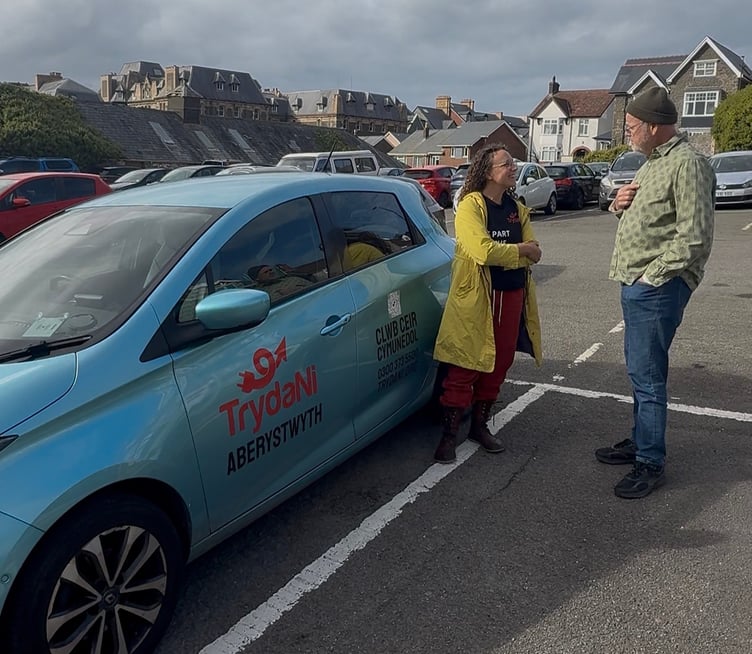
In Aberystwyth, two electric vehicles, a Renault Zoe, which has a range of up to 246 miles, and a Vauxhall Combo Life Electric, with up to 171 miles of e-juice, are based at North Road car park.
I met with Tess Cartwright of TrydaNi at Aberystwyth’s North Road carpark to talk about the club, and to see the cars in person. Video: Cambrian News
Using one is also intended to be considerably simpler than conventional car hire.




Bookings currently cost £2 an hour, capped at £30 for a full day, plus 16p for every mile travelled during the first 100 miles. Electricity for those first 100 miles is included.
For example, somebody borrowing a car for two hours and travelling 40 miles would pay £10.40.
There is no annual insurance policy to arrange, road tax to remember or MOT looming on the calendar. TrydaNi takes care of the vehicles and their associated running costs, with members effectively paying only when they actually use one.
Of course, something sounding simple on a website does not necessarily mean it remains simple when you try to use it.
So, before meeting Tess Cartwright of the TrydaNi team, I attempted to join myself.
My first impression was just how straightforward it was.
After downloading the app, I was taken through the registration process, beginning with the sort of basic personal details expected when creating almost any account.
Next came my driving licence information and a photograph.
Given that somebody was potentially preparing to hand me the keys to a car worth thousands of pounds, I had expected significantly more bureaucracy.
Instead, getting through the initial stages took only a matter of minutes and, from a user's perspective, the process was remarkably painless.
TrydaNi checks an applicant's driving licence and history before they are added to its insurance, with applications usually approved within a few working days.
There was, however, one fairly significant problem with my application.
I am 23.
TrydaNi's insurance only permits drivers aged between 25 and 79.
So, after sailing through an impressively easy registration process, my attempt to become a TrydaNi driver came to a rather abrupt end.
It also meant that a feature in which I had planned to get behind the wheel of a community electric car instead became one in which, rather embarrassingly, I would need a chauffeur.
There is a serious point behind the age restriction, though.
People in their early twenties are hardly immune from the cost of motoring. If anything, expensive insurance and the initial cost of buying a vehicle mean younger drivers could be among those most attracted to the idea of paying for a car only when they actually need one.
During our conversation, I raised this point with Tess who explained that, in the UK, there is at present very limited options for Car Club insurance and therefore TrydaNi’s hands were tied on the matter.
For those old enough to join, once an application has been approved the rest of the system is largely controlled through a phone.
Members can see available vehicles, make a booking and, when their reservation begins, unlock the car using the TrydaNi app. A vehicle access card can also be arranged for those without a smartphone.
The organisation operates as a not-for-profit Community Benefit Society and describes its clubs as community-run. Members can volunteer as ‘Community Champions’, carrying out jobs including cleaning vehicles, monthly safety checks or helping new members learn how everything works. In return, they can earn driving credits.
It means the people using the cars can also have a role in keeping their local club running.
But all of this still left the most important question unanswered.
What is the experience actually like when you want to use one?
That brought me to North Road car park in Aberystwyth, where I met Martin Leett, a TrydaNi member and finally got to hear about the system in action.
Mr Leett detailed to me how, after living in Aberystwyth for 10 years with his wife, they utilise the scheme’s services for any longer journeys that they plan, he exampled trips he has taken to Cambridge, local days out and visits to his son in Tewkesbury. He told me that his experiences using the club’s app make the whole process streamlined and simple, adding that a Whatsapp group of members adds to the community feel of the scheme, and opens the possibility of communication regarding shared usage of the vehicles.
The real test of a car-sharing scheme, however, is perhaps less about the car itself and more about whether people are prepared to organise their lives around not having one permanently available.
For someone who drives to work every morning, covers thousands of miles a year or regularly needs a vehicle at very short notice, private ownership may remain difficult to replace.
For somebody whose car spends most of the week parked outside their house, the calculation could look rather different.
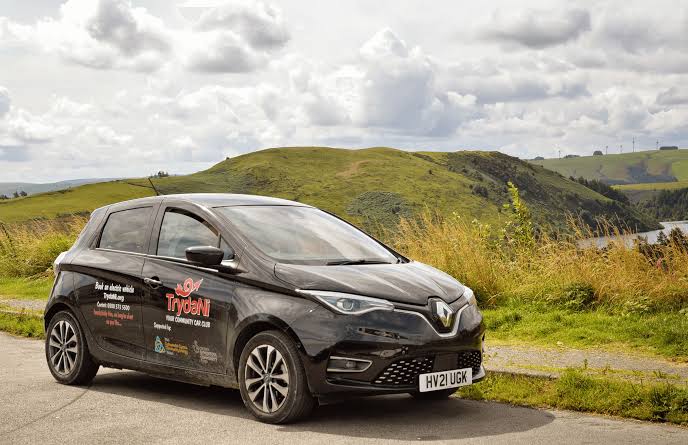
At North Road, members use the public 22kW charger, with a prepaid card kept in the vehicle covering the charging cost. After a journey, the car can be left plugged in for the next user.
TrydaNi will clearly not make sense for every driver, but reducing the environmental impact of transport does not necessarily mean removing cars altogether.
Its more interesting proposition is whether fewer cars could serve the same number of people. If a two-car household can manage with one, or somebody who only drives occasionally can use a shared vehicle instead of owning one, that could mean fewer cars being manufactured, maintained and eventually scrapped.
In rural Wales, where public transport cannot always meet every journey, shared electric vehicles could also help fill some of those gaps without requiring every household to keep an additional car on the road.
Whether that model works in practice will still depend on the individual, the journeys they make and how often they need a car, but the environmental argument is ultimately about making better use of vehicles rather than simply replacing every privately owned petrol or diesel car with an electric one.
But after a short while travelling around Aberystwyth with the people behind the scheme, the idea of having access to a car without actually having to own it suddenly felt a little less unusual.
And, in another two years, I might even sign up.
Comments
We've recently changed our login process. If you have an account for commenting, you will need to re-register on the login window.
This article has no comments yet. Be the first to leave a comment.