

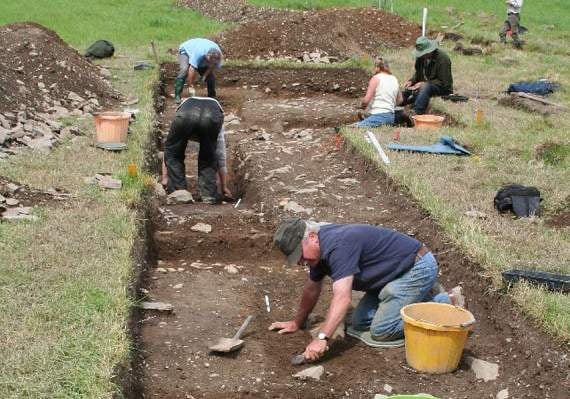
The excavation of the most remote Roman villa in Wales produced a unique cut-glass bowl and early evidence for the slater’s craft in Wales, a report has found.
The final excavation report for Abermagwr, near Aberystwyth, has just been published in the Welsh journal Archaeologia Cambrensis.
The Roman villa was a comparatively rustic building, with clay floors and open fireplaces, but it surprised archaeologists by producing fragments of one of the finest Roman glass vessels from Wales.
New work on the roof slates also revealed the staggering logistics of the task, with some 6,600 stone slates used to roof the villa, weighing up to 23 tonnes.



-Nick-Yallope-Peter-Nicolas-1.jpeg?width=209&height=140&crop=209:145,smart&quality=75)
Abermagwr, around 11 miles from Aberystwyth, was discovered by aerial photography in the drought summer of 2006 and was the first Roman villa to be found along the entire sweep of Cardigan Bay.
It is the most remote villa discovered in Wales, lying 50km from its nearest neighbour, and investigators say its excavation has “shed light on unexpected aspects of late Roman life” in west Wales.
Dr Toby Driver, senior investigator, said: “In particular its discovery changed our view of late Roman mid and west Wales, hitherto thought to have been a ‘militarised’ zone with little interaction between the Romans and local populations and little adoption of Roman ways of life.”
Roman villas are not common in Wales, there are just over 30 known or possible villas, but are all mostly in the south and east of the country.
Cropmarks of the Abermagwr villa were discovered less than a mile from Trawsgoed Roman fort.
Although suspected as a Roman building, the prospect was so unusual for mid Wales that Dr Driver and Dr Jeffrey Davies embarked on excavations in 2010 to date the building with the support of the Royal Commission, the Cambrian Archaeological Association and the Dyfed Archaeological Trust.
The dig confirmed what was – and remains – the only recorded Roman villa in Ceredigion.
Excavation continued in 2011 and 2015 as a lively community dig assisted by a volunteer workforce, with over 300 visitors to an open day in 2011 and the involvement of local primary schools.
Excavations showed that the villa was established around AD 230, at least a century after the nearby Roman fort was abandoned.
It was occupied until around AD 330 when it was abandoned following a catastrophic fire.
A cooking pot dropped on the kitchen floor was never picked up showing the urgency of the evacuation.
There is evidence for partial reoccupation of the villa ruins sometime in late-Roman or post-Roman times, but in recent centuries the building was systematically robbed of building stone and eventually forgotten in the landscape.
The star find from the excavation was an extraordinary late Roman cut-glass vessel which originated from the Rhineland in Germany.
Surviving fragments of the bowl are decorated with three bands of geometric facet-cutting, with a specialist report, describing it as “one of the finest examples of late Roman glassware from Wales.”
The Roman villa lies buried beneath modern farmland but excavated finds are on display at Amgueddfa Ceredigion Museum in Aberystwyth while photographs and plans are available for study online at www.coflein.gov.uk.
All photos courtesy of Crown Copyright Royal Commission on the Ancient and Historical Monuments of Wales
Comments
This article has no comments yet. Be the first to leave a comment.