
A CAMBRIAN News investigation reveals the damaging consequences when local government is undermined by the machinations of imperious executives empowered by feebly compliant councillors.
A corrosive combination of just this kind is embedded in Ceredigion council and has been for years, leaving the public white with fury, and threatening to shred whatever vestiges of voter confidence might remain. This newspaper’s revelations may now see chickens coming home to roost.
The council’s chief executive, Eifion Evans, has for too long been ceded unfettered authority by a cross-party majority of councillors too cowed to resist his autocratic style. This self-bestowed pre-eminence having met no meaningful or sustained challenge, it has become part of the wallpaper.
But this time Mr Evans, shadowed by executive director Barry Rees, has gone a step too far. For the first time, councillors, presumably feeling baited beyond endurance, are speaking out - anonymously, of course, their fear of executive retribution basically undimmed. Finally, the worm has turned.

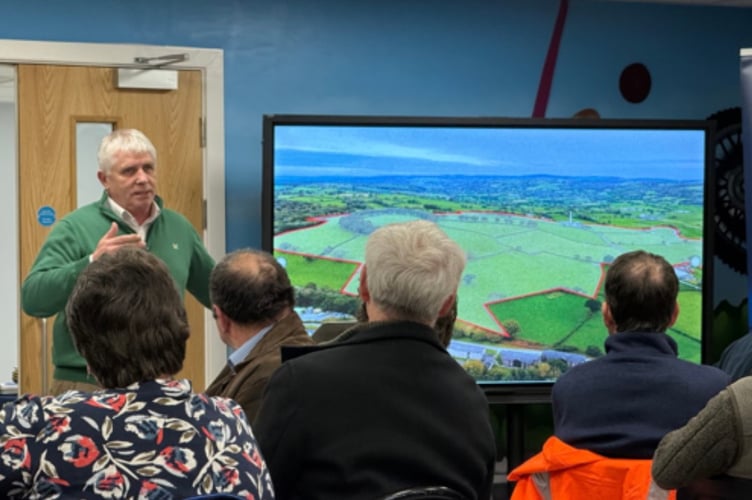
The breaking point has been the council’s highly secretive buying of a 129-acre farm, Llettytwppa, on the outskirts of Lampeter, in order to set up an agricultural education centre.
Rank-and-file councillors and the tax-paying public were told not a word about the plan until three months after it had been set in train by senior officials who had covertly arranged a £2m loan from the Welsh government - repayable over seven years at 2.15 per cent, or more than £40,000 a year. It had to be drawn down by 21 March 2025.
On 3 June, puzzled councillors, still in complete ignorance about a scheme hatched in their name, were asked to approve the buying of an unknown ‘asset’ in Lampeter. Most assumed it had something to do with the town’s wound-down university campus. Obediently, and blindly, they rubber-stamped the deal.
Since then, another £600,000 of public money has been ploughed into the Llettytwppa project.
This is a classic example of the kind of transaction that proper council practice insists must be subject to close scrutiny by councillors before any conclusive action is taken. In this case, any such procedural nicety was bypassed without a second thought. Democracy was ditched by bull-headed autocracy.



But this malfeasance is compounded, as the Cambrian News now reveals, by a trail of suspicion over individuals with council connections who may have benefited in various ways from this publicly-funded acquisition.
At the same time, a pet scheme chargeable to the public, hatched by executives apparently driven by a wholly wrongheaded sense of their own importance, turns out to have been a pretty useless idea anyway, evidenced by the fact that the would-be showcase Llettytwppa farm-school has to date recruited just two full-time students. (It gets worse, because one of the two is about to transfer to Gelli Aur, a purpose-built complex which is home to a 520-acre college farm in the Tywi Valley between Llandeilo and Carmarthen.)
In an authentic democracy, the Llettytwppa plan would at the outset have been thrown open to organised public and backbench councillor discussion, during which group wisdom may have concluded it was a good, bad or indifferent idea. The chief executive’s keen interest in exclusive personal control ensured this wasn’t done.
The heart of the matter is that Mr Evans demonstrably does not subscribe to the fact that he is the council’s servant, not its unassailable panjandrum. For any impartial observer of this council’s conduct, it’s clear that the chief executive routinely oversteps the mark, assuming a stance of supreme seniority, and thereby disregarding a core principle of public life.
It’s a rule that was clearly spelt out just over 30 years ago, when the committee on standards in public life, chaired by senior judge Lord Nolan, published its ‘seven principles of public life’, establishing an ethical framework to which “public servants” are all expected to stick.
They apply to anyone who works as a public office-holder, elected or appointed, nationally and locally, and very much includes local government.
One consequence is that a council’s chief executive is not authorised to make major policy decisions in isolation from, and without reference to, the public’s elected representatives.
Further, as Nolan puts it: “Holders of public office should act and take decisions in an open and transparent manner.”
Eifion Evans has overridden these core standards and in the process hijacked democratic governance. He must go, making way for someone who will pay more than lip-service to the guiding principles so succinctly set out by Michael Nolan. Nothing short of his departure is going to quell widespread public frustration about the way Ceredigion council is run.
Others, however, should take note of the depth of that discontent, which encompasses a kind of revulsion at the slavish loyalty lavished on the chief executive by some members of the Plaid Cymru cabinet. They need to recognise that the old sycophantic ways calculated to sustain a quiet life are regarded with a weary contempt by people beyond the Penmorfa stockade.
They are tired of the kind of stuffy, complacent conservatism which serves to insulate and isolate the cabinet from what it would see as unwelcome incursions by the main body of councillors and by the public.
This implied elitism is illustrated rather well by the reaction of council leader Bryan Davies, who also leads the majority Plaid group, when asked by the Cambrian News about aspects of the Llettytwppa affair. He answers none of the paper’s detailed questions. Instead, cabinet member and council deputy leader Alun Williams puts out an entirely non-specific statement about the Plaid group being “satisfied that all processes relating to employment at Fferm Llettytwppa have been carried out in a fair and rigorous manner in line with the council’s obligations and processes under employment law.”
As so often, an ill-informed public is left in the dark.
Back to Nolan: “Information should not be withheld from the public unless there are clear and lawful reasons for so doing.”
If this exclusion proviso had been relevant, Alun Williams would presumably have been quick to say so. The conclusion: Plaid was, yet again, content to defy the Nolan principles.
Comments
We've recently changed our login process. If you have an account for commenting, you will need to re-register on the login window.
This article has no comments yet. Be the first to leave a comment.