
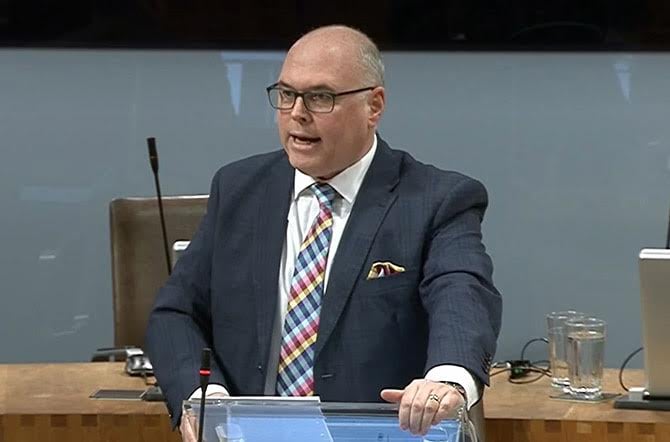
Regular readers of this space will know that I’m usually a bit of a curmudgeon, pointing fingers at things that go wrong, screw-ups, gaffes and errors.
Not today.
This week I have words of praise for two sets of good people, and I sincerely want to say thank you.
First nod goes to the wonderful staff at Specsavers in Aberystwyth who cheerily put one arm back on my glasses quickly and – yes, FOR FREE – the other week.

Being on the computer for so long each day over so many years has played heck with my eyesight and I’m as good as blind without my reading glasses.
I had a screw loose. Shush you lot! The arm came away.
The cheery young ladies in Specsavers put it all back together within minutes.
Thank you for your service.
Next, something a little more serious.



Well done to Ceredigion Penfro MS Paul Davies who is living with prostate cancer and last week called on the Welsh Government to introduce a national prostate cancer screening programme.
I couldn’t agree more.
Paul has urged ministers to make early detection a priority and ensure that prostate cancer is specifically addressed in the forthcoming National Cancer Strategy for Wales.
More than 2,500 men are diagnosed with prostate cancer in Wales each year, with around 640 men dying from the disease.
I know from personal experience.
‘You have cancer’ are three words I never wanted to hear yet in my case, I was partially expecting the diagnosis.
My father died of prostate cancer about 32 years ago when he was just 67. His cancer was undiagnosed and had metastasized to his bones by the time it was discovered. It was untreatable at that stage and the only course open was pain management.
I was about 34 at the time and living in Toronto and his diagnosis and death within a year was quite shocking.
Early detection is key to fighting this very treatable disease, so since turning 45, I have been meticulous in having an annual PSA test with my various GPs, depending on where I was living around the world.
I kept a careful note of each reading, watching out for any tell-tale rise.
Shortly after joining Cambrian News five years ago, my PSA levels rose significantly, and I was referred to a urologist. I subsequently had a biopsy that found there were some pre-cancerous cells in my prostate.
The urologist recommended monitoring and six-monthly PSA checks. It’s a simple blood test that takes less than a minute but is key to curing and treating prostate cancer.
The PSA continued to rise and I had a second biopsy a year later. That confirmed the cancer had advanced and needed treatment.
I was given two options – a full prostatectomy, where the prostate is removed, or brachytherapy, where radioactive seeds are inserted into the prostate, killing cancer cells.
My initial reaction was to go for the prostatectomy. That changed after meeting the radiologist who explained I was an ideal candidate for brachytherapy.
I researched it further and, given that there is no difference in outcomes between the two treatment options – both are equally successful for at least 12 years in men under 72 – I opted for the brachytherapy.
Treatment involved two sessions in the operating theatre under full anaesthesia. The first takes a 3D map of the prostate used by the radiologist to determine the number of seeds and their specific locations, and the second two weeks later for those to be inserted. Recovery time is about a week with few side effects.
When I say radioactive seeds, each is actually about the length of a grain of rice and the width of a paper clip.
I have 59 inside me. I laughed at the time learning that pregnant women could not sit on my lap for more than an hour, I couldn’t hug small children for more than three hours, and I couldn’t be cremated inside the first two years.
Thankfully, the treatment has been very successful. I’ve been given the-all clear and my PSA levels now are lower that they were when I first started having them tested 20 years ago.
My advice to every man over 50 is get yourself a PSA test ASAP.
It is just a simple blood test and it can save your life.
Just get it done and don’t put it off.
So, Paul: Thank you!
He told the Senedd last week: "As someone living with prostate cancer, I know first-hand the impact that a diagnosis can have, not just on the individual but on their family too.
"Early detection can make an enormous difference.
“When prostate cancer is caught early, survival rates are close to 100 per cent, yet too many men are still being diagnosed at a later stage.”
Comments
We've recently changed our login process. If you have an account for commenting, you will need to re-register on the login window.
This article has no comments yet. Be the first to leave a comment.