
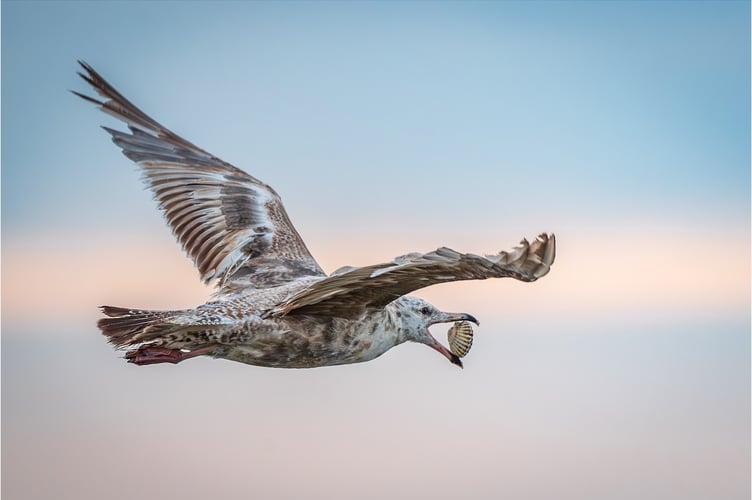
It’s clear we have a problem with rubbish being left on the streets of our towns, especially the seaside ones such as Aberystwyth and Tenby. Highly intelligent birds, like the Herring Gull, Larus argentatus, will take advantage of this situation. Many people enjoy take-away meals; it’s easy, you don’t have to take the trouble of cooking yourself and simply dump the empty tray in the bin. Which bin? I’ll return to that question. Let’s first of all examine the Herring Gull’s behaviour.
The Herring Gull is a fascinating species. One of many species of gulls, the Herring Gull is a red-listed bird. Their numbers have dropped by 60 per cent since 1986. This is due to them being seen as a pest resulting in many being shot, they also get entangled in nets and have been involved in oil pollution incidents. More than anything though, they lack nesting sites and natural food sources.
Their diet is varied. They love fish but also eat seeds and fruit as well as carrion. Carrion eaters will try their beaks at lots of things, including tasty snacks left behind by humans. They follow ploughs, noisily and in flocks, to scavenge the fields for whatever they consider edible.

Herring Gulls pair for life. They’re extremely protective of their nest sites and exceptionally so of their young. The chicks know how to beg their parents for food; they peck at the red dot on their parents’ bills. Research carried out by Nobel Prize winning biologist Niko Tinbergen showed that they’ll peck at anything long and yellow with a red dot. We’re fortunate that we have Helen Fitzpatrick in Aberystwyth who, like Niko, is dedicated to the Herring Gull.
I shall return to the fast-food trays and the bins. In Ceredigion we’ve had fantastic recycling rates partially due to the ease with which householders can put paper, cardboard, plastic and metals in the one recycling bag. Composting too requires nothing more than popping your food leftovers in the food caddy. The rest, besides glass, goes into black sacks.
Where do you put greasy fast-food trays, especially if there are chips or chunks of pizza left in them? I had a debate about this last year with some family members. One said the black sack, one said the compost bin and one said, wash it up and then recycle it. Can Ceredigion recycling officers clarify this please?
And that’s when we’re at home dealing with such waste. For tourists who visit the chippy, it’s obvious. The leftovers go in the nearest bin (or next to it when it’s full), Herring Gull take-away heaven.
After I’ve washed up the dishes, I use the leftover water to wash the milk carton, any cans and cat food pouches. Hopefully, the bag outside on bin day is not attractive to any gull. Yet I’ve noticed when walking past other people’s rubbish that not everyone is as fastidious in cleaning their recyclables. One household even proclaims their pride in leaving it dirty. I’m sure the local dustbin people know this particular household.
Yet the black sacks and the food caddies remain a difficulty. They’re especially problematic for students and those with guests in rented accommodation. Students don’t as a rule leave the premises on bin day and neither do guests. Solutions to this particular conundrum have to be found. Perhaps centralised dropping off points can be created, especially in towns like Aberystwyth with a high student population and many holiday makers. Street bins ought to be emptied more regularly. Maybe places that sell take-aways should be required to take back their waste.




I don’t profess to have all the answers but it’s obvious that neither does our council. However hard our wonderful bin people work, the rubbish problem remains.
On windy days bin bags often fly down the road and get smashed up. We put heavy rocks on them to prevent this as do others including one of my friends. She had a heavy rock on top of her food caddy. A massive kerfuffle caused her to look out of the window on bin day. Some Herring Gulls had managed to knock off the rock, open the caddy and were busy consuming the contents. They sounded as if they were fighting, ate the lot, down to the last scrap, she told me. I still worry that they may inadvertently have eaten the plastic bag in which the compostables were.
The serious point is that these Herring Gulls appeared to be hungry. They used their cleverness, knew there was food in that caddy. We need a bin system that outwits these wonderful creatures. But we also need a sea full of fish that can support and increase the population. And they need nesting sites. Humans have to stop regarding them as pests. We have after all invaded many species’ habitats, including the beautiful Herring Gull.
Comments
We've recently changed our login process. If you have an account for commenting, you will need to re-register on the login window.
This article has no comments yet. Be the first to leave a comment.