
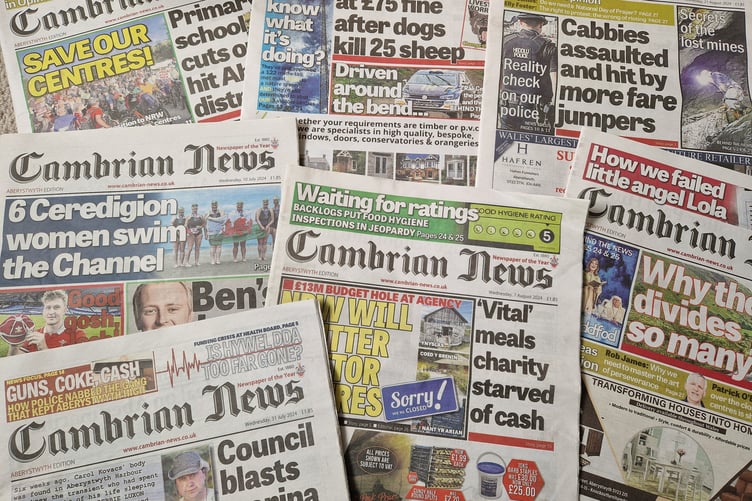
The news business has always been about change.
By its very nature, journalism is about reporting change. Every day we tell the stories of communities evolving, governments making decisions, businesses opening and closing, and people experiencing the moments that shape their lives.
From 1 October, readers will no longer be able to access Cambrian News content online free of charge. We are introducing a digital subscription model, meaning our journalism will sit behind a paywall.
Let me be clear: The printed Cambrian News will continue exactly as it always has. You will still be able to buy your newspaper every week. This change relates only to our online content.

There will, of course, be exceptions. If there is a major emergency, severe weather event, public safety issue or other matter of critical importance to the people of mid and west Wales, we will ensure that vital information remains freely available.
But from October, the days of unlimited free access to our online reporting will come to an end.
The Tenby Observer, our sister title, will also be moving behind a paywall before the end of November.
Behind the scenes, we are already working hard to put the necessary systems in place. We will be using technology that has been successfully introduced across many newspapers owned by Iliffe Media, the company behind the Cambrian News, the Tenby Observer and dozens of respected regional titles throughout England, Scotland, Wales and the Isle of Man.
Final details of pricing are still being discussed, but subscriptions are likely to cost £4.99 per month or £54.99 per year. There will be incentives for readers who choose an annual subscription, and we expect further details to be announced soon.



As many of you know, I have spent more than four decades working in newspapers. During that time I have witnessed a transformation unlike anything previous generations of journalists could have imagined.
When I entered the industry, newspapers were vast operations employing people in a whole range of specialist trades. There were linotype operators working intricate mechanical machines that cast molten metal into lines of type. There were compositors assembling pages by hand, printing staff managing enormous presses, machine operators, inserters, bundlers, drivers and delivery teams.
There were several newspaper editions every day. Saturday evenings often brought pink sports finals packed with the latest football results.
Most of those jobs and traditions have disappeared.
The arrival of the internet marked the beginning of that change. The development of smartphones accelerated it dramatically. Today, most people consume news through the device they carry in their pocket.
The way readers access journalism has changed beyond recognition.
Yet one thing has remained constant: The appetite for trusted local news is as strong as ever.
In fact, despite the challenges facing print circulation, our digital audience has never been larger. More people than ever are reading Cambrian News stories online.
The simple truth is that quality local journalism costs money to produce.
Stories do not appear by magic. Journalists listen in on council meetings, scrutinise public bodies, chase freedom of information requests, investigate complaints, interview residents, verify facts and spend countless hours ensuring that information is accurate and balanced.
That work has value.
Across the United Kingdom, many communities have lost their local newspapers altogether - "news deserts", places where there is little or no independent local reporting.
When local journalism disappears, accountability often disappears with it.
Here in west Wales, Cambrian News continues to play a vital role in holding power to account. We report stories that others may overlook. We challenge official narratives. We ask difficult questions. We shine a light on decisions that affect the everyday lives of our readers.
That work matters.
Throughout my career I have worked for 11 newspapers. Four of them, all daily titles, no longer exist. They did not adapt quickly enough to changing circumstances, and once they disappeared, they were gone forever. That reality is never far from my mind.
As editor, I have a responsibility not only to today's readers but also to future generations. The Cambrian News has been serving communities across west Wales since 1861. For more than 165 years it has chronicled local life, celebrated achievements, exposed wrongdoing and recorded the history of our towns and villages.
I want to ensure it continues doing exactly that for many decades to come.
The move to paid digital subscriptions is an important part of that future. It is not about restricting access. It is about ensuring independent local journalism remains sustainable in an era when readers increasingly consume news online rather than in print.
And if we are to continue producing the strong, independent local reporting that west Wales deserves, the value of that work needs to be recognised whether it is consumed on paper or on a screen. From October, that is exactly what we will be asking our readers to do.
Comments
We've recently changed our login process. If you have an account for commenting, you will need to re-register on the login window.
This article has no comments yet. Be the first to leave a comment.