
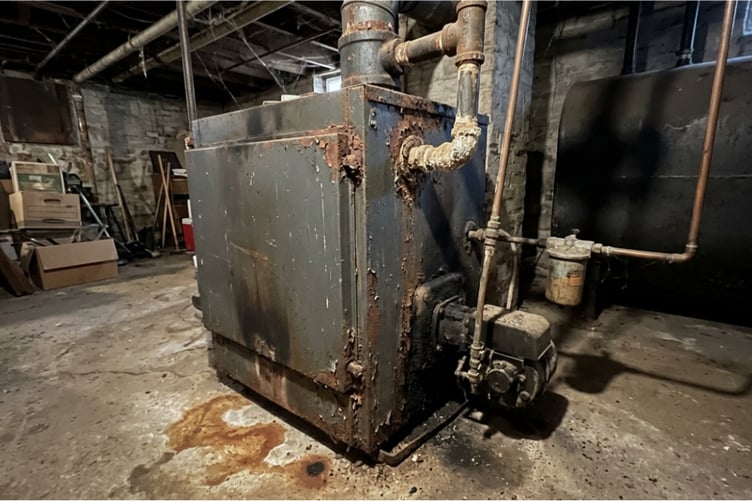
For many households across mid and West Wales, the oil boiler sits at the centre of winter life. Off the gas grid, with LPG often prohibitively expensive and heat pumps still working through their teething years in retrofit, oil remains the primary heating fuel for a substantial share of Welsh rural homes. When the boiler is working well, nobody thinks about it. When it starts to show its age, the question is whether to patch it through one more winter or replace it before it fails on the coldest week of the year.
Oil boilers often give fair warning of the end of their lifespan if you know what to look for. The signs are age, declining efficiency, worsening spare parts availability, and rising fuel use that cannot be explained by colder weather or longer runs. A boiler showing all four is not going to last another decade. A boiler showing one or two is probably good for a few more years with proper maintenance.
Replacement planning matters because the typical oil boiler replacement cost sits between £2,200 and £5,500 depending on the installation, with an average of around £3,300, which is not a cost anyone wants to face under pressure in the middle of January. Households that spot the warning signs early have time to get quotes, plan the work and arrange the finance. Households that leave it until the boiler stops working are usually paying premium rates for emergency replacement in bad weather.
The age question
Modern oil boilers typically last at least ten years, often longer, with proper maintenance. Boilers from the mid-1990s that have been serviced annually and used sensibly are now reaching the end of their useful life even if they are still running. Boilers from the mid-2000s are approaching the point where replacement planning becomes sensible rather than premature.
Age alone is not a reason to replace a working boiler. A twenty-year-old boiler that has been looked after, serviced, and cleaned every year and shows no efficiency decline can continue in service for several more years. But age is a reason to start thinking about the replacement rather than assuming it is somebody else's problem.
For households with boilers over fifteen years old, the sensible planning approach is to get an honest assessment from an OFTEC-registered engineer at the next annual service and ask directly what the realistic remaining life is. Engineers who have seen hundreds of similar installations can usually give a well-grounded view that is more useful than any general rule of thumb.
Efficiency rating decline
Oil boilers lose efficiency as they age, and the decline is both measurable and consequential. A modern condensing oil boiler is normally more than 90 per cent efficient. Older, non-condensing boilers typically run at only 60 to 70 per cent, and any boiler that is poorly serviced or scaled up will sit below the figure it achieved when new.
The practical implication is straightforward. A household burning 2,000 litres of oil a year on a boiler at 70 per cent efficiency would need only around 1,550 litres on a boiler at 90 per cent. With heating oil averaging around 115 pence per litre at the time of writing in early November 2026, that saving of roughly 450 litres is worth about £500 a year, and over the remaining life of a replacement boiler it adds up to real money.




The signs of efficiency decline are visible on the annual service report. OFTEC engineers measure combustion efficiency as part of the service and record the figure. A boiler whose recorded combustion efficiency has fallen noticeably over its service history is losing fuel out of the flue rather than putting it into the water.
Spare parts availability
Oil boiler manufacturers typically support their products with spare parts for a number of years after a model has been discontinued. Beyond that window, parts become harder to source, more expensive and sometimes impossible to obtain.
The practical reality for Welsh rural households is that an engineer attending a breakdown on a twenty-year-old boiler in February may not be able to source the required part within a reasonable time frame. The household faces a choice between waiting a week or more for a part that may or may not arrive, or booking an emergency replacement at premium rates with the heating off in the meantime.
Households whose boilers are reaching the point where spare parts are becoming hard to source should treat that as a serious warning sign. An engineer who tells you that the control board on your boiler is now unavailable new and only comes from reclamation units is telling you that your boiler is a breakdown away from a scramble.
Rising fuel use
The fourth warning sign is rising fuel consumption that cannot be explained by colder weather or longer heating hours. Households that track their oil deliveries over several years can usually spot the trend. If annual oil consumption has crept up by 15 to 25 per cent over three or four years without any change in household heating habits, the boiler is working harder for the same output.
The causes are usually a combination of declining combustion efficiency, scaling in the heat exchanger, worn burner components and failing controls. Some of these can be addressed through service and repair. Most of them are symptoms of a boiler approaching the end of its useful life rather than problems with practical fixes.
Rising fuel use is particularly worth watching now because oil prices themselves are volatile. Households whose boilers are getting worse at using fuel are being hit twice: once by the price per litre and again by the increased litres per winter.
What to do about it
For Welsh rural households with oil boilers over fifteen years old, consider taking these steps:
Book the annual service with an OFTEC-registered engineer who will give you an honest assessment. Ask directly for the current combustion efficiency, what parts have been replaced, which are becoming hard to source and what the realistic remaining life is. Get the answers in writing on the service report.
Track your annual oil consumption. Write down the delivery dates and litres purchased. Over three or four years, the trend will tell you whether the boiler is holding up or declining.
If the signs are pointing toward replacement, start the quote process in spring or summer rather than autumn. Heating engineers are generally busiest in autumn as households try to get the new boiler in before deep winter. By getting quotes earlier, you have more time to compare options.
Get three quotes from OFTEC-registered installers. Compare like for like on the boiler model, the controls package, the warranty, the installation method and any additional work (removing the old boiler, oil tank condition, pipework alterations). The new oil boiler cost will vary considerably across installers and specifications, so the comparison matters.
Consider whether this is the right moment to look at alternatives. Air source heat pumps have improved substantially over the past five years, and the Boiler Upgrade Scheme provides a £7,500 grant toward an air source or ground source heat pump in England and Wales, rising to £9,000 until 31 March 2027 for homes heated by oil or LPG with no mains gas connection. For some rural households, the economics now work. For others, they do not. The honest answer depends on the property, the current heating distribution and the household's heating patterns, which an independent heating assessment can set out properly.
Comments
We've recently changed our login process. If you have an account for commenting, you will need to re-register on the login window.
This article has no comments yet. Be the first to leave a comment.