

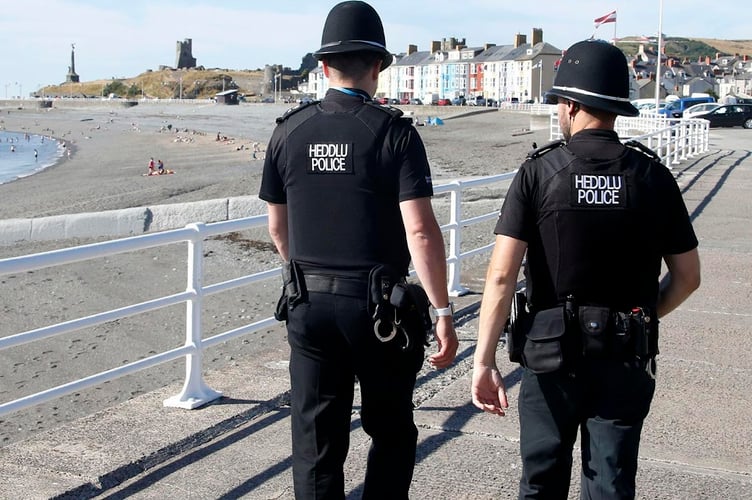
The number of police forces in Wales could be slashed as part of proposals by the Home Secretary to change ‘broken’ policing.
Shabana Mahmood confirmed the shake-up will create a new National Police Service (NPS) to fight the most complex cross-border crime and could also see the number of local forces in England and Wales cut by about two-thirds.
She described the changes to policing as the ‘most significant in nearly 200 years’.
The proposals have been met with concern however and renewed calls for policing powers to be devolved to Wales.


The paper doesn’t specify which police forces would be merged, but previous proposals have suggested just on police force for Wales instead of the four currently.
Reacting to the proposals, the four Welsh Police and Crime Commissioners in Wales said: “We recognise and support the need to modernise policing and the UK Government’s White Paper provides us with that opportunity.
“Policing in Wales operates within a distinct public service landscape, shaped by close partnerships with Welsh Government, local authorities, health services, and our NGO partners.
“The partnership approach we have developed over many years here in Wales has been praised by successive governments, and any review of the policing model and structures must reflect this work.
“It must also consider the evidence of what works best for the communities and people of Wales.
“Vital to this is the commitment that policing is rooted in the communities they serve, we strengthen neighbourhood policing and that we maintain and enhance local accountability. As locally elected representatives, Welsh PCCs are committed to playing a full and meaningful role in designing future arrangements for Wales, ensuring continuity, stability, and democratic accountability during any transition.
“The UK Government must now demonstrate how the regional and structural change it is proposing would enhance local accountability and deliver the best possible service to our communities.”
North Wales, PCC Andy Dunbobbin added: “In North Wales, day to day policing activity is closely linked to the North West of England through established patterns of serious and organised crime, including county lines drug supply, organised acquisitive crime, and the movement of offenders across borders.
“Operational effectiveness relies on well embedded joint working with neighbouring English forces, regional organised crime units, and partner agencies to manage risk, safeguard vulnerable people, and disrupt criminal networks.
“Any change to policing structures must support these operational realities and avoid introducing barriers that could undermine intelligence sharing, joint tasking, or rapid operational response.”
Dyfed-Powys Police Chief Constable Ifan Charles said: “Police leaders are united in calling for bold and ambitious reform which delivers a world class service for our communities, officers, staff and volunteers.
"The priority for policing is and will always be victims of crime, and the services and support we provide to victims and the communities we serve. In that sense, it is business as usual for now.
"Crime is changing, technology is evolving, and we need to be set up in the best possible way to tackle crime in the modern world, relentlessly focused on good quality neighbourhood policing alongside national threats.
“I am committed to doing my utmost to ensure any changes to policing are right for the people of Dyfed and Powys, and together with my fellow Chief Constables in Wales, ensuring we deliver the best possible service to Welsh communities."
Dwyfor Meirionnydd MP Liz Saville Roberts challenged the Home Secretary in the House of Commons, saying that this was “exactly the right time” for the devolution of policing to Wales.
Liz Saville Roberts said in the chamber that the white paper recognises that changes to policing governance and crime prevention in Wales will have to reflect the existence of over a quarter of a century of devolution. However, the extent of the implications of these reforms on Wales is unclear.
Plaid Cymru has long argued that policing and justice should be devolved to Wales, in line with arrangements already in place in Scotland and Northern Ireland. As Ms Saville Roberts pointed out in the chamber this afternoon, the cross-party Silk Commission report in 2014 recommended the devolution of policing powers, as did as the Thomas Commission in 2019, and the Independent Commission on the Constitutional Future of Wales in 2024.
The UK Government has repeatedly rejected these calls, but Ms Saville Roberts made the case for it now as part of the UK Government’s “package of radical changes”.
Speaking in the House of Commons, Liz Saville Roberts MP said: “The white paper recognises that changes to policing governance and crime prevention in Wales will have to reflect the existence of over a quarter of a century of devolution.
“Meanwhile, three independent commissions have recommended that justice and policing be devolved to Wales.
“Considering around 56% of our police funding already comes from devolved sources – does she not agree that this package of radical changes is exactly the right time for the devolution of policing to Wales?”
In her response, the Home Secretary Shabana Mahmood said: “No I do not.”
Speaking after the session, Ms Saville Roberts MP added: “The Home Secretary talks up these proposals as radical reform, yet continues to block the devolution of policing to Wales – despite this being an evidence-based position endorsed by three independent commissions over more than a decade. Her response is an ideologically-driven blanket denial of the needs of Wales.
“This flat refusal comes just days after the First Minister of Wales, Eluned Morgan, called for the devolution of justice, exposing the deep divisions and lack of coherence within Labour’s ranks.
“Policing works best when it is accountable to the communities it serves. If ministers are serious about making policing more efficient and effective, they cannot keep ignoring the clear and consistent case for devolution. Any credible programme of radical reform must include the devolution of policing powers to Wales.”
The Welsh Liberal Democrats have warned that any plans that would see Wales’ four police forces merged into a single national force risk repeating the failures seen after police centralisation in Scotland and could leave communities with fewer officers on the streets and less responsive local policing.
The party says the UK Government has yet to outline precisely which forces will be merged under its wider policing reforms, but that Wales must not be pushed towards a model that makes policing more remote, less accountable, and less focused on local crime, particularly in rural and semi-rural communities where residents already face long response times and limited police visibility.
The Home Office said the precise number and nature of each force and potential mergers will be the subject to a review that will report back to Ms Mahmood in the summer
The white paper says: "There are currently too many organisations overseeing different elements of policing, none of whom have the necessary powers to drive change.
"The NPS will bring together existing national bodies, including the National Police Chiefs’ Council, the College of Policing, the National Crime Agency and Counter Terrorism Policing, into a single organisation with a clear mandate and the powers to get things done."
Comments
We've recently changed our login process. If you have an account for commenting, you will need to re-register on the login window.
This article has no comments yet. Be the first to leave a comment.