

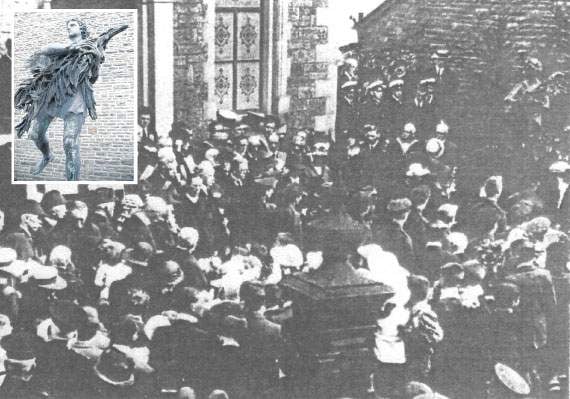
The year is 1921. It is a warm summer’s evening and I am covered with a cloth, a long one for I am almost 10 feet in height. The committee has decided to place me in the side garden close to the Tabernacle and, with my back near to the wall, I can observe all that enter. How busy some of the congregation have been putting out chairs and benches, for there is an expectation of a large congregation.
Earlier in the day I observed members standing at the Tabernacle entrance holding large flags and then one came with a ladder. A young man, his face sombre remembering his brother who died on the battlefield. With one hand he lifted the flag and slowly climbed the ladder to tie on the Union Jack. Up and down he went proceeding to do the same with the Welsh flag and then with the Corporation flag. Finally, the members gathered, looking up at the bright display gaily fluttering in the breeze.
I heard the sounds now of the Newtown Brass Band approaching and soon the garden was filled with people. Most are dressed in their Sunday best clothes, the ladies look elegant in their fine hats and the gentlemen look rather suave in their boaters. Soon they are seated, staring up wondering how I must look. Soon the ceremony will begin, this is the moment I have been waiting for, to be revealed to all!
I observe amongst the congregation dignitaries of the town, a gentleman in a morning suit with top hat, a barrister in formal gown and three elderly aldermen who stand together. With their black superior hats they stand out amongst the congregation. Also, in attendance are Army and Navy soldiers. Soon more arrive in the garden taking their place to the side of me, I watch them for a moment, their faces solemn remembering those friends lost on the battlefield.


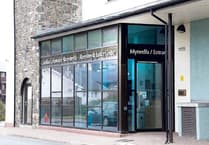
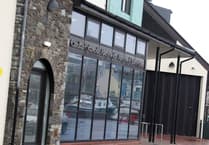
Finally, the Minister Reverend Rees comes through the doorway accompanied by a young dark-haired Professor Rutelli, and they step up onto the makeshift pulpit where the Army bugler is waiting. The congregation quietens, children are hushed by parents, the Army and Navy soldiers stand to attention for the ceremony to begin. Speeches and prayers follow and then the elder who stands close to me is given a signal. Suddenly he pulls away the cloth and at last I am unveiled – most gasp with surprise and delight for if I may dare say so – I am strikingly beautiful!
I am bronzed, I wear a tunic and a wreath circles my head of golden hair. In my arms I clasp a bundle of palms. With my wings supporting I outstretch one leg, while the other rests on the bronze sphere inscribed with 14 names, all of which stands on a pedestal of white granite.
The inscription reads “Er cof am/wroniaid/Eglwys y Tabernacl/Aberystwyth/ Y Rhyfel Mawr 1914-18.” In memory of the heroes and heroes they all were, that gave up their lives to fight for their country. So many sons and brothers, fathers and uncles fell down wounded or dying onto those blood stained battlefields, their pain filled faces half buried in the mud, some calling out for their mothers, wounded lonely and afraid. But they were not alone, for one of my relatives was there to ease their pain…
Now, as the days turn into weeks, the weeks turn into months and then soon into years, I quickly become established as a meeting point. I listen and watch the handsome young men chatting to the young women. On fine days there would always be a meeting of mothers and while their children play around me I listen to their shared worries and concerns, for these are the late 1920s, the depression years and the living is lean and hard. Sometimes in the evening after service, the deacon will come and gather around me, discussions on church matters would at times become heated for such was the passion of their faith.
See this week’s feature for the full story, in shops and online now
Comments
This article has no comments yet. Be the first to leave a comment.