
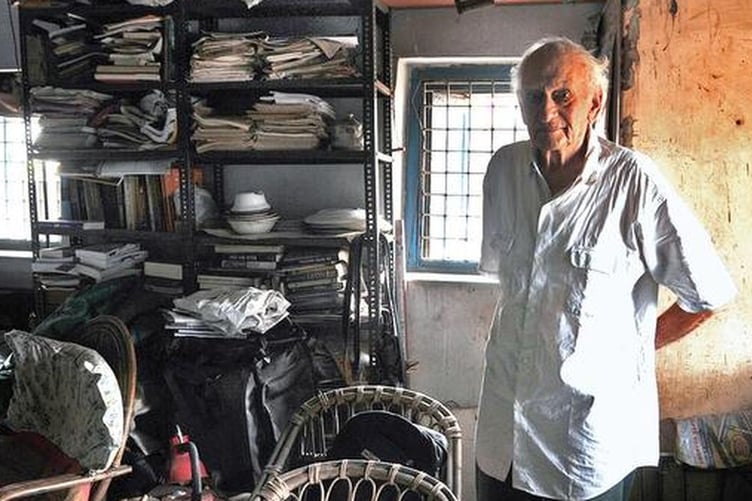
A former remote, cliffside, Cardigan farmer who went on to become one of the world's best-known pioneers of street medicine has died aged 96.
Dr Jack Preger MBE, known as the "pavement doctor of Calcutta", spent four decades providing healthcare to some of India's poorest people after making an extraordinary decision to abandon farming and retrain as a doctor.
He died at his home in Diss, Norfolk, on 31 October.
Born in Manchester in 1930, Preger studied politics, philosophy and economics at St Edmund Hall, Oxford, before running a remote farm on the cliffs near Cardigan.
According to his former college, his life changed while he was driving a tractor on his Cardigan farm in the mid-1960s.
He experienced a sudden conviction that he should become a doctor, despite having no previous intention of entering medicine.
The decision meant selling his farm and returning to education as a mature student.
He trained at the Royal College of Surgeons in Ireland, completing his medical studies in his early forties.
In 1972, following an appeal for medical help, he travelled to newly independent Bangladesh to work with refugees.
There, he established a clinic in Dhaka, but his work ended in 1979 after he exposed an alleged child-trafficking operation and was deported.


Preger moved to Calcutta, now Kolkata, where he initially worked alongside Mother Teresa's Missionaries of Charity before pursuing his own approach to treating people living in extreme poverty.
With limited facilities, he began administering medical care beneath bridges and beside railway lines.
Eventually, he established a makeshift clinic on a pavement in Middleton Row, treating patients who often had no other access to healthcare.
The roadside operation became an extraordinary medical service, with areas for consultations, dressings, medicines and patient records, despite having no permanent building.
At its busiest, the clinic saw as many as 500 patients a day. Patients sought help for conditions including tuberculosis, malaria, burns and other serious illnesses. Volunteers and local medical professionals assisted him, while consultations sometimes took place behind sheets held up to provide privacy.
Medical notes were stored in metal boxes beside the busy road.
His methods also inspired doctors elsewhere to develop services for homeless patients.
His work helped establish Calcutta Rescue in 1980, an organisation providing healthcare and education to disadvantaged communities. The charity has estimated that its services have reached around half a million people over the decades.
Preger faced repeated difficulties with immigration authorities and was imprisoned during disputes over his status in India, but continued his humanitarian work.
He received an MBE in 1993 and was named Philanthropist of the Year at the Asian Awards in 2017.
His life was also documented in the film Docteur Jack.
He retired to Britain in 2019, aged 88, after approximately 40 years in India.
Organisations associated with his work have paid tribute to his commitment to people living on the margins of society.
For those who remember his beginnings near Cardigan, his journey from a Welsh hillside farm to the streets of Kolkata remains an extraordinary story of reinvention and compassion.
Comments
We've recently changed our login process. If you have an account for commenting, you will need to re-register on the login window.
This article has no comments yet. Be the first to leave a comment.