
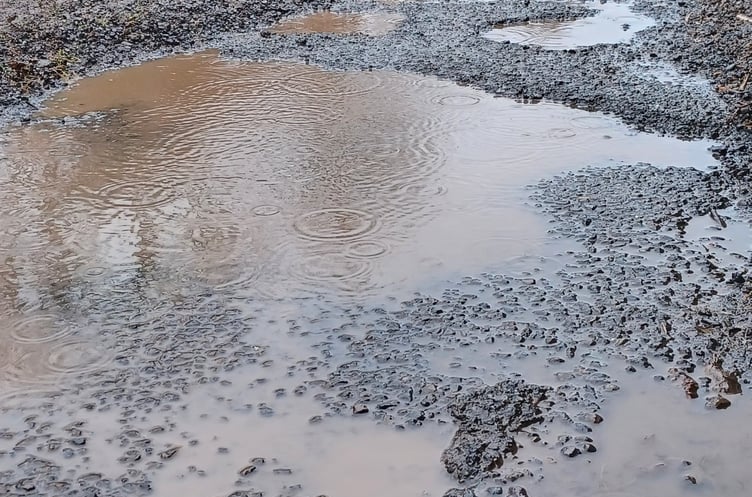
A £53.8 million backlog of road maintenance is hanging over Ceredigion as councillors review how to keep the county’s highways from deteriorating further.
The figure, reported earlier this year, puts a price on outstanding work across a network serving some of Wales’ most isolated communities.
Ceredigion County Council listed its annual Highways Asset Management Plan status and options report for scrutiny on 6 November, putting road conditions and future investment back on the agenda.
The authority’s published financial strategy acknowledges that maintenance work will always be outstanding and warns that continued investment is essential to prevent further deterioration.
It records that 12.3 percent of C roads were in poor condition in 2025/26, above the council’s target of 12 percent.
The equivalent figures were four percent for A roads, matching their target, and 3.1 percent for B roads, comfortably below the six percent threshold.
The pressures are particularly pronounced in a rural county. The council’s highways plan says 88 percent of its maintained roads are in rural settings, including narrow lanes connecting villages, farms and essential services.
Its 2025–2030 strategy estimates that £4.6 million a year is required for planned carriageway improvements simply to maintain existing conditions.
That would fund surface dressing on approximately 90 kilometres of road and resurfacing on another 20 kilometres annually.
A further £2.3 million a year is identified for reactive carriageway repairs, including responding to defects as they arise.


Earlier this year, the Cambrian News reported that more than 12,000 potholes or road defects were repaired locally in 2025, including thousands tackled by specialist Jetpatcher equipment.
The council also reported that additional funding had allowed its resurfacing and surface-dressing programme to rise from £2.2 million in 2024/25 to £4.9 million in 2025/26, with £4 million programmed for 2026/27.
Its financial strategy identifies £4.6 million of Welsh Government-backed highways investment across the two financial years, under the Local Government Borrowing Initiative.
However, the council has warned that one-off investment cannot, by itself, eliminate a longstanding maintenance backlog.
The plan also acknowledges that unclassified roads have not been surveyed at set intervals, potentially affecting which schemes are selected. It proposes machine surveys of these roads at least once every five years.
The repair policy differentiates between immediate hazards and less urgent deterioration. Critical defects are targeted to be made safe within two hours, while other safety defects on major routes should be addressed by the end of the following calendar day.
On link roads and local access roads, the target for safety defects is five days. These are council response standards, not evidence that every repair meets them.
At a scrutiny meeting last December, officers said their service had only 40 percent of the buying power it enjoyed a decade earlier, in real terms.
The unresolved questions are whether additional spending is reducing outstanding work, whether quieter rural roads are receiving sufficient attention and how long the council can afford to sustain the current programme.
Comments
We've recently changed our login process. If you have an account for commenting, you will need to re-register on the login window.
This article has no comments yet. Be the first to leave a comment.