
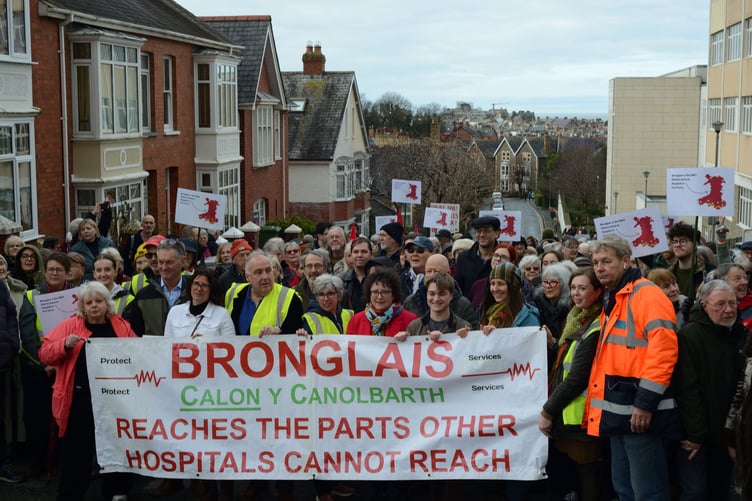
Nearly eight in ten Ceredigion respondents to a consultation on the future of stroke services opposed Hywel Dda University Health Board’s preferred proposals, newly published figures reveal.
The results come as health chiefs prepare to decide on 26 November whether to centralise specialist acute stroke treatment at Glangwili Hospital in Carmarthen, with Bronglais Hospital in Aberystwyth providing initial treatment and rehabilitation.
Of 242 respondents identified as being from Ceredigion, 192, or 79 percent, disagreed that the preferred option would improve clinical standards, patient safety and staff shortages. Of those, 168 strongly disagreed.
Across the health board area and beyond, 517 of the 745 people who answered the question disagreed, representing 69 percent, while 176, or 24 percent, agreed.
Among Ceredigion respondents who considered previously proposed alternatives, 167 chose “none of these”, while 46 preferred Option 210, which envisaged 12-hour specialist cover at Bronglais for ongoing inpatient care. This also suggests dissatisfaction extended beyond the health board’s latest preferred model.
The findings come from the report on an eight-week consultation which ran from 28 May to 26 July. Respondents volunteered their views, meaning the figures should not be interpreted as representative of the wider population.
Under the proposals, Glangwili would become the centre for round-the-clock specialist acute stroke care. Patients presenting at Bronglais, Withybush or Prince Philip hospitals would continue to receive initial assessment and urgent treatment before transfer for specialist inpatient care where required.
Bronglais would retain a stroke rehabilitation unit, enabling appropriate patients to return nearer home for their recovery.
The report records repeated concerns from rural communities about long journeys, poor or unreliable public transport and the availability of ambulances for hospital transfers.
At public events in Aberystwyth and Lampeter, participants also raised the impact on relatives visiting patients in Carmarthen, particularly during winter and for families without cars.
One participant at the Aberystwyth event said: “You cannot consider an option without looking at transport.”
The report also documents concern over whether Glangwili could accommodate additional patients, and whether adequate staffing and beds would be available.
In written representations, Ceredigion Disability Forum argued that the preferred approach would disproportionately disadvantage older and disabled residents and people living in rural communities.
Protect Bronglais Services called instead for a rural stroke model centred on the Aberystwyth hospital.
However, the report acknowledges support for improving access to specialist stroke expertise and recognition that existing services do not consistently meet national standards.
Hywel Dda says specialist stroke cover is not currently available seven days a week across its hospitals. It believes concentrating staff and resources could improve treatment, safety and patients’ prospects of recovery.
The health board has also stressed that patients would continue to attend their nearest hospital for the initial assessment and emergency treatment of suspected strokes.
Responses from all areas are being considered alongside clinical evidence, staffing requirements, transport arrangements and the costs of implementing any changes.
The board is due to consider the future model at a public meeting on Thursday, 26 November. No final decision has yet been made.
Comments
We've recently changed our login process. If you have an account for commenting, you will need to re-register on the login window.
This article has no comments yet. Be the first to leave a comment.