

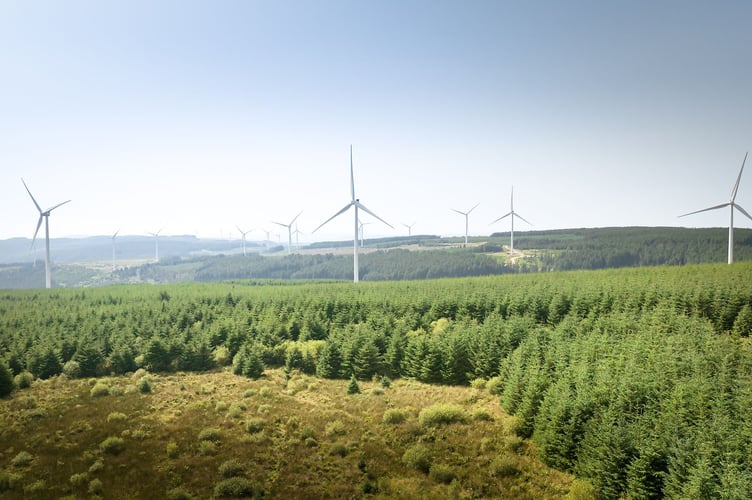
Concerns have been raised over a Welsh Government plans to speed up the building of wind farms, solar parks and tidal power schemes in a new deal with the renewable energy sector.
The Renewable Energy Sector Deal will be a strategic partnership between Welsh Government and industry, focused on unlocking the full economic potential of Wales’ renewable energy future.
The target is for renewable electricity generation to meet 70% of our consumption by 2030 and 100% by 2035, whilst also delivering at least 1.5 gigawatts of locally owned renewable energy capacity by 2035.
The Sector Deal will help deliver on these ambitious targets by accelerating renewable deployment across onshore and offshore wind, solar, marine and hydro. It also aims to strengthen supply chains, build the workforce of the future and ensure that communities across Wales reap the benefits.




Rebecca Evans, the Cabinet Secretary for Economy, Energy and Planning, will launch the Sector Deal on a visit to the Morlais tidal energy project, in Anglesey.
Owned and managed by the social enterprise Menter Môn, the Morlais scheme – which the Welsh Government has an £8m equity stake in – will become the largest consented tidal energy project in Europe.
She said: "Our ambition is to become a world leader in renewable energy, creating jobs and green growth to make families in Wales more prosperous and to help with the cost of living.
“The current conflict in the Middle East has further highlighted the importance of energy independence. Our Renewable Energy Sector Deal will provide a strong foundation for the future delivery of renewable energy – to the benefit of our economy, environment and energy security.
“The Morlais project is a strong example of how sustained partnership can unlock Wales’ natural energy resources and convert them into lasting economic opportunity for local communities and businesses.
“The Energy Generation and Energy Use report also shows we are making progress towards our renewable energy targets. Combine this with the record 20 major renewable energy projects, totalling 1,400 MW, to receive backing in the latest UK Government Contracts for Difference auction round and it is clear we are creating an environment for a more resilient, renewable energy-powered future.”
The deal has faced criticism however from countryside campaigners
CPRW, The Welsh Countryside Charity, has warned that Wales’ renewable energy transition must better protect rural landscapes and secure the support of local communities.
The charity says, as the single greatest threat to the Welsh countryside, working to address climate change and mitigate the impacts of climate change is, of course, a priority.
Renewable and low carbon energy generation will play a pivotal role, and support for the industry is welcomed, but it is essential that this is done in a way that doesn’t destroy the very things we seek to protect and maintains the social licence from the public.
CPRW adds: “The current approach of the Welsh Government is not working as they have not achieved buy-in from the communities most impacted. These communities are not, in general, climate change deniers or anti-renewables activists; they are simply against the way major change is being imposed upon them by a government which “knows best”, to primarily benefit financial investors, often from other countries.”
It offers recommendations, saying the Welsh Government needs to prioritise offshore wind, not only in the Celtic Sea, but also the vast areas of the Irish Sea off north Wales; demand that the distribution grid is upgraded as soon as possible to unlock the potential and enthusiasm for local and community solutions and apply policies they already have to protect landscapes, wildlife, habitats and agricultural land.
By 2050 it is likely that Wales will be generating three times the amount of electricity currently produced, to power homes, businesses, public transport, heat pumps and electric vehicles. Over 80% of this will come from offshore wind turbines, with the power taken to where it is most needed by subsea cables.
Both the Irish and Celtic Seas have immense resource potential. The offshore wind industry can become a major employer in both north and south Wales. The ports of Milford Haven, Port Talbot, Mostyn and Holyhead can be thriving hubs of industry for construction, assembly, operation and servicing of the offshore power stations. The Welsh Government must make this industry a priority.
CPRW adds: “Rural communities are naturally “self-contained”, accepting of developments that will bring them clear tangible benefits, but are rightly angered when told they have to have a renewable power station placed in their midst where the power will be taken away to be used by others.
“The distribution grid is holding back farm, village and community schemes that would be readily accepted, while the transmission grid, and connections to it, is being used to exploit rural areas while not delivering a single kWh to anyone who lives nearby.
“Renewable schemes that connect to the distribution system, generating electricity that will be used locally and can lower bills for the people who live near them, are needed.
“The Welsh Government needs to hold off its grand spatial plans for mass industrialisation of the countryside and facilitate bottom-up development. There is no need for anywhere in Wales to produce more electricity than it consumes, as vast offshore wind farms can always make up any deficit.
“Wales already has some excellent policies to protect landscapes, habitats, wildlife and agricultural land, but time and again these are being ignored and overruled in the mad dash to generate as much as possible, primarily to benefit outside investors.
“Overwhelming need keeps being cited by the government as the reason to ignore its own policies. The Welsh Government needs to be clear with the industry and regulators that policy “red lines” will be adhered to, and not allow itself to be bullied into allowing anything, anywhere.”
Jonty Colchester, Chair of CPRW, added: “It is well known that Wales is currently a net exporter of electricity due to large gas power stations, and will remain so due to growth in renewables. However, ironically, this actually increases bills for consumers in Wales, as we get no benefit from producing an excess and pay to send it over the border.”
Welsh Liberal Democrat Leader Jane Dodds MS also raised questions over the deal, saying: “This so-called ‘sector deal’ raises more questions than it answers.
“There is no clear plan for how we build the workforce needed, with no detail on training, skills or apprenticeships to deliver the green jobs Wales needs.
“Ministers also promise benefits for communities, but without minimum standards or enforcement, there is no guarantee local people will see the rewards.
“Most concerning is the lack of focus on energy bills. Families are struggling, yet there is no clear explanation of how this will bring down costs. Renewable energy should mean cheaper bills, but as long as electricity prices are tied to gas, households won’t feel the benefit, something Labour in Westminster has failed to fix.”
Renewable UK Cymru welcomed the deal, saying: “We’re delighted to have supported this landmark sector deal, bringing government, industry and communities together to accelerate renewables and reduce reliance on volatile gas and imported fossil fuels. It will secure jobs, anchor long-term investment in our ports, manufacturing and supply chains, and put Wales at the heart of the UK’s clean energy economy
Comments
This article has no comments yet. Be the first to leave a comment.