

Conservation workers have braved stomach churning heights to protect fragile heathland above Gwynedd’s coast.
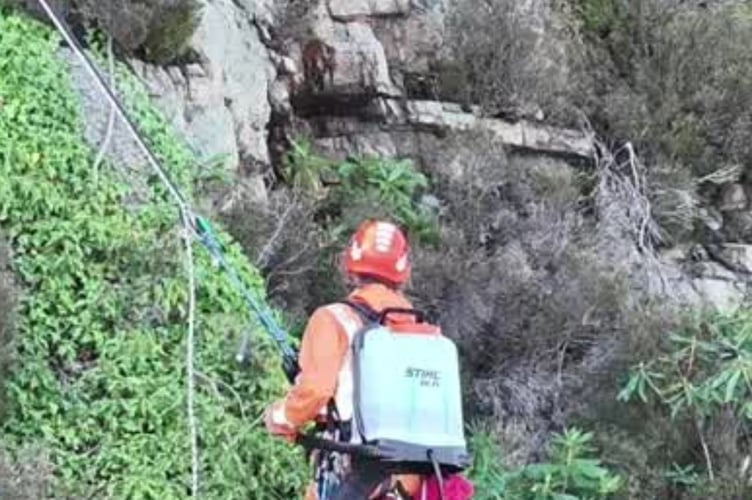
Suspended on ropes over a 90 metre drop, they treated invasive rhododendron clinging to the cliff edge high above the sea.
Natural Resources Wales planned the work at Mynydd Tir y Cwmwd on the Llŷn Peninsula after finding the invasive plants spreading across parts of a Site of Special Scientific Interest (SSSI), including a cliff face and steep ground that could not otherwise be reached safely.
Treating and eradicating the rhododendron is vital to protect the heathland habitat for which this part of the headland has been designated.



Rhododendron may be common in gardens, but in the wild it can spread fast and smothers native habitat and plants beneath its dense canopy. On the headland it had begun to block light, choke the ground layer and weaken the heath that defines the site.
NRW brought in specialist contractors to carry out the rope access work.
On easier terrain, workers treated the invasive plants with herbicide, or uprooted the smaller ones by hand.
The rope team tackled the rest, carrying equipment and working at height on exposed sections of the cliff.
The project was funded by the Welsh Government’s Nature Networks Programme, which supports efforts to restore habitats and strengthen biodiversity across Wales.
Arfon Hughes, Environment Team Leader for Natural Resources Wales, said: “Rhododendron poses a serious threat to some of Wales’s native habitats, and at Tir y Cwmwd it was growing in places that were extremely hard to reach.
“This rope access work allowed us to remove plants that would have kept spreading across the cliffs and damaging the ecosystem.
“It shows the lengths we sometimes have to go to in order to protect and restore nature.”
The operation marks an important step in restoring the coastal dry heathland habitat at Mynydd Tir y Cwmwd.
Comments
This article has no comments yet. Be the first to leave a comment.