

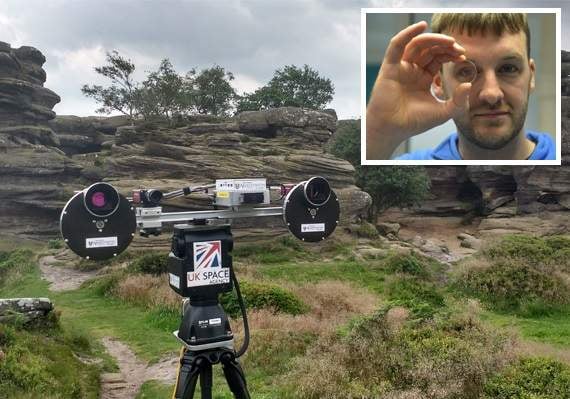
SCIENTISTS from Aberystwyth University and the University of St Andrews have headed out to Iceland to help with the European Space Agency’s 2020 mission to Mars.
The PanCam instrument, which is under development by a team led by UCL’s Mullard Space Science Laboratory, will be the eyes of the ExoMars Rover and the images it produces will be key to the success of the mission.
Dr Matt Gunn and colleagues from the Institute of Mathematics, Physics and Computer Science at Aberystwyth are part of an international team developing and testing the camera’s data processing pipelines to enable the camera to capture accurate colour images and 3D measurements of geological features on Mars.
Inspired by stained glass technology used in medieval cathedrals, Dr Gunn’s team has built a colour calibration target that will be retain the vibrancy of its coloured glass discs despite the very high levels of ultra-violet radiation on the planet.

.png?width=209&height=140&crop=209:145,smart&quality=75)


The Aberystwyth team has also developed a Rover Inspection Mirror that will enable PanCam to capture “selfies” of the rover to check itself for damage or problems during the mission.
Dr Gunn has recently returned from a field test in Brimham Rocks in Yorkshire, where the team were testing PanCam’s 3D measurement capabilities.
Developed to enable geologists to remotely identify rock formations that might indicate the previous existence of liquid water, Dr Gunn has been working on calibration and processing pipeline used to convert the raw images into accurate full colour images of the rocks.
The Iceland mission will see the team test how PanCam records colours using its advanced multispectral technology.
See this week’s south editions for the full story, in shops and online now
Comments
This article has no comments yet. Be the first to leave a comment.