
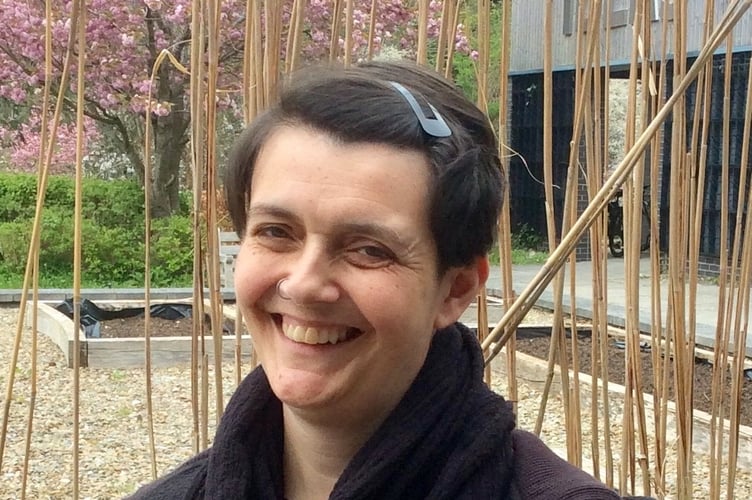
An exciting project combining art and science is underway at the Institute of Biological, Environmental and Rural Sciences (IBERS).
Dr Kerrie Farrar from Talybont is a program leader at IBERS, a department of Aberystwyth University. Her work at the centre relates to the study of miscanthus grass. Kerrie is collaborating on a new and exciting project with artists from the Aberystwyth Printmakers.
Kerrie said: “Although I am known as a scientist who studies in a laboratory here at Aberystwyth University, I have worked with people from all over the world who study plants, and particularly grasses. This might bring me into contact with other scientists, researcher institutes and companies.
“But on our own doorstep at Gogerddan, we have a group of artists, and this led to the opportunity to engage with a different way of interpreting what I do. It is a new and interesting challenge for me to engage with printmakers, painters, book artists and papermakers and a channel for a wider audience to get engaged with the science of plant growth.”
The Aberystwyth Printmakers have a workshop based in the grounds of the IBERS estate.
Kerrie said: “I’m very excited to be involved in a project which brings artists and scientists together. After an initial tour of the IBERS laboratories and green houses, the artists asked if it was possible to make paper out of the surplus grass that we grow.”
Keen to inform people about the research work at IBERS, Kerrie always looks for ways to promote the information, and explained: “Miscanthus grass is a very tall, fast growing and relatively easy grass to grow.
“It can be grown in a very varied climate. It can also be processed to make fuel and chemicals.
“Unlike fossil fuels, which release carbon that was captured millions of years ago, burning the grass only releases carbon taken up by the plant the previous year. An additional benefit of the miscanthus is that not all the fixed carbon is harvested, much is stored below ground in root and rhizome.”
Kerrie is keen to make the point that the research done at IBERS relates directly to climate change and sustainability. She said: “We want people to know what we do, so we get involved in things related to science week and attend agricultural shows, locally and nationally. We engage with school children, farmers and the wider public when we can.”
Besides local and international contact, Kerrie is also looking to connect with people further afield, like “Asia and particularly south east Asia is where miscanthus originated,” said Kerrie.
“There is an ancient tradition of hand-made paper in these regions. It is great to be linking with this history.”
The art/science project is supported by a development grant from Aberystwyth University and an exhibition by Aberystwyth Printmakers, together with some of the scientists from IBERS, will hold an exhibition at the foyer of the IBERS in July.
“Prior to this we will run workshops in paper making and printing for Aberystwyth Printmakers and our scientists,” said Kerrie.
“We started working on miscanthus in Aberystwyth in about 2004, approximately the same time that Aberystwyth Printmakers established themselves. It seems appropriate to be informing people about our vision to replace fossil fuels, plastics and other fossil derived products and processes wherever possible. Coming together with the artists for a new view and interpretation just seems to be a step in the right direction.”
The exhibition at IBERS highlighting this project will take place with an evening reception on Wednesday, 19 July.
“We want people to come and enjoy our resulting work on this project,” said Kerrie.
For information on the paper making project, email Kerrie at [email protected] or Stuart Evans, Aberystwyth Printmakers, [email protected].
To feature in First Person, or to nominate someone who should, email [email protected]