

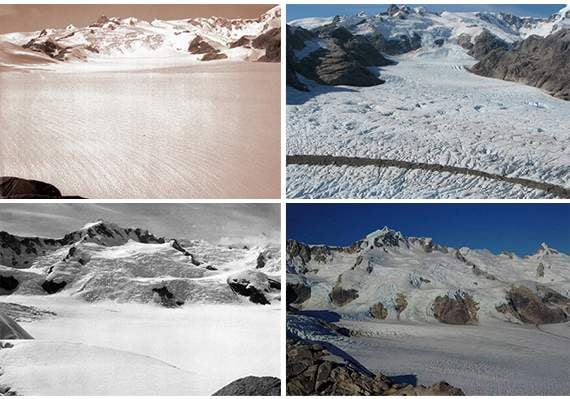
ABERYSTWYTH University glaciologists have carried out research which has shown that a glacier in northern Patagonia has thinned by 133 metres in the past 44 years.
They say the northern and southern Patagonian ice fields are two of the most sensitive ice masses on Earth to climate change and could become a leading contributor to rising sea-levels caused by melting mountain glaciers and icecaps.
The team’s conclusions are based on detailed analysis of the surface lowering of the Benito Glacier between 1973 and 2017.
The starting point for the research was a ground survey surface elevation profile of the glacier carried out by the British Joint Forces Expedition in 1973, of which Martin Sessions – one of the co-authors on the study – was the scientific leader.



Martin, his son Mark and researchers from Aberystwyth University returned to Benito in April 2017 to retrace the surface profiles and carry out a new survey using the latest GPS technology.
The 2017 survey showed that in the intervening period of 44 years, the surface level of the Benito Glacier lowered and thinned by 133 metres.
Prof Alun Hubbard, one of the researchers from Aberystwyth University’s Centre for Glaciology, said: “This study highlights the exceptional rates of ice thinning evident in Patagonia.
“I first visited the Patagonian ice fields 20 years ago, leading the first unsupported north to south crossing, summiting a number of previously unclimbed peaks and carrying out a series of geophysical measurements.
“Since that first expedition, glacier ice loss has been unprecedented across the region and, as our new paper reveals, has become a major contributor to global sea-level rise.”
See this week’s south papers for the full story, available in shops and as a digital edition on Wednesday
Comments
This article has no comments yet. Be the first to leave a comment.