
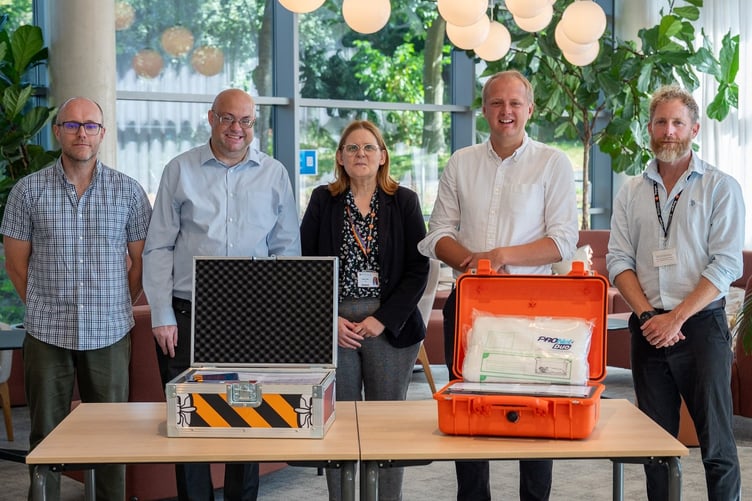
Local MP Ben Lake has visited Aberystwyth University to learn about their research contributing to the fight against malaria.
During his visit, Mr Lake heard how scientists are spotting mosquito breeding sites using the latest drone, satellite and AI technologies.
An international project led by Aberystwyth University is deploying drones equipped with advanced sensors to locate breeding sites in complex environments in Zanzibar.
AI will be trained to analyse the images and accurately find mosquito breeding grounds, even in complex or obscured environments like rice paddies or swamps with thick aquatic vegetation or algae cover.
Mr Lake also heard from academics who are unlocking the secrets of mosquitoes that bite during daylight hours.
They are investigating the genetics of Zambia’s primary malaria-carrying mosquito, which has been found to bite outdoors and after sunrise, when people are not protected by conventional control measures.
The scientists aim to determine whether these different biting behaviours occur within a single mosquito population or are associated with genetically distinct groups.
Their findings are expected to help strengthen Zambia’s national malaria control strategy.
Advocacy charity Malaria No More UK joined the MP on his visit to explain how the Aberystwyth University research fits into wider efforts to control and ultimately eliminate malaria in our lifetime.
They talked the Ceredigion Preseli MP about how tools including bed nets, drugs, and vaccines had helped make significant progress in reducing malaria cases and deaths over the last 25 years.




The group says that new innovations, such as those pioneered by Aberystwyth University, could finally end one of the world’s oldest and deadliest diseases.
But scientists have warned that without continued investment in the fight against malaria, continued progress is by no means guaranteed.
Ben Lake said: “It is encouraging to see that researchers, public health experts, and community stakeholders are able to come together to develop locally led strategies for such devastating diseases.
"Cuts to development funding across the world are risking the progress we have made on tackling malaria.
“We need to continue to invest in malaria tools, and the research that is creating a new generation of innovations, such as Aberystwyth University's groundbreaking work.
“The innovative ways in which research is being undertaken to improve UK-led research, using a combination of genetic characterisation and drones, satellite technologies and artificial intelligence has the potential to transform how these habitats are detected, analysed, and managed. This will open up new opportunities for malaria control and elimination."
Professor Angela Hatton, Pro Vice-Chancellor for Research, Knowledge Exchange and Innovation at Aberystwyth University said: “Our excellence in research has inspired generations of people from all over the world to change lives for the better: growing knowledge, building communities and strengthening Wales and the wider world.”
Chris Walker, UK Senior Advocacy Manager at Malaria No More UK said: “The UK is a malaria science superpower, and that science is saving lives across the world and boosting life science jobs and the Welsh economy.”
Comments
This article has no comments yet. Be the first to leave a comment.