
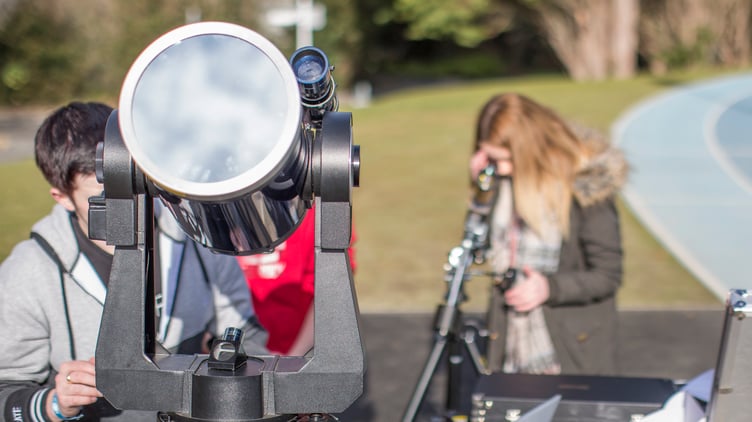
Aberystwyth University is hosting a special solar eclipse event on the town’s Promenade this week, where the public can learn from experts and safely view the celestial spectacular.
On 12 August, more than 90 per cent of the sun will be obscured by the moon, creating a deep partial eclipse that will be visible across the country.
To mark the occasion, physicists from Aberystwyth University will host a free public viewing event at the town's Bandstand.
Visitors will be able to observe the eclipse safely using specialist equipment and learn more about the science behind the phenomenon from solar physicists and researchers at the University.
The eclipse will begin at 6.10pm, reach its maximum coverage of the sun at 7.12pm, and end at approximately 8pm.
Visitors of all ages are invited to join a hands-on workshop from 5.30pm when they can create their own pinhole eclipse viewer.
Free eclipse viewing glasses will also be available while stocks last.
Dr Rachel Cross, Senior Lecturer and Researcher in the Department of Physics, said: “This will be one of the most impressive solar eclipses visible from Wales for many years.
“Although the eclipse will not be total in Aberystwyth, seeing more than 90 per cent of the sun obscured by the moon will be a rare and memorable spectacle.
“We are very grateful to the Institute of Physics in Wales for supporting this event.




“Its funding has helped us offer a safe and accessible viewing experience while showcasing the internationally recognised solar physics research taking place at Aberystwyth University and inspiring the next generation of scientists.”
While Wales will see a deep partial eclipse, the total eclipse will be visible from a narrow corridor stretching across Greenland, Iceland, northern Portugal and Spain.
Members of the University’s Solar System Physics Group will be carrying out scientific observations in Spain during the eclipse.
Should cloud cover prevent direct viewing in Aberystwyth, live streams and images from eclipse observations around the world will be shown inside the Bandstand, ensuring visitors can still experience the event and learn about the science behind it.
Timing for the Wednesday evening will be as follows:
- 17:00 - 17:30 set-up at the bandstand
- 17:30 event open to public
- 17:30 onwards visitors can make a solar viewer
- 18:00 solar glasses can start be handed out
- 18:10ish eclipse starts
- 19:12 maximum
- 20:00ish ends
- 20:30 event ends. Pack up van, return scopes kit to the department.
Comments
This article has no comments yet. Be the first to leave a comment.