
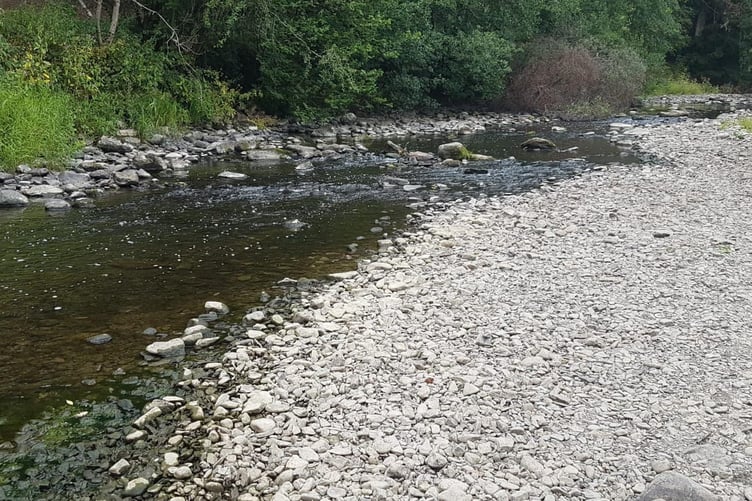
Several rivers across Wales are recording some of the lowest levels since recorded began, but western areas are faring better than other parts of the country.
Analysis of Welsh river level data by Afonydd Cymru is showing an alarming picture of water heights after weeks of drought, with many of Natural Resources Wales’s gauging stations registering lowest recorded levels.
As of Monday morning, 17 August, 28 gauging stations across Wales were registering lowest recorded levels (since recordings began at that location), with a further 46 within 3cm of this mark.
Many of the rivers with lowest recorded levels are tributaries. This is bad news for already threatened fish species such as Atlantic salmon and particularly sewin, whose juveniles largely inhabit the smaller streams.
The lower levels mean higher temperatures, lower oxygen levels, increased potential predation on these small fish and the increased chance of streams drying up completely.
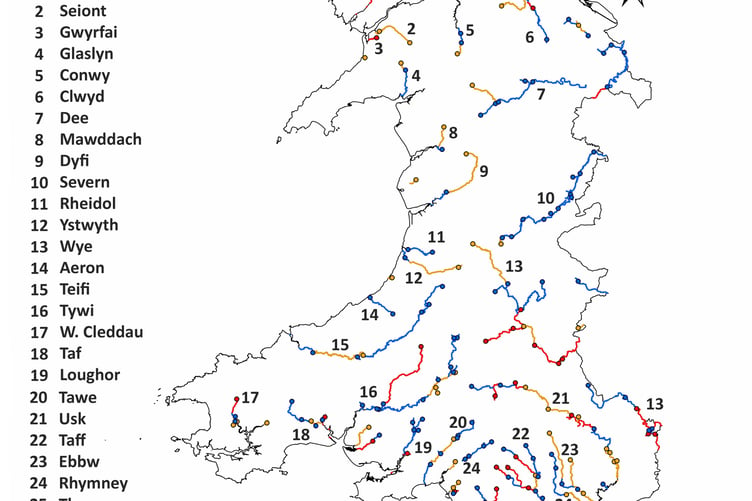
The study however shows that west Wales seems to be the area where levels are holding up best, even before the small amount of rain that fell over the weekend.
However, even in this area, sections of the Western Cleddau (17), Taf (18) and Ystwyth (12) are at lowest recorded level or close to it.
The Rheidol is more than 3cm above the lowest ever recorded level.
The weather over the next two weeks is forecasted to be more unsettled with some rain arriving from the west.




For many rivers across Wales and their fish populations, this break in the dry conditions cannot come soon enough.
Looking further ahead, hotter summers and more prolonged dry periods will become an increasing pressure on rivers and our environment. Wales needs to create healthier and more resilient landscapes that retain more water in wet periods to be released slowly into rivers, giving some alleviation to the kind of conditions experienced this July and August.
Comments
We've recently changed our login process. If you have an account for commenting, you will need to re-register on the login window.
This article has no comments yet. Be the first to leave a comment.