
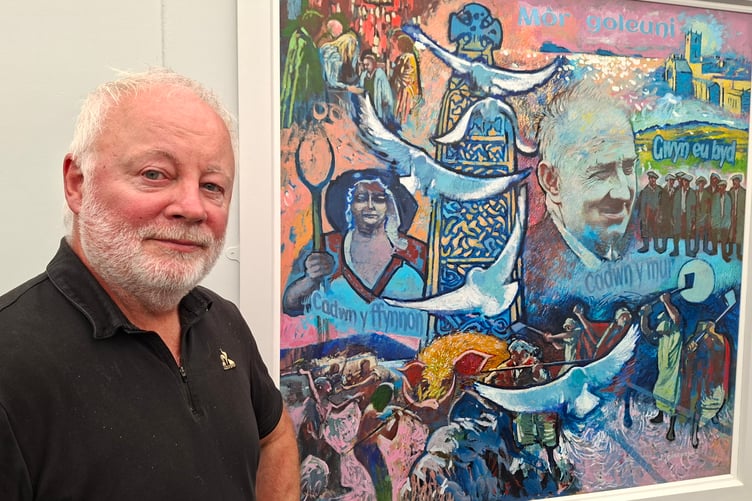
THE artist Meirion Aneurin Jones thought long and hard for two months before starting to create the impressive painting which is the work of a commission for the National Eisteddfod and which can be seen on the cover of the Eisteddfod programme.
It took another two months to complete the work, which is four feet, or 120 square centimeters, in acrylic paint before a special unveiling ceremony in Cardigan during the spring.
Meirion said: "It is a reflection of the locality in terms of people more than the landscape and tradition of the locality in terms of its identity and independence. But at the same time I was keen for it not to be a photo album.
"I thought about creating the painting for a long time, about two months, before starting the work which took two months to complete.
“This year's Eisteddfod area is a very special one, with its people firm with strong principles, and I wanted to reflect that.
"Waldo (Williams) is central to the painting; the first Eisteddfod in Cardigan is in the top corner, and Tyddewi and the Cathedral, along with Jemima Nicholas, the Twrch Trwyth, Merched Beca, and Twm Carnabwth.
“The strength of a row of men creates the wall of my life.”
Meirion Jones was born in the Cardigan area and, after secondary education in the town, attended Dyfed College of Art in Carmarthen and the University of Wales.
After graduating, he took a job at Fishguard High School, and was a teacher for a decade until he decided to focus on his art full time in 2002.
"The day after I left the classroom for the last time, I was out with my drawing tools on the coast. I didn't want to be known as a weekend artist, and regret in my old age what I could have done," he said.

.jpeg?width=209&height=140&crop=209:145,smart&quality=75)
Much of his work is heavily inspired by Wales, the rural scenery and the beautiful coast of west Wales, as well as Latin American influence thrown into the mix.
His preferred medium is acrylic on board.
"The ideas come from parts of Wales that are familiar to me. The north and Patagonia have fueled a few series, but overall it's the west that inspires me.
"The subjects are arbitrary: Prom Aber, Preseli, Llyn y Fan, the Pembroke coast, imaginary work and experimental seascapes; and as far as I can see, there is no pattern to these trends, only that the accidental element plays its part.
“The medium is usually acrylic paint and ink on a thin board.
“As the decades go by, the work becomes more suggestive, and the narrative element becomes more prominent," he explained.
Meirion Jones is the son of the well-known artist, the late Aneurin Jones, and they have collaborated on several projects and shared space in exhibitions.
It is possible to see similarities in their style; for example, they both convey light in a magical and hazy way, but the strongest impression is that each artist immersed in his chosen element – water for Meirion and soil for Aneurin.
In 2010 the two were commissioned to create a painting to celebrate the 900th anniversary of the formation of the Cardigan borough.
John Davies, chairman of the Eisteddfod 2026 executive committee, explained that Meirion had been commissioned to create the painting to celebrate this special Eisteddfod.
"It is extremely impressive work and meets the requirements that the committee had perfectly," he said.
He added, "Meirion has presented the painting to the Eisteddfod, but also to the Brifwyl area, so the picture will remain in the Garreg Las area."
Although the original work will not be sold, high quality editions of it have been printed and are being sold to raise money for the Eisteddfod.
Comments
This article has no comments yet. Be the first to leave a comment.