
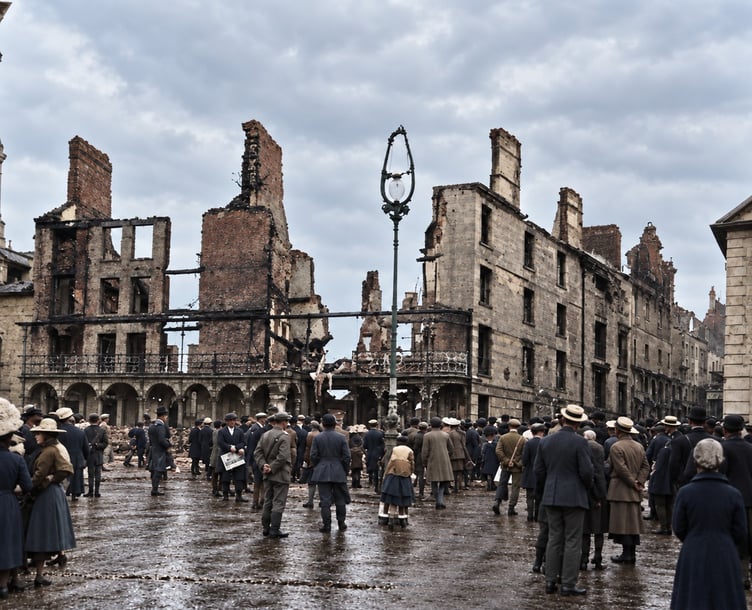
In the early hours of Tuesday, 26 August 1919, Aberystwyth was woken by one of the most destructive fires the town had seen in more than thirty years.
The Waterloo Hydro Hotel stood prominently on the seafront, a large block stretching from the Marine Parade along Terrace Road towards Bath Street. By the time morning came, much of it had gone. Blackened walls, empty windows and tall chimneys were left standing above the ruins, and the Cambrian News would later describe the blaze as the greatest fire Aberystwyth had experienced since the College fire of 1885.
It had begun at around half past one in the morning, when fire was discovered in the basement on the Promenade side of the hotel. At first there must still have been some hope of stopping it. The chef, Jean Pasche, together with Herbert Wilson and James Good, threw bucket after bucket of water onto the burning timber, but the flames were spreading too quickly. Smoke forced them back, water pipes were damaged and gas pipes began to melt. Within a short time, whatever chance there had been of bringing the fire under control had gone.
The greatest danger was upstairs, where most of the hotel was still asleep.
There were around 150 people inside, including staff, and police went from room to room waking guests and telling them to leave immediately. Some had enough time to pull on clothes and gather a few belongings; others escaped with scarcely more than they had been wearing in bed. On the balconies, desperate scenes unfolded as people found their way outside and, in some cases, jumped down into blankets being held for them on the Promenade below.
For Mr A. Bennett of Shrewsbury, escape was far from certain. Bennett had lost a leg in childhood and was sleeping in an attic room when he discovered that smoke had cut off the staircase. He made his way to a dormer window and called for help as the fire drew steadily nearer. The first ladder brought to the building was too short, so another had to be fastened above it. James Jackson tried to reach Bennett with a rope before Jack Thomas, a young merchant seaman, climbed towards the roof and helped him onto the ladder.
Bennett was eventually brought safely down to the Promenade.
By then the Waterloo was ablaze. Windows glowed before bursting into flame, floors gave way, and the fire in the upper rooms was said to stretch almost halfway across Terrace Road. With the wind carrying sparks and heat towards nearby buildings, there were serious fears that the blaze might spread along Marine Terrace and into Bath Street. Much of the fire brigade’s effort was spent preventing just that, and despite everything happening around them, they succeeded.
What happened next says something about Aberystwyth itself.

.jpg?width=209&height=140&crop=209:145,smart&quality=75)

The Belle Vue Hotel, Grosvenor House and neighbouring homes opened their doors to those who had fled. The Bandstand became a temporary refuge, St Michael’s Hall was opened, and by eight o’clock breakfast was being provided for those affected at Teviotdale’s in North Parade.
By five that morning, the Waterloo Hydro had been gutted. A hotel capable of accommodating 200 visitors, with 107 bedrooms, dining rooms, lounges, baths and a ballroom, had been reduced in only a few hours to a shell. The Cambrian News estimated the damage at around £50,000.
But for all that was lost that night, something far more important remained.
A hotel full of sleeping people had burned with frightening speed, and yet everyone got out alive.
When morning finally came and people stood looking at what was left of the Waterloo, that must have mattered more than anything else
Comments
This article has no comments yet. Be the first to leave a comment.