
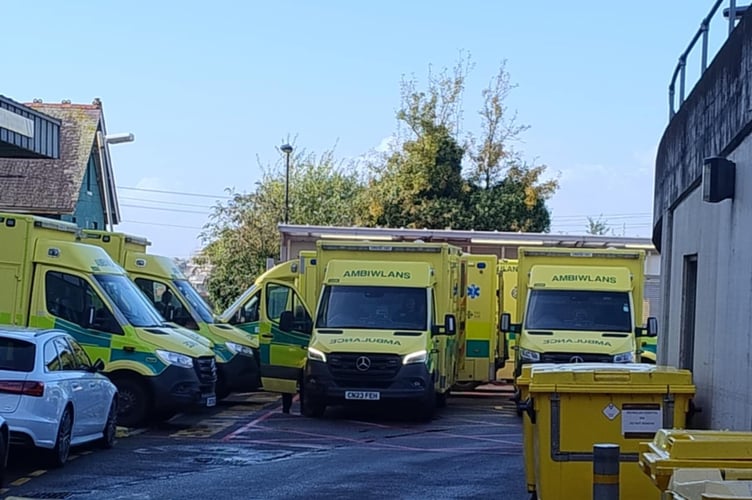
The Welsh Government must set out how it is going to tackle the overcrowding crisis in our Emergency Departments – as what was formerly a winter crisis has become a year-round problem.
That's the main message from the Royal College of Emergency Medicine following the publication of NHS Wales' latest data on ED performance, covering June.
Last month saw some of the worst waiting times for Accident & Emergency department patients since records began.
Around one in six (17 per cent, or 11,813) patients attending a major (Type-1) A&E in Wales in June waited more than 12 hours to be discharged, admitted or transferred – the worst June on record, and comparable to the depths of this past winter.
The dire picture comes despite the number of people attending A&E actually falling compared to May, and remaining largely stable over the last decade.
Dr Rob Perry, RCEM vice-president for Wales, said: "The state of our Emergency Departments right now is nothing short of shameful.
"We're now in a situation where the majority of our patients are waiting more than four hours to pass through our department, and many are waiting more than half a day.
"This is an unacceptable state of affairs, and some of the worst waiting times since records began.
"I must be clear: no patient should wait 12 hours on a trolley, or a chair, in an overcrowded Emergency Department. Long waits like this are not only stressful and undignified, they are dangerous and put lives at risk.
"Worse still, these are milestones which we are passing in summer. We aren't even battling with flu or cold weather – but the wheels are coming off the bus anyway."




Meanwhile, less than half (49 per cent) of patients passed through the A&E within four hours, the lowest ever – and far below the 95 per cent NHS constitutional standard.
Dr Perry said: "This is a fixable problem and we know what the causes are. Delayed discharges, and the accompanying lack of available beds in wards, are a serious problem - not the number of people arriving at our doors.
"Exit block makes it impossible for us to move patients in need of admission out of the ED. This complete breakdown in patient flow is causing untold misery for ED patients.
"The new Welsh Government has signalled that it understands the need to reduce long waits and overcrowding, and we are pleased that it is engaging with RCEM on this issue.
"I hope, for our patients' sake, that these words become action soon. As today's figures show, the problem is only going to get worse without the proper interventions."
Cabinet Minister for Health and Care, Mabon ap Gwynfor said: “My immediate priority is clear - cut the waiting list backlog inherited from the previous Government, help those who have been waiting longest, and build an NHS here in Wales that can stand strong for generations to come.

“[The] statistics are disappointing and unacceptable. Too many people are waiting for treatment, and they are waiting too long. We have a plan to tackle this which will deliver the real change the people of Wales need to see and that they rightly deserve.
“We’re doing things differently to previous approaches. Through our clinically-led surgical hub programme we will strengthen local capacity, get patients treated quicker and ensure that elective care demand is managed more sustainably within day-to-day NHS activity. We are committed to delivering our investment to support waiting list reductions this year.
“June saw the highest number of emergency department attendances recorded for that month. Prolonged hot weather led to more people turning up with heat-related issues, adding further pressure on health and care services. Sustained year-round preparedness is vital to anticipate seasonal risks such as heatwaves, and this Government will work closely with our partners to deliver it consistently. We have already begun preparations for expected winter pressures.
“Meanwhile, the response time target for the ambulance service to respond to patients in the purple category - those experiencing a cardiac or respiratory arrest who need an ambulance immediately - has been met consistently for the past 12 months which I am pleased about.
“I want to recognise the incredible people working in our NHS and social care. Every single day, they show up and give everything they have - often under enormous pressure. Their dedication and compassion is something we should all be proud of. Thank you for everything you continue to do.”
A previous report in March from RCEM said nearly 1,000 deaths are linked to long A&E waits in Wales in 2025.
RCEM said that “the scale of deaths linked to long A&E waits last year should send shockwaves through the entire political system in Wales” and said that “whoever forms the next Welsh Government must commit to ending the link between long waits and deaths by 2030.”
RCEM’s State of Emergency Medicine in Wales report revealed that an estimated 965 deaths in Wales in 2025 were associated with waits of 12 or more hours at Emergency Departments before admission into a hospital bed.
That’s an average of 18 people per week dying due to long waits in A&E.
The new analysis shows an increase of 29 deaths compared to 2024 and outlines how the long waits, high bed occupancy and deaths associated with them can be curbed.
The report says that “overcrowding and long waits remained significant issues for Welsh emergency departments in 2025” and added “there is little sign of improvement.”
Figures show that 122,166 people waited 12 hours or longer in A&Es in Wales in 2025.
“We know that there is a direct correlation between long waits, overcrowding and patient harm in the A&E”, the report says.
“In 2025, RCEM conservatively estimates that there were on average 18 deaths every week associated with waits of 12 hours or longer in Welsh A&Es.”
In 2025, 800,432 people attended major A&Es across Wales – an average of 66,703 per month.
That is a slight one per cent increase from the last year, with the figure remaining relatively consistent since 2011 other than during the coronavirus pandemic.
Comments
This article has no comments yet. Be the first to leave a comment.