
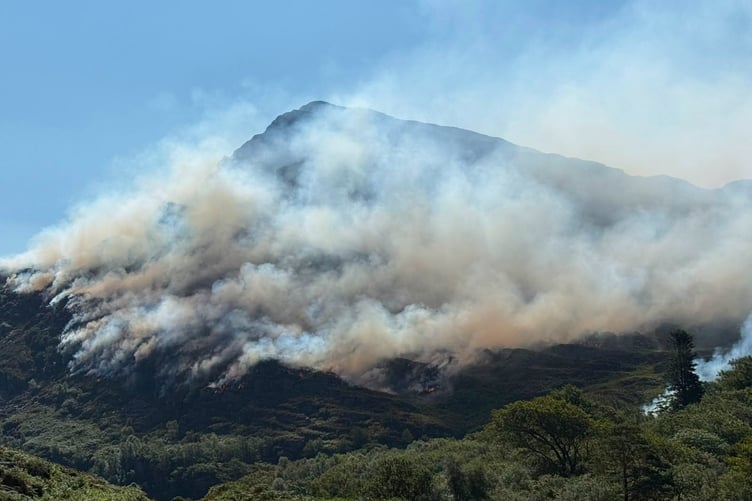
Natural Resources Wales (NRW) has said that recent wildfires in north Wales “have demonstrated the need to consider whether current arrangements remain sufficient” after aerial support to control the blazes was severely delayed.
In July, Rhinogydd mountain near Harlech was one of six wildfires in north Wales, including Pentrefelin in Holyhead, Mount Pleasant, Hope Mountain, Pentre Halkyn, and the mountain above Capelulo which burned for days without helicopter support to try to douse the flames.
More than 4,000 people signed a petition calling for urgent aerial support at Rhinogydd after the fire was ablaze for more than 11 days.
North Wales Fire and Rescue Service requested aerial support through NRW, and while the request was approved, helicopter support was unavailable for days due to demand from wildfire incidents elsewhere across the UK.
A helicopter arrived at Rhinogydd on 24 July, 12 days after the fire was first reported.
In a statement NRW said: “The prolonged spell of dry weather has significantly increased wildfire risk across Wales and our teams continue to work closely with Fire and Rescue Services, Welsh Government, landowners and other partners to support a coordinated approach.
“With Fire and Rescue Services leading the response to wildfire firefighting operations, our role is shaped by our statutory responsibilities, environmental expertise and the management of land in our care.
“On land we directly manage, around seven per cent of the land area of Wales, we work alongside Fire and Rescue Service colleagues to support response and recovery efforts.
“For wildfires on land we do not manage, responsibility rests with the landowner and the relevant Fire and Rescue Service. In these circumstances, we provide environmental advice and practical support, helping inform operational decisions and supporting recovery efforts.
“There has been understandable interest in the availability of helicopter firefighting support during recent incidents.



“Helicopters can be a valuable asset in specific circumstances, but form only one part of a broader wildfire response.
“Our current helicopter framework was established primarily to support incidents on land we manage.
“Helicopter firefighting is a highly specialised service requiring strict aviation, operational and safety requirements.
“There are only a small number of companies that can provide this capability and during periods of exceptionally high demand, availability can be limited.
“What we are seeing in Wales is unprecedented in terms of the scale, duration and complexity of wildfire incidents.
“Climate change is expected to further increase these risks.
“While partners have worked tirelessly to respond to these events, recent experiences have demonstrated the need to consider whether current arrangements remain sufficient for the challenges we now face.
“We must work together to develop a stronger Team Wales approach, review the current arrangements and consider how aerial support provision can be strengthened.
“Welsh Government Ministers intend to review current capabilities available to fight wildfires, and the First Minister has said there will be a multi-agency Wildfire Summit to look at how we deal with the increased threat, the way we tackle them and why they are becoming more dangerous because of climate change.”
Comments
This article has no comments yet. Be the first to leave a comment.