
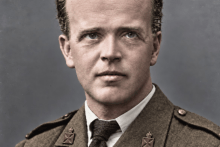
The Reverend David Cynddelw Williams went to France in September 1915 as an Army chaplain. He was an Aberystwyth man, born and brought up in the town, and came from a well-known local family. His mother was the late Mrs Emma C. Williams, and with her sisters, lived at Haulfan in North Parade. Before the war, Williams had been a Calvinistic Methodist minister.
On 27 September 1915 he joined the Army and was attached to the 10th Battalion, Royal Welsh Fusiliers.
Williams kept a diary during these years. It is now held at the National Library of Wales under the reference NLW ex 2789 and covers the period from 1914 to 1920.
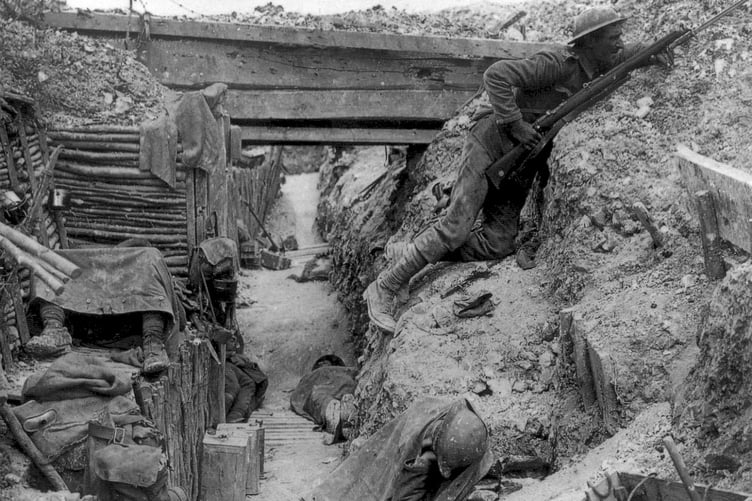
One entry tells of a service he arranged at Courcelles, on the Somme. The place he used was a ruined farm building. Shellfire had damaged the walls and part of the roof was missing, but the men still gathered there.
They prayed, listened to readings and sang Welsh hymns together.
For men who had grown up with those hymns in chapels and homes across Wales, there was something familiar in the middle of very unfamiliar surroundings. Outside was the war.
Inside, for a short time, were words and tunes they had known long before they became soldiers.
Williams's duties did not keep him safely behind the front line.

[1].jpeg?width=209&height=140&crop=209:145,smart&quality=75)



The citation for his Military Cross records that he “accompanied the battalion to the front line and administered to the wounded under an intense fire.”
He was there with the men while the fighting was still going on, tending to the wounded and carrying out his work in dangerous conditions.
The citation also contains another short sentence: “He has on many previous occasions done fine work.”
His Military Cross was awarded for “conspicuous gallantry and devotion to duty” and was announced in the London Gazette on 29 January 1917.
Williams was remembered by his soldiers for more than his courage. They spoke of his kindness, the care he showed towards the soldiers and the interest he took in their spiritual welfare.
They remembered Courcelles, where in a shell-damaged farm building, a group of Welsh soldiers stood together and sang the hymns they knew.
For a few minutes, Welsh voices could be heard amongst the sound of the guns. For a few minutes it reminded them of home.
Comments
We've recently changed our login process. If you have an account for commenting, you will need to re-register on the login window.
This article has no comments yet. Be the first to leave a comment.