

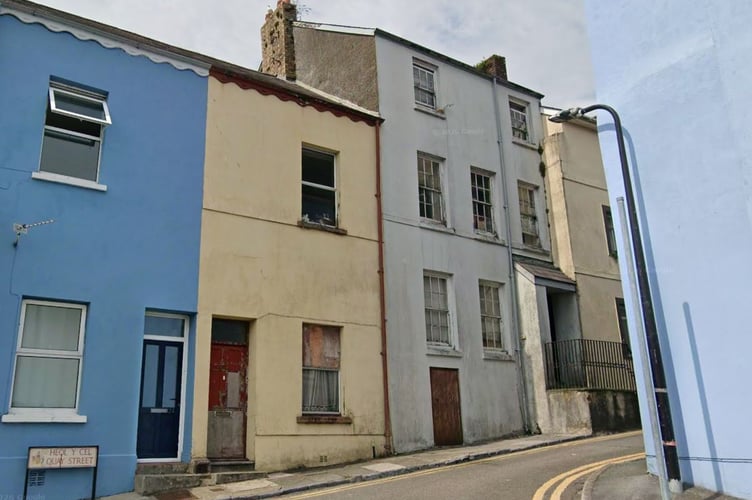
Plans to convert a listed former townhouse into a nine-bedroom shared house in Carmarthen have been refused on appeal.
The Quay Street property had been used as offices before becoming empty several years ago and an application to turn it into a house of multiple occupation (HMO) was turned down in 2025 by Carmarthenshire Council because it judged the scheme would have a detrimental impact on its character and special interest.
A subsequent attempt by the same applicant, Safe High Living Ltd, to convert it into a nine-bedroom HMO sought to overcome the reasons for refusal and came with a heritage impact assessment and a condition survey but it too was rejected by the council.
Safe High Living Ltd appealed the decision via planning agents who said the development sought to retain all external and internal features of the Grade II-listed building with some new internal walls added for en suite bathrooms.




The planning agents said rain was getting in through the roof at the rear causing internal damage although the timber floors and main staircase were in very good condition.
The agents said the proposed alterations would be minimal and the scheme’s impact on the historic interest and value of the building was “at most negligible” and would have no effect on the wider Carmarthen conservation area.
The terraced property was listed in the 1950s as a townhouse of early 19th-century external character and 18th-century origins with good surviving features.
Now a Welsh Government-appointed planning inspector has upheld the council’s refusal. The decision report said the information submitted by the applicant didn’t provide enough detail to enable the inspector to assess the impact of the alterations on the building’s fabric.
It said: “With regard to the essential services, the particular nature of HMOs will require the installation of sound proofing, insulation, ventilation, fire doors and fire-retardant internal walls and ceilings, individual plumbing and pipework, heating, water for each room and other internal fittings and fixtures.”
The report said it acknowledged there would be very little external changes and reusing a vacant building had a heritage benefit but said detail was nevertheless lacking to properly assess the impact.
It concluded the application hadn’t met the requirements of planning policy in terms of listed buildings and therefore the scheme would not preserve or enhance the listed building or character and appearance of the area.
“The lack of detailed information is highly undesirable in general terms, but especially given that the property is a Grade II-listed building located within an historic and important part of the conservation area,” it said.
Comments
This article has no comments yet. Be the first to leave a comment.