

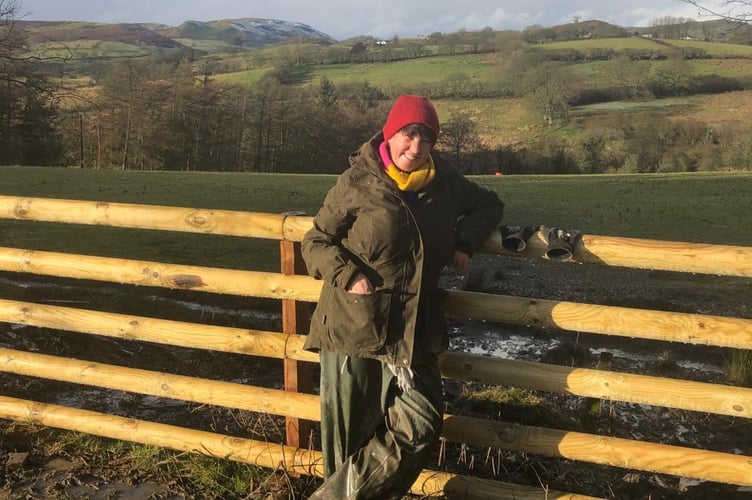
A WOMAN who runs a farm and eco-campsite in mid-Wales only found out that surveyors had accessed a stream on her land because of video camera footage, a court has heard.
Natalie Barstow was said to be “on tenterhooks” about a survey planned by a company proposing to build new electricity pylon lines in Wales.
Barrister Sian McGibbon, on behalf of Miss Barstow – the lead claimant against Green GEN Cymru – said Miss Barstow was told in an email on August 7 last year that the survey had been deferred for a second time.
Ms McGibbon said video camera evidence emerged later showing that the surveyors had entered the stream on July 29.


She alleged they had entered the land near Builth Wells without consent and that Green GEN Cymru “actively misled” her by saying the survey had been deferred when it had taken place.
Earlier it was alleged in the High Court judicial review hearing in Cardiff that those carrying out the survey were in dirty clothes and hadn’t taken adequate disinfection steps, posing a biosecurity risk.
Ms McGibbon said Miss Barstow’s earlier attempts to engage with Green GEN Cymru had been ignored.
She said Miss Barstow’s mental health had deteriorated as a result of the situation, had had “a profound emotional toll on her personally”, and impacted her family life.
The Campaign for the Protection of Rural Wales and the Land Justice Coalition Ltd are also claimants in the case and are challenging whether the use of notices to allow access to land ahead of possible compulsory purchase orders (CPOs) by Green GEN Cymru was lawful.
A CPO allows some organisations to forcibly acquire land or property to make way for infrastructure projects deemed to be in the public interest.
Green GEN Cymru needed to survey land along three proposed pylon routes in mid and West Wales carrying electricity from wind farms to connect to the grid. It was due to set out its position on the second day of the hearing on April 22.
In a statement to the Local Democracy Reporting Service on April 21 it said it remained committed to working respectfully with landowners and engaging openly with communities and that pylon lines were needed to help provide a secure and resilient energy network.
The case is being heard on six grounds, including alleged unlawful conduct and a lack of biosecurity policies.
Sasha Blackmore, lead counsel for the claimants, said inadequate biosecurity issues risked farmers losing contracts with supermarkets.
There was no evidence, she alleged, of Green GEN Cymru having biosecurity policies of its own in place with contractual force.
Ms Blackmore said Green GEN Cymru moved to “statutory powers” one month after being granted a licence by energy regulator Ofgem and that at its heart the case was about how a statutory power was properly used.
She said CPOs ought to be used as a last resort and alleged that the company had breached a series of interlocking duties.
She said farmers who hadn’t signed a licence with Green GEN Cymru weren’t told via notices that were sent out when the surveys would take place. “We say that’s not fair,” she said.
Ms Blackmore said: “Some farmers actually wanted a licence and were never offered one.”
She said notices were served on “entire land areas” and no attempt was made to exclude residential homes and curtilages. The notices were “batch-produced” and issued via solicitors on the company’s behalf, she added. No attempts were made, she alleged, to identify occupiers such as tenant farmers as opposed to landowners.
She said the engagement offered to farmers was a “take it or leave it approach” and that there was “no willingness to engage further”.
Ms Blackmore said it was imperative to have “sensible conversations first” with landowners to understand what was happening on the land in question. “What you can’t do is attach a massive schedule with no particularity of day, month or year and where you’re going to go,” she said.
The claimants are also alleging that personal data acquired by Green GEN Cymru had not been processed lawfully because it was collected during “unlawful entry” onto people’s land.
Barrister Ms McGibbon said the court would hear arguments from Green GEN Cymru driven by climate change and the need for cleaner energy and that the claimants accepted the legitimacy of these objectives in principle. But she said they could not come close to outweighing “all the harm suffered” by Miss Barstow and the farming community when considering a proportionality balance. This harm, she said, could have easily have been mitigated by the use of less intrusive measures.
Green GEN Cymru’s statement on April 21 said: “We recognise the significance of this week’s hearing and the continued public interest in the timely resolution of these matters.
“As proceedings are ongoing, it would not be appropriate to comment on the specifics of the case. We will continue to engage constructively through the proper legal process.
“In the meantime, our work continues in line with established procedures. Pre-application environmental and ecological surveys remain an essential part of ensuring that potential impacts are properly understood by all stakeholders, including planning authorities and host communities.
“We remain committed to working respectfully with landowners and engaging openly with local communities. Our approach is to seek agreement wherever possible and to carry out all activities with due consideration for people and the environment.
“The development of this infrastructure remains an important part of delivering a secure, resilient energy network for Wales and forms part of critical infrastructure aligned with government policy. We will continue to progress this work responsibly while the legal process runs its course.”
The case continues.
Comments
This article has no comments yet. Be the first to leave a comment.